Thursday, May 21, 2009

Dark Water by Robert Clark and The Monster of Florence by Douglas Preston

I recently finished two nonfiction books on terrible historic events—one natural, the other unnatural—in Florence, Italy’s recent past; well, recent when compared to the age of the city itself.

Dark Water, by Robert Clark, recounts the devastating flood that struck the city in the fall of 1966, specifically the damage wreaked on the renaissance art that is synonymous with Florence, and her citizens’ efforts to restore it.

In his story, Clark parallels the history of 13th Century Italian artist Cimabue’s Crocifissue with that of the Arno. The Crocifissue is considered to be the seminal transitional work that links the art of the Medieval Age and the beginnings of the Renaissance. As Florence’s main tributary, flowing through the center of the city, the Arno is her lifeblood. Clark takes the reader from the early days of Cimabue’s career to the day of the flood, highlighting the Crocifissue’s periods of distinction and celebrity, and her lows of disfavor and disinterest by the art world. So too has Arno had its share of highs and lows, flooding the city every few decades. Clark does a nice job of integrating Florentine’s reactions to their waterway’s occasional distemper and their efforts—mostly a lot of talk—to prevent her banks cresting again in the future, including Leonardo da Vinci’s earliest proposal, which is returned to every time the Arno floods. Clark looks in on other works along the way as well, including Vasari’s Last Supper.

Throughout this preliminary history leading up to the flood, Clark keeps from crossing the line into art-history pedantry by sprinkling in entertaining but pertinent anecdotes. When the flood does hit, the pace kicks up to The Da Vinci Code levels. At times I was breathless as Clark followed the personal stories of Florentines and transplanted outsiders during the cataclysmic event, like the tragic tale of the wheelchair-bound elderly woman who was trapped in her apartment. The most emergency crews could do was hoist her as high as possible with a makeshift rope winch dropped through the security grill of a window and hope the waters crested before they reached her. Or the story of the priests who rowed into the church in which the Crocifissue was displayed in order to save it, scooping up bits of floating gold paint that had flaked off which they hoped could be used in the crucifix’s restoration.

When news of the flood’s devastation was reported the next day, restorers, artisans and students from around the world descended upon the city to help in the recovery of Florence’s art and antiquities, including several tons of priceless books and documents. As more and more attention is drawn to the plight of the Crocifissue and other irreplaceable works, and as city officials and overseers of the recovery process take advantage of the increased global attention to further their own careers, Clark’s examination gives equal due to the human cost of the tragedy. Who restores their lives? Clark wisely leaves the reader to make his or her own conclusions.

If there is one glaring fault of Dark Water, it is the lack of photographs—barely a half dozen—to accompany the text. Yes, the reader is treated to a shot of the Crocifissue before the flood, but not after. And the few photos of certain events after the catastrophe are interesting. But they only serve to accentuate the reader’s hunger for more.

Still, Dark Water is a great read and receives four out of five spiders.


As for The Monster of Florence…

What would you do if, after moving to your dream home on a hilltop of the beautiful Tuscan countryside, you discover that a brutal murder took place just outside the door of your home a few decades before?

So that’s why the house was so cheap, might be a reaction once the initial shock subsided, but more than a few would seriously consider moving. But if you’re a writer whose move to Florence was in order to research and write a murder mystery concerning Renaissance art, you might simply shift gears and write about real slayings instead. That’s what author Douglas Preston did. In The Monster of Florence—which Preston wrote with journalist Mario Spezi—Preston recounts the serial killings that shook Florence from 1968 to 1985 and the investigation that continues to this day.

Spezi is actually the one who reveals the horrifying secret of the house to Preston, during an interview Preston undertook as part of the research for his planned mystery. As one of Florence’s most distinguished newspaper reporters, Spezi followed the slayings closely. His knowledge of the inner workings of the criminal and court systems; his deep network of contacts therein; his deductive analysis and flair for dramatic writing increase his notoriety as well as his paper’s circulation.

The killings are brutal; the victims’ lives taken while in the act of lovemaking. Evidence of both a gun and knife—believed to be the sort used by scuba divers to gut fish—are found at each scene, and the female victims are never left whole. Still, a mere hundred pages into the book, the murders are done . . . and the real story begins to unfold. Nary had I a chance to question the direction the book would take when I was hurtled into the unbelievable world of the investigation.

It is said that the difference between fiction and nonfiction is that fiction has to make sense. The Monster of Florence could be the poster child for this adage. My flurry of page-turning was only given respite when events in Preston’s story forced me to take a moment to shake my head in disbelief and remind myself that I was reading a true story. Then I plunged back in, each time under the delusion that things could not possible get any stranger . . . and then they would!

The Monster of Florence isn’t so much about a serial killer as it is about the Italian judicial system, a system wrought with conspiracy theorists and run under the firm belief that the answer to a crime must equal the temerity of the crime itself. The evidence be damned; logical deductions that do not measure up to the wickedness and horror of the crime cannot be viable, regardless of how solid the findings. And woe be to those who deign question the investigation.

Unlike Dark Water, The Monster of Florence contains eight pages of black-and-white photos. But DO NOT look at them until you have finished the book. Key plot points are revealed in the captions that accompany the photos. Rip the inset out and give them to a friend, if you must.

The Monster of Florence receives four and a half out of five spiders.

Thursday, May 14, 2009

Crazy Hair by Neil Gaiman and Dave McKean


Crazy Hair is the third children’s book from the multiple-award–winning team of writer Neil Gaiman and artist Dave McKean, but the first of their efforts set to rhyming.

Young Bonnie confronts a teenage boy about his misbehaving mop of hair, which he proudly proclaims has not been touched since he was two. He then regales Bonnie with the outlandish things that have taken residence over the years within his manic mane, one-upping the absurdity level with each successive claim.

This is a common device used in many children’s books and one that can easily fall to lackluster repetition if not handled with ingenuity and deftness. Gaiman doesn’t disappoint. His rhymes are never stale, though the cadence remains consistent, kept fresh with McKean’s “heady” mix of real (or just realistic?) hair with ink and exuberant splashes of color. His adroit use of mixed media captures deep dark jungles, roiling oceans and cacophonous carnivals. I found myself reluctantly turning the pages, torn between my desire to linger on McKean’s beautiful art and wanting to see where Gaiman’s playful text would take the artist next.

When the young man’s warnings continue to go unheeded by Bonnie’s relentless pursuit to comb his feral follicles, the reader may suspect what will follow, only to have Gaiman twist them with a sweetly surprising conclusion that is all the more satisfying in its unexpectedness.

This is a delightful book that children will love and parents won’t mind reading to them over and over again.

Four out of five spiders.

Tuesday, May 12, 2009

'Ice to Meet You!

More often than not, I was cold in the costume. When I knew I’d be appearing outside in a cold clime, I’d bring the thermals with me that I’d gotten at my first appearance in Vermont. Unfortunately, there were times when I didn’t know I was going to be outside until I arrived at a gig. Such was the case in Regina, Canada one winter.

Regina is centrally located above the US border. It has two seasons: August and winter. I was traveling in January, so I knew the temperature would be in the double digits below zero. My actual appearances, however, were to be indoors at various gas station kiosks in the area. You know the type. Go in to pay for your gas before pumping and perhaps pick up a freshly brewed cup of coffee, a cold beverage, the newspaper, the latest bestseller or some candy and snacks. If your lucky, maybe a Slush Puppy, although I wasn’t betting on the Slush Puppy empire having a strong foothold in Regina. I had no reason to believe that the convenient kiosks at the gas stations in Canada would be any different, so I left the Spider-Man thermals at home. Key fateful-decision music.

As expected, Regina was cold, –30˚ C or approximately 20˚ below zero Fahrenheit to us Americans. Like Winnipeg, the city was connected by a series of heated underground and aboveground walkways, because mere seconds exposed to the intense cold they experience for much of the winter risks inflicting frostbite to their skin. I don’t know how the locals got around pumping gas in these frigid temperatures. As with all gas stations, my appearance locales were stand-alone affairs. Worse, yet. They were situated in remote areas outside the city, remote flat, barren areas with nary a snow bank or bare tree in site for miles, giving the wind free reign to blow unimpeded across the plains. The “frozen tundra of Lambeau Field” that ESPN Sportscaster Chris Berman often eludes to was a patch of sand in Death Valley on a summer’s day compared to the places I was visiting in Regina. No worries. I’d be safely ensconced in the warmth of the convenience kiosks of the gas stations, nestled somewhere between the rack of Tim Horton Doughnuts and the Labatt’s Beer display.

The news from my chaperone that I should already in uniform when he picked me up from the hotel and would be unable to take off the costume until the day’s appearances were complete, should have triggered a warning klaxon in my head that these kiosk visits would not be as I’d envisioned. I knew the schedule was tight—there were Spider-Man appearances set for a half dozen or so petrol stations (that’s what Canucks call ’em) consecutively with only enough time betwixt them to travel from one to the next—so I assumed the reason behind my inability to change into my civvies between visits was due to time constraints, not that there weren’t any bathrooms, or even closets, in which to change in the kiosks. Why? Because they were about as big a Mini Cooper.

Technically, yes, I was indoors, but these petrol-station convenience stores were far from the snack food oases that I’d envisioned. They were more like Foto-Mats with doors on both sides that enabled the cold Arctic wind to whip through like a Ping-Pong ball in a vacuum tube. The only available space was directly between the two doors, which were no more than ten feet apart . . . if that. I was already shivering from the short trip from my ride to the first stop, breaking and re-breaking a land speed record each time I arrived. Yes, that red-and-blue blur was I. Had the doors remained closed, I might just have defrosted and only been terribly cold, but the locals came out in droves, keeping the doors open as they patiently waited to meet Spider-Man. I couldn’t tell you much about Regina’s winter activities, but, given the residents’ enthusiasm to standing in line outside gas station kiosks in –20˚F temperatures just to get Spider-Man’s autograph on a free comic book, I’d say these people were starved for entertainment. I’d have been flattered if I wasn’t so busy trying to keep my eyes from crystallizing.

And they followed me!!! I was on a tight schedule, an hour at each location, then approximately fifteen minutes to get to the next. Anybody who missed out at one station followed me to the next, where they were first inline to those already awaiting Spider-Man. It was like something out of Hoosiers with everyone in town following the team bus to the game. Like a traveling missionary, my flock continued to grow with more and more people overflowing to the next stop. I should have been running for the Canadian Parliament. Truth be told, I was incredulous. Not a single person complained. They were that happy to meet Spider-Man. I certainly wasn’t about to disappoint them, but I was freezing. I barely could hold a Sharpie never mind sign the comics.

Relief came in the form of a gas station attendant’s jacket, the heavy, uncomfortable-looking affairs that mechanics wear in the winter of an indiscernible hue forever stained by oil and reeking of diesel fumes. I was loathe to cover the costume, but I had no choice. To keep my toes from chipping off, I’d remain hunkered on the chair so the coat draped over my entire body, keeping what little body heat I still had intact. Fortunately, a coat was available to me at each locale. My fans thought it was a hoot. Most were understanding, but there was the occasional jerk, who asked why Spider-Man needed protection from the elements.

“It doesn’t get quite this cold in New York and I forgot my thermal suit,” I’d quip. Or, “Cold? Me? Pshaw, I just felt it was the least I could do in exchange for the wonderful hospitality Petro Canada has shown me. Just a wee bit of reciprocal promotion.”

The suit absorbed the fumes, so I smelled of gas long after I defrocked and took a hot shower. I’m sure the Tin Woodsman would find it an alluring scent, but it was making me stoned. Still, it was better than getting frostbite.

Monday, May 4, 2009

Of Mice and Monkeys

Gorillas don’t like Spider-Man.

I can’t speak for other primates, but I know for certain that gorillas don’t like Spider-Man.

I was in New Hampshire at Benson’s Wild Animal Farm, a family-owned and -run zoo and amusement park that I was shocked to recently discover had closed its gates in 1987. That would mean that my Spider-Man appearance occurred during its final months of operation. At the time I was excited, because I took field trips to Benson’s as a kid through a program at the playground in Manchester-by-the-Sea where my family spent their summers and loved the park. Unlike today’s combination amusement park/animal safaris, Benson’s retained a warmth, charm and hospitality.

Although small, Benson’s had all the features of a larger park, sans the acres of cement. There were rides, games, food, souvenir shops and wild animals, but on a smaller scale. They also gave as much consideration to the grounds as they did the amusements. Everything was nestled amongst towering conifers, expansive picnic areas and natural flora. Visitors were neither mugged by lights and noise as they entered, nor were their feet assaulted by an endless sea of hard tarmac. Also, while the park’s rides were decent and entertaining, they didn’t have the cutting edge, supersonic, inverted, double twister, zero gravity, triple loop-de-loop, mega-ones that were being installed in other parks. Unfortunately, these unique and appealing features were most likely what led to Benson’s eventual downfall.

I was appearing as Spider-Man, one weekend, little realizing I would be joining another superhero cartoon character. Mighty Mouse and the Terrytoons stable of characters had become the park’s mascots—the way the Peanuts characters are for Knott’s Berry Farm in California; and Bugs Bunny and the Warner Brothers Merrie Melodies characters are for the Six Flags Adventure Parks across the country—in the years since I last visited the park in my early teens. What’s more, Benson’s featured a Mighty Mouse Playhouse, an adorable, little barn, set in a grassy lea with a raised proscenium thrusting from its faux barn doors. It’s the type of barn one envisions in those endearing classic MGM musicals, wherein Mickey Rooney inevitably cries out, “My Uncle’s got a barn,” to which Judy Garland replies “Let’s do a show!”

Twice a day, the “Mighty Mouse Players” performed a skit, which echoed the Mighty Mouse cartoons of yore. Oil Can Harry kidnapped Pearl Pureheart and Mighty Mouse would “come to save the day,” as made notable in his famous theme song, which in turn briefly regained prominence in an amusing, early Andy Kaufman routine. Another of the Terrytoons characters, Sour Puss, was also featured in the cast, although, in the cartoon shorts, his character played second fiddle to another named Gandy Goose, who was not represented. I can only assume that Sour Puss was perpetually terrified in these cartoons as the costume’s mask was designed with an expression of terror.

Contrary to Spider-Man, the Terrytoons characters were played by amateurs, specifically three local high school boys on summer hiatus. They took the job nonchalantly, figuring as far as summer jobs go, it was better than flipping burgers at McDonald’s. When I say “nonchalantly,” I don’t mean to imply that they didn’t work hard or portray their characters accurately. They simply were as relaxed as beanbag chairs, kidding around as they dressed, even though they were portraying somewhat iconic characters themselves.

Yet, they were impressed with the visiting professional Spider-Man from New York City. There were a lot of “Cools!” and “Awesomes!” as they pummeled me with questions about being the world-famous Web-Slinger. They fawned over the costume, all of which embarrassed me. Comparatively, they certainly were making peanuts. Yet, they were working as hard, if not harder than I was.

I dressed with them backstage. Surprisingly, they rotated costumes. It was no big deal for them to don a costume that one of their colleagues had worn and sweated in the day prior or even during a earlier performance that day. On one occasion, one of them did let out a pronounced “Ew, this one’s due for a cleaning!” Then, he put it on and didn’t say a word about it the rest of the day. This also meant that they all knew each other’s parts. Granted, it wasn’t Shakespeare and it was only a ten-minute skit, but it’s worth noting nonetheless. And since, there were no women amongst them, a man played Mighty Mouse’s love interest Pearl Pureheart. Again, there were no complaints. On the contrary, one of them announced “I think I’ll play Pearl today for a change,” and that was it.

There wasn’t a director and the owners of Benson’s left me in the hands of Mighty Mouse and his friends to work out Spider-Man’s integration in the show. Management’s trust was well-founded. These high school kids were more professional than most professionals I’d worked with. And, blessedly, less vain and emotional. There were none of the dramatic ego-clashes synonymous with actors left to direct themselves; no one was whining or pouting over their ideas not being heard, or storming off because their staging—which was obviously better than anyone else’s—was not being considered never mind used. The teens’ approach was practical, pragmatic and economical—they retained the entire production, adding Spider-Man’s entrance during the show’s final moments. It took minutes and didn’t even need to be rehearsed.

The show itself was approximately ten minutes long, comparable to the average length of an animated short. Mighty Mouse’s arch-nemesis Oil Can Harry abducts the valorous vermin’s paramour Pearl Pureheart—with the help of a dim-witted sidekick Sour Puss—sets a trap, from which Mighty Mouse escapes; and a crazy chase ensues, at the end of which Pearl is rescued, and both villain and accomplice are confronted. The restaged ending: with Oil Can Harry and Sour Puss’s back to the upstage barn-door entrance as they face off against Mighty Mouse, I slink in and tap the feebleminded felons on the shoulder. Seeing Spider-Man, Oil Can Harry and Sour Puss drop to their knees, kiss my feet and beg for mercy. Of course, there are no punches thrown—this was a family show, after all. Mercy is granted and everyone descends from the stage and greets the audience.

While Mighty Mouse and I remained sedate, as our characters demanded, Oil Can Harry and Sour Puss played like puppies. They ran around, wrestled, even climbed trees. Yes, climbed trees. Wearing costumes similar to those worn by the bipedal characters on Sesame Street or at Disneyland—with oversized heads and enormous feet—they actually climbed trees. And they were hysterical. I got so caught up watching their antics that I forgot that I was working. I also had to remind myself that they were not trained actors. Yet, they imbued their characters with such life, I could almost hear the voices, though their every movement was pantomimed. I’ve overseen Marvel character auditions and witnessed professional actors “dissolve into a dew” after donning the webbed red-and-blue. These “kids” were amazing puppeteers. They were one of the best troupe of performers I’d ever worked with; no egos, no whining, gut-wrenchingly funny and talented.

What does this have to do with Spider-Man-hating gorillas? Not far from the performance barn, was the gorilla house, wherein Colossus, a 500-pound silverback gorilla was kept. Unfortunately, Benson’s animal accommodations were not ideal. Most animals were pent up in small caged areas. There were some animals which had larger areas, because their size demanded it. The African rhinoceros, for example, had large ranch-like quarters with room to run around. Still, the facilities were a far cry from the facilities provided for the animals at the San Diego Zoo or Bronx Zoo. Colossus had it worst of all. First, he was alone, no others of his kind to play with. Second, he was trapped in a room, no bigger than 20 x 20 feet, surrounded on three sides with plexiglass walls. The room was housed in a larger facility, so the ape never saw the sun or breathed fresh air. There was the prerequisite tire swing and that was it. The only item missing was the Samsonite Luggage.

During a lull, I bounded to the Gorilla House in my Spider-Man suit to take a peek. Upon seeing me, Colossus quite literally went ape. He bounced off his walls, punched the glass, swung the tire in a fury, roared and pounded his chest, all in an attempt to get at Spider-Man. I do not doubt that had he escaped he would have ripped off every one of my appendage and then used my head as a soccer ball. I was terrified and quickly left. I trepidatiously returned later when out of costume, but the gorilla was nonplused. Call it naïveté or stupidity, but I was seriously concerned that Colossus would recognize me and explode in a frenzy of anger again.

I’m sure a zoologist could offer a logical explanation for the gorilla’s insane behavior, but I figured he was just more of a Superman fan.

Friday, April 24, 2009

My, What Big Eyes You Have

The costume design, when I started, reflected the character in the comics at the time. Spider-Man’s original artist, Steve Ditko, drew the super-powered homo-arachnid’s adventures from the character’s ten-page origin, in Amazing Fantasy #15, through the initial thirty-eight issues of his eponymous comic book. Under his artistic guidance the costume’s webbing was tight and the eyes were big, bigger than the hoi polloi remember by the mid-eighties, with the black which surrounded the white far wider than any artist thereafter. He would adjust the eyes accordingly to express emotion, even though it defied logic. On one occasion, to emphasize surprise, he literally drew wide eyes on the white areas of the mask. One might argue Ditko was abusing his creative license in this particular instance, but no one will debate that Ditko’s quirky style perfectly suited the character and greatly contributed to Spider-Man’s instant success, firmly establishing the hero’s iconic stature. Ditko’s design also included webbing underneath the arms that extended to the waist, like the membrane of a bat’s wings. It was sometimes colored a purple-gray, other times it was translucent, sometimes it was omitted altogether.

Ditko’s successor John Romita streamlined the eyes, creating a more mysterious look to the character, and loosened the suit’s webbing, if for no other reason than it was easier and quicker to pencil, an important factor to consider when one has to complete twenty plus pages of art in two weeks to keep the deadlines of a monthly comic book. Romita retained the diaphanous under-the-arm webbing, but as he continued to pencil Spidey’s adventures, this web membrane appeared less and less until it disappeared entirely. Most people, even avid fans, don’t remember its ever being a part of the suit.

It wasn’t long before Romita’s interpretation became standard. In fact, Romita himself—who served as Marvel’s in-house artistic director for many years after retiring from monthly penciling duties—designed the original costume that the personal appearance Spideys wore. It tickled me to think I was wearing a “Romita,” the way celebrities gush over donning a “Dior” or “Armani” on the red carpet.

Beginning with issue #298 in early 1988, in a controversial move by then Amazing Spider-Man Editor Jim Salicrup, a new young artist Todd McFarlane—previously creating a sensation with his penciling on the Incredible Hulk—was assigned to the title. Fans immediately took to McFarlane’s highly stylized, somewhat “cartoony” design of the Web-Swinger and McFarlane became an overnight sensation. His impact on Spider-Man was such that it broke into the mass media. The artist’s name was even used as an answer on an episode of Jeopardy.


Ironically, although viewed by some as a bastardization of the character and by all as a totally new look for the Web-Spinner, McFarlane’s Spidey owed much to Ditko albeit a highly exaggerated interpretation of the hero’s original artist. McFarlane’s webbing design was similarly tighter and busier, and he drew his eyes bigger, à la Ditko. He also made the Web-Head’s moves creepier by exaggerating them, making them more angular, as if performed by a contortionist, much the same way as Ditko. In fact, it was Ditko’s take on Spider-Man that inspired my performance of the hero.

McFarlane’s style was like Ditko on acid. Beyond revamping these aforementioned traditional elements of the suit, he also redesigned the character’s chest icon and the look of the webbing when it shot from Spider-Man’s Web-Shooters. The spider chest icon, for the entire life of the character to that point, was drawn less representational, more like a child’s conception of the arthropod. McFarlane’s was still economic, as symbols should be, but more realistic. McFarlane’s webbing—when shot—detailed the strands as they projected, presenting them as entwining to create a single super strong strand. It was impressive, but a headache for all those that followed to emulate.

McFarlane’s popularity made my appearances more difficult. I was frequently asked, “Why are your eyes so little?” Some of the more confrontational fans challenged with “You’re not Spider-Man. Your eyes are too small.” I’d remain unperturbed and counter with “You must be referring to that McFarlane guy’s wild interpretation of me in the comics,” but the “eye” attacks only increased while my patience decreased.

By 1993, McFarlane’s design for the Web-Slinger became the standard, and the Marvel Mucky-Mucks decided that the design of the costume should be updated to reflect the change. It only took them a half-decade, which is only a few months in corporate bigwig years.

For a department with little to zero budget, this was a big deal. Bigger still was the woman they hired to create the redesign. I did not know Betty Williams, nor had I ever heard of her, but she was a legend in New York theater circles. Her costume work on the Great White Way spanned more than four decades and included the costumes for the original productions of The Fantasticks, The Boys in the Band and Oh, Calcutta (Quite an accomplishment when one considers that the show featured extended scenes of total nudity). She also worked extensively with New York City Opera, Alvin Ailey Dance Company and New York Shakespeare Festival.

I knew none of this when I entered her second floor studio on Seventh Avenue in Manhattan’s garment district to test the new suit. The space was vast; it appeared to be a single room—nearly the entire floor—flanked on three sides by floor-to-ceiling windows. Yet, it was still dark. What little light there was came from the occasional fluorescent light fixture and a smattering of desk lamps at the sewing-machine stations. I half-expected to hear the buzzing of a bulb. Swatches of fabric were strewn around the room; on desks, tables, hanging off of lamps, window sills and across the floor. It looked like a legion of harlequins and tatterdemalions did battle with neither side proving the victor. Leaning against the one windowless wall stood bolts of fabric of every shade and pattern. In the intermittent areas between the windows and directly along the left wall of the entrance were corkboards covered with sketches of the latest projects Williams and her team were working on. Turn-of-the-century French gowns rubbed against 20s flapper dresses which fought for cork with Victorian gentlemen. But one design instantly caught my attention: Howard Stern as his ignoble gaseous guardian of good, Fartman!

It was love at first sight. The place screamed creativity, and I figured anyone who ran this Disneyland of design must be a lovably eccentric creative genius. How could she not be? She created the Fartman costume!

I was not disappointed.

Betty Williams was a diminutive elderly woman who looked like a cross between Woody Allen and Bea Arthur, or Edna Mode—the superhero seamstress from The Incredibles—only with gray hair and wrinkles. Her hair looked like she went to the same hair stylist as Moe Howard of the Three Stooges. An off-white work apron—that looked as if she hadn’t taken it off in half a century—covered a short black dress. Around her neck hung a golden-yellow tape measure; behind her ear was a red wax pencil. She had crows’ feet around her lips often indicative of people who smoked three packs a day since grade school, though she didn’t reek of smoke. She had sharp steely eyes that said, “I’ve been around some, so don’t f*** with me!” a look that only one who’s dealt with hundreds—perhaps thousands—of actors during numerous costume fittings spanning more than sixty years can achieve. When it comes to fittings, actors are like children getting cleaned and dressed for church: they whine, fidget, bitch, moan, and ask, “Are we done, yet?” every five minutes. It’s a scenario perfectly exemplified in Mike Leigh’s Topsy-Turvy, which, despite its antiquity, has not changed one iota since Gilbert and Sullivan were Sultans of the Savoy in London, circa 1900.

This was not to suggest Williams was a witch. Hardly. Though her mien was stoic. There was a sparkle behind her eyes and an affection in her demeanor that could only come from someone who still loved what they did. She just didn’t suffer fools, or actors, lightly. The stage may be their milieu, but here, in her workshop, she was Queen, i.e. Leave your ego at the door and let me do my job.

She handed me the newly-designed threads, or webs, as the case may be, and waited. There was no need for her to say “Drop your drawers. I haven’t got all day!” She respected that I was a professional and expected my feelings toward her to be mutual. There is no room for humility on the part of the actor during fittings, just as there isn’t any tolerance for salaciousness by the costumer. I had no problem stripping in front of Williams. I’d done my fair share of baring myself, not only in fittings before countless other Betty Williams’s of school and summer theater productions, but also offstage in front of cast and crew members. Williams was as interested in seeing my naked body as a sister or brother espying his or her nude sibling is. Contrarily, my boss, when she realized that I wasn’t going to retreat to the bathroom to try on the new suit, blurted, “You’re going to change here?!!” Williams and I exchange a look, then both turned to my boss, who got the hint and walked to another part of the shop.

As I disrobed, I could see that the occipital area of the new threads were indeed larger, but not as crazily so as McFarlane’s delineation. I also noticed that the blue was not as deep—more toddler blue with less black in the mix—and the red was less crimson, more pink. This change may have been Marvel’s attempt at making the costume less scary to little ones or maybe Williams’s fabric supplier couldn’t match the original colors scheme. The weblines were only minimally tightened, and the spider symbol on the chest was altered to reflect McFarlane’s new design.

Minutes later, I was in the suit. I was at once struck by the increased thickness of the fabric, which felt less giving, more resistant to movement. There was additional foot padding as well, which was not necessarily a good thing. I understood Marvel’s wanting to extend the wear on the costume’s most vulnerable area. And there may have been some consideration toward the comfort of the actor. But by increasing the padding, the tactility of the feet was decreased. When wearing a proper shoe, there is little fear of stepping on an irregular surface; the protective sole helps keep the foot in place, thus preventing an ankle rollover or even a simple moment of awkwardness. The thicker padding caused the foot to “float,” making the wearer’s footfalls less stable. When one is leaping upon tabletops or simply bounding over open terrain, the feel of one’s toes and sole is very important, especially with the suit’s limited sight. I would rather have had no padding whatsoever.

Once I had zipped up, I leaned into Williams’s face and asked, “Are my eyes straight?” I was less concerned with the symmetry of the mask than trying to get a reaction out of the unflappable Williams. No such luck.

“Fine,” she replied without flinching. “How does it feel?”

I leapt onto the work table, landing into a deep crouch with my elbows resting before me and my right arm up, hand out, striking the “Well” pose that was Jack Benny’s signature. “Seems comfortable enough,” I quipped.

For a fleeting moment, the corners of Williams mouth curled up and her mien softened. “Behave yourself,” she playfully scolded.

Though the enlarged eye area extended my peripherals, it seemed my vision was worse, as if the holes of the mesh screening that covered the eyes were smaller. I voiced my concerns to my boss, but she assured me that the fabric was unchanged. Truth be told, I’m not even sure she heard me, she was so immersed in gushing over her handiwork. I almost expected her to start exhorting, “It’s alive! Alive!!!” like Dr. Frankenstein when he noticed the slight movement of the monster’s fingers in Frankenstein. I chalked up the decreased vision of the amended suit to the gloomy conditions of the workshop. I was also told before test-piloting the new costume that the changes were essentially cosmetic, that it was just the design that was changed, not the textiles, so I let the issue drop.

It was only later when the new suit was coming off the production line and after several of the other Spider-Man actors complained that my boss admitted they had switched the fabric of the eye meshing. By then it was too late to affect the latest crop of costumes, but we were assured future orders would be constructed using the original material.

As for the public’s reaction, no one made note of the change, but the complaints of my eyes being too small were thankfully put to a halt.

Sunday, April 19, 2009

Houston, We Have a Problem

The Spider-Man suit was brilliantly crafted—comfortable, functional and visually stunning. It worked on anyone from 5'9" to 6'3". It’s ease of transport made it possible to fit in any over-the-shoulder bag as small as a Ziploc. I never had to waste time at the baggage carousel, or worry that the suit might get lost in transit.

It was resilient, too. Most holes occurred along the seams and it was not rare to see me repairing the costume on flights to appearances. I still have more than a few mending kits from hotel rooms across the country. I only encountered one irreparable rip during my Spider-Man tenure, but it was a doozy.

I was flown to Houston for a week of appearances. The day I landed I was quickly hustled to a street fair downtown, changing in the car of my host along the way. It was a Sunday, and that, coupled with the street fair—which was a huge annual event for the city—ensured that businesses were closed and the blocks surrounding the area of the fair were deserted. It was eerie and more than a little I Am Legend. But after parking, I only had to bound a few blocks before I was met with what seemed like the entire population of Houston gathered in the city’s central park for the event.

I immediately looked for prospective perching spots. My host did not have a booth of any sort, so she just picked a street corner that wouldn’t interfere with any other booths. The only thing in the vicinity was a newspaper-vending machine...a wobbly newspaper-vending machine. I checked it before my ascent and though it shook, it wasn’t in danger of collapsing or falling over, so up I went. The host offered free photos and the box proved a perfect height for fans to stand before for pictures.

Normally, I could stay in a crouched position for upwards of an hour, signing autographs and posing for photos the whole while. When my knees couldn’t take it any longer, I’d leap off. I must have overstayed my usual time limit on the box, as I felt my ankles and feet go numb or rather didn’t feel them at all. Okay, time to leap off. But given the unstable condition of the vending machine and the fact that I couldn’t feel my feet, I was concerned I might break or twist an ankle upon landing. Thus, I tried to “cheat” off the box, without broadcasting my predicament.

According to Shakespeare “The best laid plans of mice and men often go awry.” You can add spiders to that list. A bit of the costume under my right butt cheek caught the corner of the vending machine and “R-I-I-I-P!!! The ass of the suit was torn wide open, exposing my cute candy-cane–striped bikini briefs. I guess it could have been worse. They could have had “wittle duckies” on them.

I stood stock-still for a moment, keeping my overexposed gluteus maximus against the front of the vending machine, like an inebriated worker on the copy machine at the annual holiday party. I can only imagine the Rorschach design my backside created on the vending machine’s display window, but I’d bet even money it didn’t look like a butterfly. My only hope was that none of my fans had noticed. Thankfully the form-fitting design of the costume kept the effects of the damage contained around my right “cheek,” so unless I left the protection of the vending machine, my little problem went unnoticed. This ignorance extended to my host, who continued to escort people forward to get their picture taken with Spidey without hesitation. I posed best I could, all the while trying to get my host’s attention. I finally had to interrupt her and ask her to come over to me. I whispered the situation into her ear. True to human nature, her immediate reaction was to look toward my butt. I stopped her.

“Trust me,” I said, “the cooler than usual wind against my ass cheek tells me it’s hanging out.”

My answer came in the form of a windbreaker one of my fans was wearing, which they graciously agreed to let me borrow. For the remainder of the day, I posed with the windbreaker tied around my waist. Most people didn’t notice or question its presence. My explanation to those who did was that I’d had a run-in with Electro on my way down from New York and he zapped a hole in the backside of my suit before I subdued him.

I couldn’t rightly take my savior’s jacket with me when I was done, so I hightailed it (pun intended) back to the car with my host playing interference behind me. Still, I was barraged by a bevy of colorful offers and marriage proposals along the way. Boy, was my face red, both inside and out!

Monday, April 13, 2009

Webheads II: The Screamer, The No-No and The Return Engagement

Continuing my award-winning series on the types of fans I encountered at my Spider-Man gigs, I showcase a trio diametrically opposed to the example of which I spoke in the previous installment (Still, available for your viewing pleasure at www.heroesinmycloset.com. Check local listings.). None of the children pictured in this post represent the categories under discussion. They are here merely to help lighten the subject matter, add a splash or three of color and satisfy those blogophiles who do not like a lot of words. And no, I do not have photos of children that would correspond to those I am about to mention (Shame on any who want to see such!)

THE SCREAMER:
Unconsolable, The Screamer screams . . . always! From the moment they first lay eyes on Spidey, a banshee wail erupts from their tiny forms, and nothing short of leaving the store will assuage their hysterics. At least, I can only assume their screaming stops when they depart, as it's the only time one can’t hear them. I understood why there were children afraid of Spider-Man. I had a featureless face; my eyes were big iris-free blobs of white, rimmed with black that extended up at either outer corner like a feline's; I spoke without a mouth, my entire face shifting when doing so; and the inhuman body posture could be unnerving. Even kids who worshipped the Web-Slinger—showing up wearing their Spider-Man Underoos—would occasionally flip-out. For them, it was a case of emotional overload at finally meeting their idol. Heck, there were adults, man and woman alike, who would run screaming when they saw Spider-Man (I’d hate to think what would happen if I wasn’t wearing a mask—cue drum riff).

Still, it didn’t make me feel any less bad when children were scared and cried. But The Screamer tore out my heart. It’s like I’d killed their dog or stolen their favorite toy. I’d turn to them and say in my softest most unthreatening tone, “I’m sorry,” only to be greeted with an even more blood-curdling scream. I’d know better than to even look in their direction, let alone speak to them, but I couldn’t help myself. I felt so terrible that I had done this to them.

And distance had no effect, The Screamer could notice Spider-Man from the furthest point in the store and “Aaaaaaaahhhhhhh!” I felt badly for the parent who held The Screamer, as well. They’d put a stranglehold on Mommy or Daddy, the likes of which would make a professional wrestler envious, and all the while screaming in their parents’ ears as they squirmed and tried to push mom or dad away from Spider-Man while in their arms.

THE NO-NO
A less dramatic off-shoot of The Screamer was The No-No. In lieu of screaming, these children uttered “no-no, no-no, no-no” in an incessant staccato as if approaching the door to the dentist’s office. They’d still wriggle furiously to get away while in their parent’s arms, much the same as The Screamer, only without the need for ear plugs. More often than not, The No-No would evolve into The Screamer. This would usually happen with a parent insensitive to his or her child’s wishes and went something like this:

The parent—with child in arms—espies the line or crowd from afar and approaches. Maybe the parent even knows of Spider-Man’s appearance and wants to surprise his or her little one.

“What’s going on over there, [insert child’s name]?” Sometimes asked innocently, sometimes uttered with premeditation.

“Look, [insert child’s name]. It’s Spider-Man.”

Despite all the great qualities of the Spidey suit—it’s nigh-perfect interpretation of the character; the ease of movement and relative comfort for the wearer; the vibrancy of its colors; the facility in its tranportation, cleaning and upkeep—it did present an odd downside: one-dimensionality, a tromp l’oeil effect that flattened the character, making him appear like a cardboard cutout, i.e. not real. From afar the affect is more pronounced. A child may not “see” me, even though directly looking at me, or sees Spider-Man, but thinks it is just a display.

Then, I move. My head turns toward the next child in line or a parent, as I deliver a quip or answer a question; it could be a movement as small as Spidey’s hand signing…

“no-no, no-no, no-no, no-no, no-no…” It begins…

In the case of a caring parent:

“Okay, Sweetie. It’s okay. He won’t hurt you. He’s a good guy.” As the child is swiftly redirected away from the signing area.

But I’m exemplifying a bad parent, so after the “no-no”s begin…

The parent continues toward Spider-Man, despite the child’s protestations, the volume and speed of delivering the “no-no”s inversely proportional to the distance from the Web-Swinger…

“C’mon, Honey. Don’t you want to get Spider-Man’s autograph?”

No, you insensitive jerk, they obviously don’t. That’s why they
’re wriggling like a fresh-caught Marlin and shaking like a margherita machine, not to mention the continuous ‘No-no”s, which grow in intensity until…

“no-no, no-no, NO-NO, NO-NO-e-e-e-e-e-E-E-E-E-E-E-E-E-E!!!!”

There is no sound on Earth quite so piercing as the scream of a small child. Fire engines get out of the way, when they hear its approach.

It is only at this point that the parent turns away…

“That’s okay…okay…we’re going…” with all the sincerity of an apologizing waiter who has to return to the kitchen with your steak that wasn’t cooked properly.

And worse is the toothy smile these shameful parents sport when they’ve achieved scream-age. They knew their kid was going to scream, the sadistic bastards. The whole grotesque scene was staged for their sick thrills.


THE RETURN-ENGAGEMENT:
Another off-shoot of The Screamer, The Return Engagement begins his or her Spider-Man experience as such but returns, either of their own volition, with the prompting of their folks or by coveting the prize they see their brother or sister holding. Suddenly gone is the terror they so recently experienced. They want a comic dammit and they’re not going to let their parents leave until they’ve gotten one. They scarcely hear their parents chiding as they turn back toward the signing area. Rather than commend the kid for overcoming their fears in order to give a difficult task another go, parents would get pissy toward their child when he or she wanted to try and see Spidey again after an initial first attempt.

“If you cry again, we’re not going back,” they’d admonish. Or worse, a threat: “If we wait in that line again, you’d better not behave the way you did last time.”

The kicker was the perturbed parent who, when their little one wanted to return to see Spider-Man, grabbed their arm and pulled them toward the exit with a “No, I am not going to stand in that line again. You had your chance!” Some added the infamous, “You’d better stop crying or I’ll really give you something to cry about.” Would any of these callous moms and dads react similarly if their kid reattempted to ride a bicycle without training wheels or swim in the deep end of the pool for the first time?


No-Nos never transcended to this category. Rather, the occasional Returner transmuted to a No-No when their fear of Spider-Man turned out to be too great to overcome after all.

“If we get back in line, you’re not going to scream, right?”

Hell, if my brother/sister can do it, I certainly can.

“We’re not coming back a second time . . .”

How hard could it be. Spider-Man is a good guy . . . right?

“Get ready . . . there he is . . .”

I’ll just walk up, take my comic and—“no. no, no, NO, NO, NOOOOOO!”

If I noticed a Return-Engagement, I’d excuse myself from the child I was attending to and make sure the Return-Engagement received a comic from me—either via a sibling, parent or adult nearby—before the Return-Engagement was hustled away by Mom or Dad.

There were those occasional stories, whereby a Return-Engagement faced me successfully with their second attempt. Time would stand still as they drew closer and closer to Spider-Man. An audible hush would still the crowd. Screamer’s were rarely forgotten and quickly gained a reputation that no change in their nom de guerre would extinguish.

The suspense rises and a silent gasp is felt as the child hesitates . . . before proceeding. Now the name. The child’s mouth opens... The tension is palpable. Will it be another scream?

“Sally.”

And the child skips back to their parents.

“Another satisfied customer,” I’d playfully say, breaking up my onlookers and the mood.

Monday, April 6, 2009

Quiet Nights by Diana Krall


I picked up Diana Krall’s recently released CD, Quiet Nights, this weekend and have been playing it like a four-year-old with a Wiggles DVD, i.e. incessantly. I have always had a penchant for standards that goes back to when I was a child digging into my Mom’s 45s (small vinyls with a single song per side for the young’uns in the audience) and discovering the likes of Sammy Davis Jr. singing That Old Black Magic, a version that exemplifies Davis as not merely a great singer, but also one of the finest entertainers of any era.

The secret and challenge in performing standards is not to over-sing them; there is no need. Composers such as Johnny Mercer, George and Ira Gershwin, Hoagy Carmichael, et al were geniuses in their ability to weave deceptively simple, yet rich melodies that endure and continue to win over successive generations of fans, regardless of who is singing them. The better entertainers, such as Tony Bennet, Ella Fitzgerald and the aforementioned Davis, are adept at doing this while still making the songs their own.

One need only look at the success of Rod Stewart’s four consecutive top-selling collections of American standards as proof of the power of the genre. A lifetime of excesses have not been kind to the legendary rocker’s voice, which sounds like Brenda Vaccaro with a cold. But the moment music producers propped him in front of a mike with some tunes by Irving Berlin and Cole Porter, Stewart’s stock soared once again. He offers little by way of interpretation, but is wise enough not to impose himself onto the tunes. He simply sings them; the songs do the rest.

Krall has been performing standards from a young age, but what raises her performances above others are her breathy, seductive voice, jazzy interpretations and deft piano playing, a winning combination she continues in Quiet Nights. There is a warm, cozy feel to the collection’s ten tunes (twelve in the expanded CD) that is as inviting as a home-cooked meal or enjoying the company of another on a cold winter’s night with a bottle of wine before a crackling fire. Krall doesn’t force the tunes; instead allowing the melodies to be the focus, while still making her mark with occasional piano flourishes, economic pauses and subtle tempo changes.

Compounding the challenge to covering standards is their ubiquity; most have been done to death, and thus more difficult to raise above the fray. Krall wisely chooses some lesser-performed tunes and adds a 60s cover to the regular edition (and a 70s cover to the expanded one) to help keep the collection fresh. Still, she covers at least two songs—Where or When and The Girl From Ipanema (“boy” understandably traded for “girl”)—that could certainly be perceived as overdone. She succeeds in the former with an uptempo version that presents the Lorenz Hart/Richard Rogers classic in a refreshing matter-of-fact way that makes the subject matter more poignant than the maudlin, slow-tempo versions that abound.

Her interpretation of the latter Carlos Antonio Jobim tune is brilliant. As she begins, her tone is that of an uninterested observer, describing the paradigm of manhood that all other women adore. But as she gets to the signature “Ah-h-h-h,” her own desire begins to betray her cool reserve. Her composure reverts at the start of verse two, but crumbles even more quickly as her description becomes more suggestive. By the bridge, her exposure is complete. Her voice acquires a dreamier tone which grows more hopeful as she sings through the phrasing, taking on a note of petulance as the boy continues toward the sea without a hint of regard for the desirous chanteuse. Still, when she “smiles,” her tone is most hopeful, as if the singer is performing this last ditch effort for attention just as she hits the word, only to descend into disappointment immediately thereafter. It is during the short piano solo where Krall’s strength and advantage over other “standard bearers” lie. She even interpolates a chord from a later song from the CD, So Nice, the similar theme of which is captured in the lyrics to the chord she homages (“Someone to hold me tight/that would be very nice”).

Another standout is I’ve Grown Accustomed to His Face (again, a trade: his” for “her”). This Alan Jay Lerner/Frederick Loewe number from the popular musical, My Fair Lady is the one moment in the show that Henry Higgins lets down his aloof, professorial guard, displaying his true feelings for Eliza Doolittle. It is a song famously “spoken” by Rex Harrison in the original production. Sung from a female perspective with the lovely voicing of Krall, the tune tears at the heart. In the show, there is no doubt Higgins will eventually get the girl, but Krall sings as if her discovery has come too late; there is no additional scene to save the day, just the plaintive words of a woman who let love slip away. Gets me every time.

Quiet Nights isn’t going to convert someone to standards who doesn’t like them, the way the best Black Sabbath album isn’t going to change the minds of anyone who doesn’t like heavy metal. But if you are a fan of the genre, Krall’s latest is a treat.

Quiet Nights receives 4.5 out of 5 spiders.

Monday, March 30, 2009

The Coming of Vroom!

More than a few of my blogophiles have noticed that my entries are signed Vroom! and have rightly queried whence the title comes. Sit back my faithful and enjoy. They’ll be a quiz in the morning.

As the creator of such iconic comic characters as Spider-Man, Incredible Hulk, Fantastic Four and Iron Man, Stan Lee is known and loved the world over. And anyone fortunate enough to have met him, knows him as a boisterous, affable and warm person, whose flamboyant hucksterism might appear insincere at first glance, but quickly reveals itself to be charming and genuine, not the least bit unctuous. Stan truly loves his characters, and that love is only matched if not surpassed by his love and appreciation for the devotion the fans have for his creations.

But Stan is also notorious for having a terrible memory when it comes to remembering people’s names, a debatable weakness in character that he is the first to admit having. One gets the sense that, had Stan his way, he’d recall the name of every person from hotel doorman to infant swaddled in Spider-Man onesies that he meets on his journeys, regardless of how scant the encounter.


This problem extends to comic book professionals as well. Having left the day-to-day rigors of the Marvel offices years ago, only sporadically writing a special one-shot story—say, for the 500th issue of Amazing Spider-Man or in regard to some other such prevalent event—and handling that work from his home or personal office, he rarely, if ever, faces the industry’s current crop of talent. Not that he doesn’t keep tabs on the field. Stan still loves the medium and follows it religiously. But though he’ll recognize a current writer or artist’s name, he won’t necessarily recall what titles that pro is working on or known for, never mind having a clue as to what he or she looks like.

This was even true in the mid-eighties when I was portraying his most famous character at a time when comics were still the milieu of comic aficionados (read, “geeks”), outside the mainstream. Today comic books (or “graphic novels” to which they are referred by those who still have a stigma against using the term “comic books”) from Spider-Man to Persepolis to Watchmen have gained greater respect and have become rooted in the public consciousness.

I was unaware of Stan’s “flaw” when I started doing Spider-Man gigs with him. It first came to my attention at the Mid-Ohio Con, an annual comic-book convention in Mansfield, Ohio. Spider-Man was appearing with his creator and a bevy of other comic book professionals. As was the case, I was stationed next to Stan at his signing table where we humorously bantered about what Stan put me (Spidey) through in the books. I also noticed that he would sometimes refer to me (Spidey) as “son.” That was how he regarded the Web-Slinger, so near and dear to his heart Spider-Man was.

As this was a comic-book convention, most everyone attending genuflected before Stan, who abashedly would beg their humility and always offer a self-deprecating comment about his work and the adulation bestowed upon him. More often than not the fans would also get Spidey’s autograph, though quite a few preferred not to mar the sanctity of the book now blessed with the signature of their beloved hero Stan Lee. My feelings were never bruised by this. I understood completely and probably would have acted the same way.

When my offer to sign their comic was met with refusal, I would joke “I don’t blame you. What’s saving the world a few times over compared to penning a handful of funny books?” Or I’d make a more pronounced reference to Spider-Man, grumbling “Probably reads The Daily Bugle; believes all those disparaging comments made by J. Jonah Jameson about my being a ‘menace to society’ . . . Sheesh!” These playful comments always got a chuckle from Stan and the fans.

(Above; left to right: writer Mark Verheiden, artist Mark Nelson, artist Marie Severin, Stan Lee and yours truly at a convention in Edmonton, Canada)

Occasionally, a parent would attend for the sole purpose of having their children meet Spider-Man. Mom or Dad or sometimes both would dutifully stand in line with their charges but, when they reached Stan, the kids walked past, beelining to yours truly and delivering a hearty “Hi, Spider-Man,” while paying no heed to the strange old man behind the table. Stan would never acknowledge the slight—to him there wasn’t one—instead enjoying watching the children interact with his “son,” like a proud papa. Inevitably, the parent would notice Stan and ask, “Are you anyone?” to which Stan would good-humoredly reply, “Naw, I’m lost; I thought this was the Bingo hall,” or “I just came in here to get warm.”

Even the other guest professionals would stop by, when they were on break or during a lull at their respective tables, to meet Stan. After all, he was Stan Lee, architect of the Marvel Universe, creator of Spider-Man and so many other superheroes, and as such an inspiration, instrumental in their being in the business. Stan would greet them warmly with a vigorous handshake and copious “Aw, shucks, t’weren’t nothin’”s when they thanked him for all Stan had done for them. As they walked away, Stan would lean over to me and ask, “Who was that?”

When this first happened, I was taken aback a moment. The way Stan had so heartily spoken with the pro, one would have never suspected that he hadn’t a clue who he had just met. I do not fault Stan for not asking the pro who he or she was; it would be awkward after the person basically deified Stan for him to ask, “Who are you? What do you do?” Not to mention potentially crushing the professionals feelings.

Being a comic-book geek myself, I had all the information Stan needed. “That’s Joe Public. He’s draws SuperDuper Guy for Splendiforous Comix,” I’d reply quietly enough so that the next fan in line getting their autographs wouldn’t hear. It certainly helped that no one could see my mouth in costume. Stan always recognized the name and the series on which they worked and usually in a tone that suggested he enjoyed the work. From that point on, I would surreptitiously lean into Stan and whisper any pertinent information to him when a comic-book professional approached. This way he knew the person’s significance before he greeted them. And as the resident comic-book expert cum Spider-Man actor, I was most often the one to accompany Stan at comic events.


I even acted his Cyrano when not in costume, just more circumspect as my mouth was exposed. It got so Stan naturally leaned toward me when someone that he wanted the goods on approached, much like Anne Hathaway’s Andy Sachs in The Devil Wears Prada in the scene at the industry gala wherein she has to feed Meryl Streep’s Miranda Priestly the three-sentence bio on the VIPs as they arrived, so Miranda would greet them accordingly.

Still, given Stan’s memory or lack thereof when it came to names, I have no doubt I’d have had to reacquaint him with my name at every new event had it not been for one incident at the Mid-Ohio Con. While waiting for one of the other guests who would be accompanying the show promoter, Stan and me for dinner, Stan asked the origin of my last name (Of course, this followed his asking my last name to begin with, since he had characteristically forgotten it).

Understandably, as a consummate wordsmith, Stan loves words, their origins, usage and clever juxtapositions. He spent his tour in the army writing copy for posters that warned GIs of the dangers of contracting VD, and did so in a clever manner that proved much more effective than a more dry, surgical approach. I spent hours conversing with him in off hours about words, discussing questions like “How come you always hear of someone being uncouth, but never couth,” or listing the nomenclature for groups of animals, such as a pod of whales or murder of crows, and then suggesting alternatives or making up ones for other groups of creatures, such as a cacophony of clowns.

So when he asked about my last name, he wasn’t just taking an interest to be polite; he really wanted to know. He understood that Vrattos was Greek, but was more curious as to where the odd “v-r” consonant combo derived, since there is no V in the Greek alphabet. Truth be told, I wasn’t sure. My father had never been forthcoming with my surname’s origin, despite my persistent queries growing up. I shame-facedly admitted my ignorance, but quickly made light of my odd last name by saying, “There is only one other word in the English language that begins with a “v-r” . . . Vroom!

The M had nary a second to linger on my lips when Stan exploded in ebullience. “VROOM!” he pronounced, extending both outstretched arms to me. He was so tickled, he was giddy. I couldn’t have been prouder had Bugs Bunny knighted me “Sir Loin of Beef.” From that moment forward, I was known to him as Vroom! and he knows me still by that title today.

Monday, March 23, 2009

Football Hero


Who could forget SuperPro?

Oops, sorry! I mean . . . Who could remember SuperPro?

Not since Peter Puck (seen at right) has there been a lamer marketing ploy by a major sports league. At least the National Hockey League valiantly attempted to build interest in Peter Puck. No such luck for SuperPro.

SuperPro was a forgettable hero created by Marvel for the National Football League. He made his debut in the comics in January 1991, but his greater coming out party was at the big game of 1990: Super Bowl XXV. I’m sure no one needs to be reminded of SuperPro’s origin—he said facetiously—but for those in the audience who’ve been living on a deserted island most of their lives, here’s the skinny:
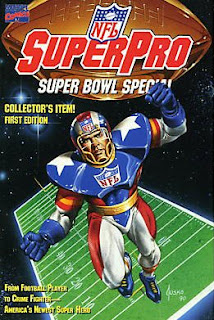
Phil Grayfield was a college all-American linebacker whose injuries sidelined his professional career. As a television investigative sports journalist, he fights evil on and off the field using a suped-up football uniform, originally designed to better protect pro football players, but which proved too costly to manufacture. The suit was primarily red, white, and blue with spot-yellow, and enhanced Phil’s natural athletic abilities. Apparently, the suit reversed the effects of those injuries that ended his career. I mean, really . . . football? Too dangerous. Fighting crime? No problem.

I was pegged for Spidey duty, along with fellow superhero actors Marc and Stewart, who would represent the Hulk and Captain America respectively. As far as any of us heroes knew, the gig was a PR event to promote Marvel. None of us knew of SuperPro. All that changed at a meeting at NFL offices in New York, where we convened one afternoon prior to our leaving. There we got the scoop: The NFL was using the Super Bowl—and the festivities leading up to it—to introduce a new hero, SuperPro. Spider-Man, Captain America and The Incredible Hulk—being internationally recognized heroic icons—would be on hand to introduce NFL’s new hero to the entire world and—more importantly—the media. Essentially we would be the whistles and bells for SuperPro’s coming out party. To spend a paid, week-long trip in Florida, playing Spider-Man at the events leading up to the Super-Bowl, perhaps including a ticket to the game? Yeah, I think I could genuflect before another hero without it bruising my ego.

The NFL didn’t need nor want the help of Marvel’s personal appearance program to find their new hero. Apparently, they felt that no experience was preferable over more than a decade’s worth when it came to hiring a character actor. Actor, Shmactor . . . they found themselves a genuine NFL football player, more precisely a recently retired L.A. Ram.

The former Ram was measured and fitted with a custom-built costume. I never saw the receipt, but the formerhead of the Personal Appearance Department once told me that the Spider-Man suits cost three thousand dollars apiece, and that was just for replacements made off the already-set design. The SuperPro suit had to have cost that much before a single yard of fabric was purchased. I’m guessing ten to twenty thousand, and that isn’t even reflecting an amount for insurance purposes, as the appraisers say on the Antiques Roadshow. It was a bill the NFL almost ate. Less than two weeks before our scheduled departure, the man who would be SuperPro backed out.
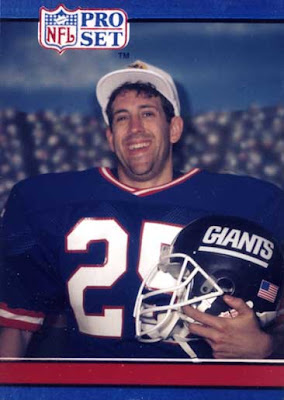
Fortunately the NFL found themselves a replacement, but he wasn’t a former professional football player. The new “Phil Grayfield” was a professional bodybuilder. As far as bodybuilders go, Phil had a neck and could scratch his back without having to rub against a tree. He looked like a cross between Willie Aames of Eight Is Enough and Ian Zeiring from Beverly Hills 90210 only with the body of Lou Ferrigno. He had a good toothy smile and looked like a typical all-American, hot-dogs-and-apple-pie–type of guy. In the SuperPro uniform, Phil looked great, surprising given that he replaced the man for whom the suited was custom fitted. The NFL marketing nabobs obviously thought so as well going by the excited grins on their faces as they paraded him through the NFL offices like a blue-ribbon heifer. (Above l. to r.: Our Phil Grayfield, Marvel Personal Appearance Department head Alison, Marc and Stewart strategize during an NFL dinner before the big game)

Like good second fiddles, we heroes dutifully followed. It was immediately made clear that we were going to have our work cut out for us when it came to spotlighting SuperPro. Phil was certainly nice enough, but he had the charisma of a mannequin. Put up against professional character actors, he all but disappeared. Patrick Swayze had it easy teaching Baby how to dance next to the Herculean task set before us. And of course, being the most iconic of the characters, the onus fell more squarely on my shoulders. (Below: the "Just-Us League" under the stands at Tampa Stadium.)
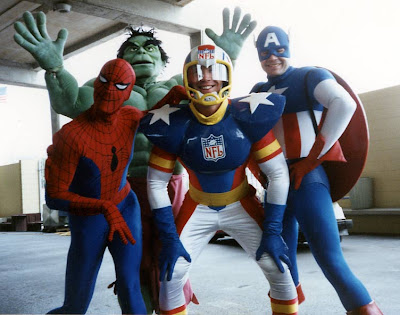

Alison, Marc, Stewart and I flew down on the Saturday the week prior to Super Bowl weekend. The NFL had flown Phil down a day or two prior. This special treatment of Phil was something the three of us “lesser” heroes would have to get used to. Although the game was to be played in Tampa, we flew into Orlando—a quick hour’s drive west—because the recently-opened Walt Disney World Dolphin Hotel was the NFL’s Super Bowl headquarters. We would be rooming there as well, only not the first night. The superheroes were scheduled to appear at a football clinic in Tampa early the next morning.

The flight was uneventful, but as we deplaned the flight crew informed us that the flight was the last Eastern Airlines flight . . . ever. While in the air the company went out of business and the crew was informed that they were out of work. The forced smiles and cheery “B’Bye”s were even more disturbing than usual. I’ve never been more relieved that firearms are not allowed on flights. While Alison began the process of rescheduling our flight home—an unenviable task given she had to find four seats on a flight out of Orlando the day after the most famous annual sporting event in the country, arguably the world, when tens of thousands of people would be flying out—we went to claim our luggage and the trunks holding our costumes. Not the Spider-Man costume, of course. That I carried with me. If the other costumes got lost in transit, at least Marvel’s most famous character would still be available. In fact, I had brought two costumes, just in case. The gig was far too important to risk damage or loss to the suit. Plus, with nearly ten days of continuous use, without access to cleaning facilities, a single costume would smell mighty ripe by the final days.
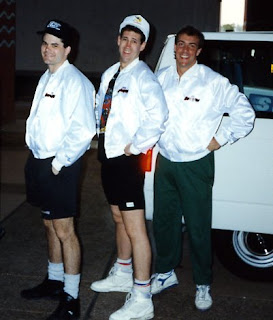
We were also responsible for shlepping the SuperPro suit around, which traveled in a trunk only slightly smaller that that used to transport the Hulk. And when I say “we,” I mean Alison, Stew, Marc and I; Phil was provided with his own humungous SUV. Wouldn’t want him to break a fingernail and thus jeopardize his SuperPro portrayal all because he was responsible for transporting his own costume.

The trunks in question—holding the Hulk and SuperPro costumes—were the same proportion as a steamer trunk, only much bigger. One could easily store an artificial Christmas tree in a trunk, complete with lights, garland several boxes of ornaments, stand, as well as Santa and several reindeer. The Captain America costume fit in a large over-the-shoulder duffel bag. But the shield . . . Oy! Imagine a pizza box designed to hold a garbage can lid or one of those circular metal sleds. A Cadillac from the early seventies wouldn’t be able to transport one of these costume storage facilities in its trunk, never mind two of them, Cap’s shield and costume, four adults and enough luggage for a ten-day trip. So we rented a van and headed for Tampa. (Above: Stewart, yours truly and Marc, stand before our trusty van in our SuperPro jackets)

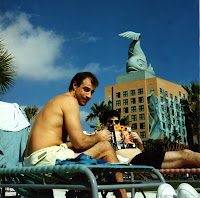
Super BowI XXV was to be played in Tampa Stadium, home of the Buccaneers, but we would be lodging in Orlando—a short hour’s drive from Tampa—for all but the first night of the trip. The reason: The NFL had booked its rooms at the new Dolphin Hotel, located in the Disney World resort area. A companion to the Swan Hotel, which opened January and sat directly next to it, The Dolphin opened in June, a mere seven month prior. It was Disney World’s most luxurious hotel; no surprise then that the NFL was staying there for its most important event of the year. As a part of the Super Bowl festivities, we were staying there as well. But early the following morning of our arrival, SuperPro and the Marvel heroes were scheduled as guests at a football clinic for kids in Tampa. The highlight of the clinic was the participation of some of the NFL’s greatest stars, including Dan Marino, Bernie Kosar, Warren Moon and Ozzie Newsome, who would be overseeing the various activities. (Above: Marc and Stewart enjoy a rare off-day at The Dolphin.)
I couldn’t have been less enthused about meeting Dan Marino, the Hall-of-Fame quarterback for the Miami Dolphins, who were my beloved New England Patriots biggest rival. The only positive from meeting Marino would be the ability to tell friends later that I had met football legend Dan Marino. . . . or so I thought.

After our arrival and change into costume, Alison had the characters split up each to participate in a different activity overseen by an NFL star. Lucky me. I was directed to an area of the field where Dan Marino was throwing passes to a group of kids. Lined beside Marino, the children would one-by-one take off down the field ten to twenty yards, then cut across where Marino would lightly toss the ball to them.

It was a beautiful day: sunny, relatively dry and not too hot. Unfortunately, sunshine reeks havoc with the vision of anyone wearing the Spider-Man costume. The white mesh stretched over the eyes creates what can best be described as snow blindness when one faces the rays of the sun. The expansive field on which the activities were being conducted provided no shadows that might relieve the problem, either. I was able to cheat my way across the field to Marino and the kids, looking askance the sun under the mask while not twisting my head, so I wouldn’t appear drunk and start walking into anyone.

On my way, a young boy approached me. He had broken off from another group that were going off with one of the other NFL players and characters to partake in a different activity. “Hey, are you the guy that wrote that article for Marvel Age?” he asked.
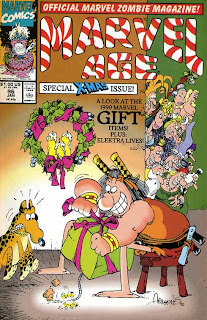
It took a moment to realize to what he was referring. An article I had written for Marvel’s in-house magazine, Marvel Age, had appeared in the issue that was available in December. It was my first writing assignment ever, and I had hopes that it would lead to my writing more articles and eventually the comic books as well.

Marvel Age was similarly packaged as a traditional comic book—same dimension, paper stock and color process—and featured behind-the-scenes articles on everything Marvel, whether that be future storylines; upcoming toy releases and other licensed product, like T-shirts and hats; or new titles that would soon be released. I wrote a half-page piece, entitled “My Life as Spider-Man.” It encapsulated some of my adventures as the company’s most famous character and accompanied a shot of me perched on a table top beside a seated Todd McFarlane, the penciler for the Amazing Spider-Man comic at the time.

It was kind of cool that this kid had enjoyed my article and made a point of finding out if I was the same guy he had read about. At the same time I felt strangely exposed. I was more concerned with landing my first writing gig for Marvel than with “outing” Spider-Man. Fortunately, no one at Marvel seemed to notice.

As I got closer to Marino, the kids toward the back of the line and those who had already had their turn began to swarm around me, eliciting high-fives, shaking my hand and asking the usual array of questions. I immediately struck a pose in a crouched position. I would normally do this anyway when meeting younger to heighten the effect of the costume while also putting me closer to their level, in hopes of setting at ease any of those kids that are freaked out by the experience. But I also wanted to use the children to shade my eyes. Though they averaged twelve years of age, they were tall enough to do the job. Otherwise, I couldn’t see the high-fives coming at me or the hands being extended to shake, let alone the risk of trampling the smaller ones.

"Hey, Spider-Man, why are you in Tampa?” was an immediate query.

“I came to visit my friends in Tampa. Took a bit longer than I anticipated, though. Once I swung out of Manhattan, I ran out of buildings and had to hop a ride on a southbound bus,” I replied. “Fortunately, the Fantastic Four are keeping an eye on things while I’m away.”

“Let’s see you shoot a web,” another asked.

“No can do. I never shoot my webbing irresponsibly, and with great power comes great responsibility. I just hope the Green Goblin doesn’t show up. I didn’t even put my web-shooters on. Otherwise I wouldn’t be able to shake hands with you guys.”

At which point I would go into a short explanation of how I shot webbing, using my middle two finger pressed against the inside of my palm while keeping my wrist bent down so as not to impede its firing. Then I had the kids show me how to shoot webbing if they, too, had a set of web-shooters.

“C’mon, who's next?!”

Dan Marino’s pointed question did little to stem the kids’ enthusiasm for Spider-Man, but it was only then that I noticed—even with my limited eye sight—that he stood alone, and not a single child paid him heed.

For the life of me, I cannot explain what happened next. Maybe my actions were an attempt to return the children’s focus onto Marino or maybe it was pure ego that drove me. There was no think; there was just do. Seeing the line empty, I shot out from the throng of youngsters and passed Marino calling, “Throw me a pass, Dan!” I sped straight out from his right about thirty yards; then cut across in front of him. Only in the instant that I looked toward him did I realize I was in big trouble; all I could make out was a faint, fuzzy blob in the distance.

What a f***ing idiot I am! I can barely make out shapes directly in front of me, never mind twenty yards away. And touch? My hands are covered in slick spandex. If I am even lucky enough to get my hands around the ball, I will only feel it once the ball’s slipped through my grasp. What was I thinking? How bad will it look if Spider-Man misses this catch? Spider-Man CANNOT drop this ball. Stephen Vrattos? PShaw! He can drop the ball, especially one thrown by Dan Marino. But if Spider-Man misses the ball—before the expectant eyes of a dozen or so adoring fans—that could end my short-lived career as the world-renown web-swinger; at the very least, I would never again be chosen for any high-profile events.

Call it divine intervention or Spider-Sense, but my cut cross-field had only taken me about five yards, when I noticed a flash of shadow as the rocket that Dan threw at me eclipsed the sun for a fraction of a second. I could only react. I leapt, shot my arms out and something akin to a head-butt slammed my sternum. Hitting my chest did little to slow the projectile as it caromed upwards, delivering an uppercut to my chin. Good thing to; had the football bounced off me in any other direction I wouldn’t have had the chance to get my arms around it and pull it in. Showing none of the terrifying affects of the experience, I lightly alit, and without losing stride, jogged smoothly back to the fuzzy blob that was Dan Marino, nonchalantly tossing him the ball and delivering a cool, “Thanks, Dan,” before rejoining the children, who were oohing and aahing over what they had just witnessed.

Meanwhile a sharp pain accompanied every breath I took and I could hardly speak; my jaw was numb. It didn’t take a science nerd like Peter Parker to understand that the pass that Marino threw Spider-Man was not the easy lob he administered to the children. And while Spider-Man—or rather the average joe beneath the costume—was certainly no youngster, he wasn’t a professional football player either. And that pass was a rifle, or rather, in football parlance, a shotgun. Marino wanted me to drop that ball. maybe he even hoped it might knock me/Spider-Man down—physically and psychologically; show the kids what a nobody Spider-Man is.
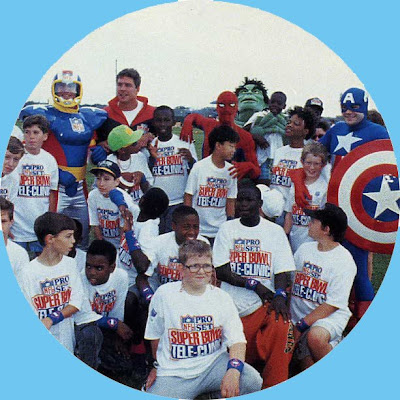

There is every possibility that Marino—having been throwing a seemingly endless stream of unsatisfying easy passes—just reacted like a well-oiled, Hall-of-Fame quarterback to the sight of an adult going out for a pass, the bronco enduring the heft of a cowboy until the gate is finally flung open and he can buck to his heart’s content to throw off the annoying rider. I might buy that explanation if it wasn’t for they way he acted the rest of the day: like a petulant child.

As they day wrapped up, the kids were gathered together with the superheroes and the NFL stars for a group photo. I was directed to stand next to Dan Marino. As the photographer prepared to shoot, I placed my hand—fingers splayed in a traditional Spidey manner—on Marino’s shoulder. He violently shrugged my hand off and spat, “Watch the hair, man!” I was dumbfounded. I wasn’t anywhere near his precious hair, and a simple “Please, don’t touch me”—while still being undeservedly rude—would have sufficed. I didn’t say anything, but remember thinking, “That’s Mr. Man to you, Mr. Dan ‘No-Super-Bowl-Ring’ Marino!”