Monday, February 22, 2010

Tim Burton at the MoMA

If you are anywhere near Manhattan in the next several weeks, creep, crawl, lurch, or better yet, run as if some unspeakable horror is chasing you, to the Tim Burton exhibit at New York’s Museum of Modern Art (MoMA). Burton is a filmmaker (Beetlejuice, Batman, Willy Wonka, Sweeney Todd, etc.) the type whose distinctive touch is instantly discernable in everything he creates. Much like the films of Terry Gilliam, the Coen brothers or Hal Hartley, one cannot help but know they are watching a Burton flick.

This Burton-inspired balloon stands in the foyer of New York’s Museum of Modern Art (MoMA)

What many may not realize is that Burton is also an artist. But it won’t take long for anyone experiencing the MoMA exhibit to see that Burton’s talent in the visual arts is as masterful as that in his filmmaking.

NOTE: Get your tickets in advance; most days sell-out long beforehand.

The entrance to the Tim Burton exhibit at the MoMA

I had seen some of Burton’s preliminary sketches for various films, such as Nightmare Before Christmas, and those he provided for Melancholy Death of Oyster Boy and Other Stories, his short story collection that was released a few year ago. But I expected more of the exhibit to focus on the former—along with props and costumes from his movies—than the latter, less commercial work.

I was happily surprised.

Sure, there are cases filled with puppets from the aforementioned Nightmare and his other stop-motion feature, Corpse Bride; props, such as the heads of Sarah Jessica Parker’s and Pierce Brosnan’s characters in Mars Attacks!; and costumes, including the cape worn by the headless horseman in Sleepy Hollow. But there are also hundreds of drawings and paintings, beyond those done for his movie work, from throughout his life.

Notice the fine line work and economy of color in this storyboard panel from Nightmare Before Christmas

Burton’s art is extraordinary; his line work—the control and wherewithal of such—had me shaking my head in profound disbelief. Even in his most lackadaisical of doodles, one can see genius. It’s no wonder he won a scholarship to the prestigious CalArts, the fine arts institution founded by Walt and Roy Disney, when he was eighteen.

Isn't it romantic?

Artists Gahan Wilson, Edward Gorey and MAD magazine were clear influences in both subject matter and technique. And Burton’s signature twisted, subversive humor is evident in his earliest pieces. I especially liked “Man Undressing a Woman with His Eyes,” the three-drawing sequence of a couple meeting at a party, “Man with Permanent Seeing Eye Dogs,” and “Little Dead Riding Hood,” but there are many others that tickled me.

Pablo Picasso once said that he spent his whole life learning how to draw like a child; to create with a mind free of preconception, prejudice, rule or life-experience. Burton’s art is a testament to this belief. His work is fearless, boundless, unfettered by convention. I was as awe-struck as I was jealous of his facility to just draw whatever comes to his mind; not think before putting instrument to paper.

Who doesn't think clowns are evil?

Accompanying some of Burton’s one-dimensional creations are maquettes by model maker Rick Heinrichs. And there are also a few “life-size” statues of his dark visions. All add to the exhibit’s enjoyment.

Unfortunately, the space MoMA provides for the exhibit is too limited—two small rooms. Most McDonald’s restaurants provide more space for their customers. Burton’s numerous drawings are crowded on the walls like the celebrity photos at Sardi’s. Alcoves the size of half-baths featuring screens on which the filmmaker’s early animated work played, were pigeon-holed in the exhibit like an afterthought. Unsurprisingly, museum-goers stopped—many even sat—before the screens to watch, creating immovable areas of traffic. I would have liked to enjoy them myself, but the set-up was not conducive to doing so. Other screens hung among the scads of art further impeding the flow of the patrons. And the exhibit was PACKED. I was among the first day’s group to enter and the space filled in minutes and only got worse as each successive scheduled ticket group’s time opened up.

What was the museum thinking? That an exhibit featuring the work of one of the world’s most popular visionary’s, in the country’s most populated—not including the millions of tourists that visit everyday—cities, wouldn’t be busy?!! I’d hate to think the decision was prejudiced, that the MoMA nabobs responsible for such decisions didn’t feel Burton’s work worthy of more space. As much as I enjoyed the work, the overall experience was hot, uncomfortable and completely AVOIDABLE had the exhibit been given the space it deserved.

Clean my room? Don't have to tell me twice!

Fortunately, MoMA’s website freely provides many, if not all, of the pieces featured in the exhibit, including the video segments. It’s not the same as seeing the art live, but at least your not getting jostled about or intimidated to move away from any piece you’d prefer to linger over.

Tim Burton’s work gets the full five spiders.

The exhibit gets a woeful two and a half spiders (the extra half a result of the museum’s website coverage of the exhibit)!

Shame on you MoMA!

Wednesday, February 17, 2010

The Brief Wondrous Life of Oscar Wao by Junot Díaz

I originally heard about The Brief Wondrous Life of Oscar Wao on a Sunday-morning program. In the segment, a lot was made of the fact that the main character—the eponymous Oscar Wao— was a comic-geek, and the author liberally referenced comics and other pop-culture minutiae in the telling of Oscar’s tale. This facet would nary induce a blip on the literary radar were it not for the fact that Wao had just won the 2008 Pulitzer Prize for Fiction.

That the highest honor in bookdom should go to a novel whose hero is a comic lover and whose author used four-color lore—at times daring to (gasp!) quote comic books—was unheard of. Apparently, the correspondent was unfamiliar with 2001 Pulitzer Prize winner, the exemplary The Adventures of Kavalier and Clay by Michael Chabon, a novel that doesn’t merely cite comics, but is actually immersed in that particular art form’s world. Fortunately, the segment was more journalistic than sensationalistic, but the inference that the Pulitzer Prize committee had lowered its standards or that the award had been cheapened by honoring Díaz’s work was plainly evident.

I didn’t care about the Pulitzer or the disparaging subtext of the segment—comics aficionados are used to it—the correspondent had me at “Fantastic Four,” to paraphrase Jerry Maguire. Wao went straight to my Christmas list and made it into my greedy little paws a few months later.

The Brief Wondrous Life of Oscar Wao is the story of an unsightly, social misfit Dominican’s journey to getting laid. Díaz uses the idea of achieving sex as a euphemism for Oscar’s struggle in overcoming his nigh-crippling shyness/awkwardness/not-fitting-in-ness and gaining acceptance. It’s a universal theme, one not exclusive to Dominicans.

Much to my delight, the book opens with an epigraph from Fantastic Four, Vol. 1, No. 49. Díaz further sets the stage with a poem from Nobel Prize (for Literature) winner Derek Walcott. Both present important facets to Oscar’s character: his affection for comics—more importantly the odd sense of greatness that geeks have for being expert in something beyond their fellow man, whether facility in comic books or fluency in Klingonese—and his feeling of displacement.

Author Díaz quotes World-Devourer Galactus in Wao’s opening epigraph

A short introduction on the Dominican idea of fukú follows. Fukú is an ancient curse with which our hero believes himself to be cursed. Whether Oscar is a victim of fukú or simply uses it to explain his perceived misfortune is left for the reader to decide.

An intriguing and clever start, the efficacy of which was immediately derailed by Díaz’s preponderance of footnotes. Or should I say, foot“novels”? Four of the seven introductory pages discussing fukú contain them. One travels half a page only to continue and conclude at the bottom fourth of the succeeding one. They are less frequent as the story progresses, but not less voluminous—at times extending more than two pages!

These short novels-within-a-novel most often explain references to Dominican culture, figures and language in the main text. They are engrossing in their own right, but intrusive. I found myself taking a deep breath before tackling them and pausing to recollect the main storyline upon my return. It was like putting a traffic stop on the Autobahn.

Far fewer of the notes concerned comic-book or pop-culture references—most of those were written into the text in a way that they needed no further explanation—and the info contained in those was already familiar to me. So it not only impeded the flow of my reading, but also proved aggravating each time I realized I need not have stopped, which I continued to do for fear that I might meet some nugget of info of which I wasn’t aware.

When Díaz wasn’t interrupting Oscar’s journey with footnotes, he was abruptly changing the story’s point-of-view. From Oscar to his sister, to the childhood tale of his mother, and back again. There were chapters that I was several pages into before I realized the narrator had changed, forcing me to return to the chapter’s start.

An author’s use of language or particular character’s vernacular normally deepens the reading experience. The opening dialogue of John Kennedy Toole’s brilliant 1981 Pulitzer Prize-winning novel, A Confederacy of Dunces, is a perfect example. The heavy Cajun accent that Toole employs takes some getting used to, but well worth the effort. And once familiar—by the end of that inaugural scene, easily—it proves no obstacle for the remainder of the book. Like anchovies in a well-crafted puttanesca: they add depth and complexity to the dish, but will only go unnoticed if not included.

Díaz’s liberal use of Spanish could have had the same effect, enhancing the depth and complexity of the novel and its characters. Unfortunately, the reader is never allowed to familiarize themselves with Wao’s voice—there are just too many other distractions—so the author’s use of language only exacerbates the situation.

I got the sense as I was reading that Díaz didn’t trust his writing talents or the story or both. It was as if he were trying to be clever to compensate.

Wao is nonetheless a good book. Not a great book. Just a good one. And that has less to do with its not meeting my high expectations than with the author’s overuse of these literary devices.

And because Wao is a Pulitzer Prize winner, it has to be held at a higher standard. Compared to the aforementioned Chabon and Toole classics, The Brief Wondrous Life of Oscar Wao falls painfully short and gets a disappointing three out of five spiders.

Wednesday, February 10, 2010

How Now Salchow?


Given former U. S. Olympic skater Nancy Kerrigan’s familial woes, the impending Winter Olympics in Vancouver, Canada, and this past weekend’s Super Bowl win by the New Orleans Saints, the following seemed appropriate.

For those of you have been living under a rock the past month, Kerrigan’s brother was arrested in connection with the death of his and Nancy’s father a couple of weeks ago. Her father died of a heart attack during an altercation with his son who had his hands around his dad’s neck at the time.

I met Kerrigan briefly shortly after her return from the 1994 Winter Olympics in Lillehammer, Norway, where she won the silver medal (Ukrainian Oksana Baiul won the gold) only seven weeks after the infamous “knee-capping” attack by rival Tonya Harding’s then husband, Jeff Gillooly, at the U.S. Figure Skating Championships in Detroit.

I was gigging at a trade show in New Orleans (hence The Saints reference) for Marvel’s newsstand department, which deals with comic sales through major distribution channels as opposed to direct distribution, which was how comic specialty shops received their books. A recently-signed Kerrigan was appearing at the Revlon booth. A few years earlier Ron Perlman, Revlon’s owner, had purchased Marvel, so I was splitting my appearance time between the Marvel Comics and Revlon booths.

Kerrigan was certainly affable enough, but somewhat cold (no pun intended). I wouldn’t say she was aloof, but rather there was an uncomfortableness that may have come from her unfamiliarity with stardom and the endless stream of fans wanting to meet and get an autographed photo with her. As a native Bostonian, I tried cajoling her into opening up, as she was from Stoneham, Massachusetts, a town north of Beantown. I had actually visited the town’s zoo—now called the Stone Zoo—as a child while on a field trip and remembered the trip fondly. Alas, my feeble attempts fell flat and her demeanor remained reserved.

Obviously, the feelings she had from meeting Spider-Man so overwhelmed her, it was all she could do so as not to faint.

Marvel, in its infinite wisdom, would oftentimes register me as Spider-Man (Note badge in photo)... So much for a secret identity!

Wednesday, February 3, 2010

Webheads III: The Quiet Storm, The Loner, The Watcher and The You-Go-First

After receiving countless letters and emails demanding its return, I bring you, my devoted Bloglodytes, the third installment in my discussion on the types of fans I met on my near decade-long adventure as everyone’s favorite neighborhood Web-Swinger. Those of you wishing to relive those pleasurable past postings—and who wouldn’t?—have only to click on the following convenient links. For “Webheads I: The Exuberant,” CLICK HERE; For “Webheads II: The Screamer, The No-No and The Return Engagement,” CLICK HERE.
I have to admit I’m tickled when one of you reveals to me your relating to a category I’ve described when you were a wee worshipper of the webbed wonder. See if any of these spark memories…

Occasionally, I’d encounter a child without a hint of trepidation. Case in point: This little boy threw himself into my arms, giddy at meeting his hero; a marked contrast to the wee lass in the background, who stares worriedly at our meeting while clutching onto her mom.

THE QUIET STORM
Patient, careful—but not hesitant—Quiet Storms were determined to show no fear before their peers. Most often, they’d appear accompanied. I’d easily envision Quiet Storms urgently telling attendant parent that they didn’t want Mom or Dad standing by them during their Spider-Man encounter; that would be far too embarrassing. Not that the Quiet Storms wanted said parent to leave the area entirely. The savvy Mom or Dad would save their independent offspring the ignominy of their having to ask their parent to stick around with a “I’ll just be waiting over here,” as they indicated the exit area.

A far cry from any of the children described here, this young lad could not tell me enough about his day, and queried me in great length about why I was in town, where my eyes were, and who I had been battling recently.

A Quiet Storm’s steps were measured as they neared. They'd never offer conversation, or elaborate with their responses. The internal conflict betwixt their fear at approaching Spidey and the pressure to appear unafraid before their peers didn’t allow for extraneous activity. They’d answer quietly and succinctly, even though their insides were flip-flopping in terror.

“Would you like an autographed comic?” I’d ask, the book before me, Sharpie already poised.

“Yes, sir.” they’d most often politely reply. From the corner of my eye, the parent would reveal themselves with a more-than-casual-observer smile.

“What is your name?”

“Trey Daniel Phillips.”

“I’ll just put it to ‘Trey.’ Is that okay?”

“Yes, sir.”

“And how do you spell that?”

“T-R-E-Y…” Each letter carefully articulated, as if a code that would diffuse a bomb were being conveyed over a walkie-talkie.

Most often, the moment they had completed their task—must… overcome… fear… get… autograph—they’d scamper back to their parents, doing an emotional one-eighty—beaming, showing off their comic and talking a mean streak.

THE LONER:
Like Clint Eastwood in a Sergio Leone Spaghetti Western, The Loner would appear. Unfettered by parents, guardians, siblings or friends, they’d dutifully wait in line to get a comic book and go. Like the Quiet Storms, they were not talkative, just economic in their use of words, usually saying no more than a “Hello, Spider-Man” at the start, stating their name when asked, and ending the encounter with a “Thank you, Spider-Man,” before disappearing by themselves into the crowd. The Loner was never frightened, just independent. Yet, unlike The Exuberant, who were also carefree, The Loner was unemotional and never shared his experience with others.

The Loner bothered me. I always wondered what caused them to be so independent and alone at such a young age.

THE WATCHER:
From the crowd of onlookers, waist-level sets of eyes stare intently at the proceedings: The Watchers! These were children—oftentimes brethren of others in line—who were scared to death to confront Spider-Man personally, yet fascinated enough to observe the proceedings from the safety outside the barriers. Sometimes they’d whimper for their brother or sister when their turn came up—certain their siblings were walking toward their doom. Of course, once their loved one escaped unscathed The Watcher couldn’t wait to grab the signed comic out from their hands for a peek.

I’d always offer the parents of Watchers an autographed comic from my perch, handing it to their brother or sister for delivery. Sometimes, depending on the reaction, I'd get up and give the comic to The Watcher myself, stretching as far as I could muster. The Watcher, too, would extend to their wee limits, just grabbing the corner of the comic with tremulous fingers. The scene was like that in many an adventure movie with the hero saving the heroine from a perilous fall with an impossibly outstretched hand at the last possible instant.

A lot of very small children, who didn’t know me from Elmo, were simply fascinated with the primary colors of the suit. Gotta love that red-and-blue!

Some children became Watchers when confronted with the moment of truth, after spending hours in line… much to the parent’s chagrin, I might add. Literally faced with their hero for the first time they’d stop short of the signing table and park themselves at the outskirts of the autograph zone, just out of range of whatever danger they considered might befall them if they got any closer.

Oblivious to their parents’ goading to either meet Spider-Man or concede defeat, the newbie Watchers remained stock-still in their parking spot, observing each successive child in line.

I had parents—overcome with impatience—literally leave their children by my table while they went shopping. They’d return an hour later to find their offspring still transfixed, frozen in the spot they’d left them, trapped between meeting their hero or fleeing. Oftentimes it was a sibling of The Watcher, who would return and drag their brother or sister off with a “C’mon, Mom’s leaving!”

THE YOU-GO-FIRST
Traveling in small packs or duos, the You-Go-Firsts would huddle together and shuffle warily toward the signing table, directing one another to be the first to meet Spider-Man. Much like a medieval jester—who would sample the king’s repast before His Highness to ensure the food wasn’t poisoned—The You-Go-Firsts or rather the Go-First would wriggle forward, to make sure the way was safe for the rest of his or her tribe.

You-Go-Firsts shared giggle-fits as they neared, the result of mutually-shared fraught nerves. Occasionally, the Stay-Behinds would have the audacity to push forward the volunteer of their group. Of course, once their tribe mate succeeded, they’d hurry forward en masse to claim their prize, forgetting the fear they held moments before. Sometimes duos would never come to a decision between themselves as to who would go first. So they sheepishly approached like conjoined twins attached at the hip.

Sometimes kids just wanted a hug...

It was always endearing to me to see wee You-Go-Firsts step forward who were BFFs. The tell-tale signs could be matching temporary tattoos on their forearms or identical barrettes in their similarly-styled hair; they might be clutching the purse or dressed in the same color schemes. Sometimes even they sported matching outfits. Meeting Spider-Man, with its high-risk level, was something that couldn’t not be done together. They’d depart, still arm-in-arm, clutching their autographed comics, already gabbing about the experience.

I’d like to think these encounters with me are retained with fondness, periodically brought up with a “Remember when we met Spider-Man…?”

Tuesday, January 26, 2010

DOOM’S DAY


It’s not often that an elderly couple takes out Dr. Doom.

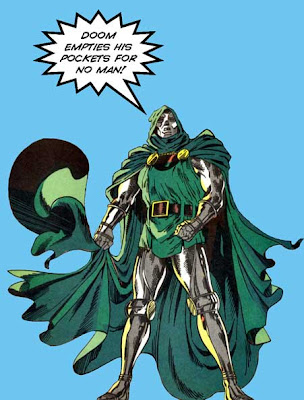
For those of you just joining us, Dr. Doom is a super-villain, one of the most heinous and powerful in the Marvel Universe. Like all good evil-doers, he spends his time and resources devising nefarious schemes to take over the world, only to be thwarted by his arch-nemeses The Fantastic Four or whoever’s title he happens to be wreaking havoc in any given month.

The dastardly Doctor was only one of a handful of bad guys for which Marvel had a costume that could be used for personal appearances. As far as comfort and maneuverability, Doom’s threads were on the favorable side, although the visibility when wearing the suit was low. It was easy to don, functional, and emulated the character beautifully.

The costume also was a treat to perform in. It wasn’t every day you could be revered despite being an arrogant prick. Its only drawback was its portability. The costume was kept in a large canvas duffel bag of the size one would use to transport hockey equipment. Thus, it had to be checked whenever traveling.
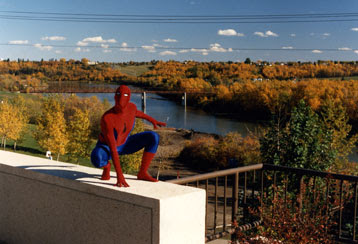
I had the good fortune to portray the character on several occasions (see prior post, “See You, in the Funny Papers”). Fortunately, this was not one of them. The hapless victim in this story, Fred, was joining my portrayal of Spider-Man as featured guests of Edmonton, Canada’s annual Canada Day Parade. Sponsoring our inclusion in this most important of our northern neighbor’s holidays were my old friends, the unpredictable, yet oddly loveable Darwin and his saintly better-half Lola (see prior post, “Survival of the Fittest, Parts I and II”). As such, immediately following the parade, Spider-Man and Dr. Doom were scheduled for a signing at one of Darwin’s and Lola’s comic shops.

This was to be Fred’s coming out party; his very first gig as any character for Marvel. The head of Marvel’s Personal Appearance Department, Barbara, thought it would be a good idea to pair me with Fred, so I could secretly monitor his performance. This speaks volumes about Barb’s judgment and trust in your’s truly (Whether misguided or not, I’ll let you decide).
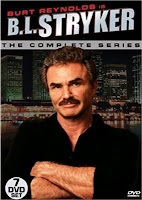
I met Fred at the airport. He was slightly taller and broader than I was. He’ll make a great Dr. Doom, I thought (You don’t want your Spidey more imposing than your Doom). His long brunette hair framed a friendly face and a big smile. Fred looked like a rock star, only more effusive. At the time, he was working as either a stunt man or extra or both on the short-lived Burt Reynolds show B.L. Stryker. We immediately hit it off.

Our flight departed the evening before the parade with a scheduled stopover in Minnesota. Delays while approaching Minnesota had us concerned that we would miss our connection. We discovered that our worries were unfounded upon landing. Due to bad weather over Edmonton, nothing was flying into the area. Our connecting flight was canceled. Worse, the weather up north was adversely affecting the phone lines. Try as we might, we couldn’t get through to Darwin and Lola to tell them of our plight. Not that it would have mattered; the number we had was for the comic outlet at which we would be appearing the next day, not their home. And the store was certainly closed by this time.

At wit’s end, we called Barbara. Barbara was always bemoaning how her work—due to its nature—followed her home. She had to be prepared for calls exactly like the one we were making. Still, I felt terrible disturbing her. Our delay had us landing in Minnesota just shy of midnight. It would be an hour later in New York. We woke Barbara, who was clearly perturbed. Her response to our situation: “What do you want me to do?” We suggested she either contact Darwin and Lola at their home or at least give us the number so we could try.

“I don’t have those numbers here,” she snapped, in a tone that suggested we were off our gourds for ever assuming that she might have that information.

Gee, Barbara, what part of your job actually makes it home, I thought.

We dutifully apologized-through gritted teeth-and resumed our endeavors to call someone up north. The only other number we had was the hotel at which we’d be staying. Miraculously, the call connected. We explained the situation to the receptionist and left a message for Darwin and Lola that we’d be getting up at the crack of dawn to be the first in line to get on the standby list for the earliest flight the next morning. Of course, we had no idea there even was an early-morning flight to Edmonton the next day or whether it would arrive in time for us to participate in the parade if there were. But we weren’t going to not try to get there. We crossed our fingers that Darwin and Lola would check with the hotel.

By this time, the food vouchers the airline had given us were no good. All the restaurants in the airport food court had closed, which, given the selection, was probably not a bad thing. Thus, we proceeded to Bloomington, Minnesota’s famous Thunderbird Motel, where we could at least redeem our accommodation coupons and get a few hours sleep before returning to the airport at the crack of dawn.

Marked by a towering, multi-colored, illuminated roadside totem pole–designed sign and a colossal Indian statue at the entrance, the Thunderbird Motel also is unique in that its lobby doubles as a Native American museum. Cases, filled with an amazing array of headdresses, quivers, arrows, papooses, clothing, moccasins and stuffed buffalo, moose heads, snakes, bears and the like, lined the walls. Given our exhausted state, it was surreal, like something directed by David Lynch. We scheduled a wake-up call that would allow about three hours of sleep and headed for our room. I dropped off with Fred heading out of the room for a smoke.
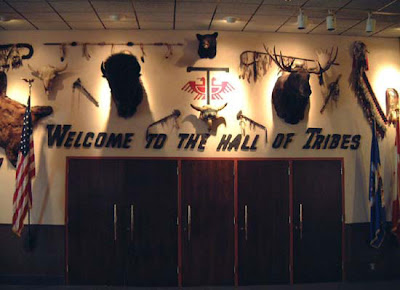
He seemed to return just as the wake-up call startled me out of bed. Had he been wandering the hallways of the motel all night? Perhaps he’s an aficionado of Native American memorabilia? I didn’t have time to dwell on my internal queries; airport check-in awaited, and we couldn’t afford to be late. Besides, Fred seemed mightily concerned about the whole megillah. Not surprising as it was his first gig. He obviously wanted it to go well and probably shouldered a lot of guilt, though faultless. I, conversely, was familiar with the occasional hiccup in appearances, and though certainly concerned and focused to do whatever it took to ameliorate the situation, I remained nonplussed.

With nary a moment to spare in the Bow and Arrow Coffee Shop, we rushed to the airport and succeeded in being the first in line at the counter. With luck, there would be two openings. Just in case, it was decided that my name go first. If only one of us made it, Spider-Man was the obvious choice. We tried phoning Darwin and Lola again to no avail. If worse came to worse, if they did not greet us upon deplaning, we would dress in a cab on the way to the parade’s origin and join the festivities, which were set to begin soon after the scheduled landing of our flight.

When they announced the standby names, our initial joy at hearing my name, turned to confusion, when it was followed by two other names, neither of which was Fred’s. I may not be a math whiz but even I understood that if there were three available stand-by spots on the flight and Fred and I were the first two names on the list, then he and I were shoe-ins for two of those three spots. Apparently not. Confused and upset, we approached the counter at the gate. Yes, Fred and I were atop the stand-by list. And yes, there were three spots open. But the third and fourth spots were held by an elderly couple who were on a second honeymoon to celebrate their 50th anniversary and the airline didn’t have the heart to break the octogenarian love birds up.

Fred and I, on the other hand, had no such qualms.

“You don’t understand,” Fred pleaded, “small children are expecting both of us to be there. You’ll be breaking their little hearts.”

I have to admit it was amusing to see the dreaded Dr. Doom beg not to be bumped from a flight. When he started telling the counter attendant that the children the airline would be disappointing with his absence were “special,” it began to sound more in character. When that wasn’t eliciting the desired response, Fred tried “handicapped.” What was next? I thought, Orphans? How low and vile to fabricate mentally-challenged and physically-disabled children as an excuse to gain a plane seat. Add to that the elderly couple Fred was attempting to bump and the occasion for which they were traveling, and Fred was beginning to make Dr. Doom seem like Mother Theresa in comparison.

“They’ve been together for 50 years, what difference is another hour or two going to make?!” I imagined him desperately spouting at any moment. Fortunately, he relented before crossing that line or venturing to using terms like “cancer-stricken” or “Make-A-Wish Foundation.”

Instead Doom stepped away duly defeated; no bodies, no smoldering carnage, not even a “Curse you, Reed Richards! Next time, it will be I, Victor von Doom who stands triumphant!,” while shaking a gauntleted fist. I felt terrible. The next available flight wouldn’t get Fred into Edmonton until well after the parade was over. If he were lucky, he’d make part of the scheduled store signing. His disappointment was palpable.

Meanwhile, the prune-faced paramours giddily scurried past his slumped figure onto the plane. I got on and the plane took off... on time, ironically. Accompanying me, was Dr. Doom, only without his body. The suit was checked and in the baggage hold. It and Fred would reunite later in Edmonton… unless, of course, he was bumped by someone traveling to deliver an organ to a dying child or something equally inarguable.
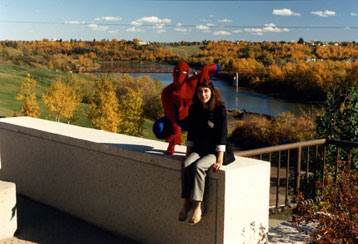
Wondrously, I arrived as planned and Lola was there to greet me. She had gotten our hotel message, after all. “Where’s Doom,” she asked.

“He didn’t make it. I’ll explain on the way to the parade,” I offered.

There wasn’t a vestige of the havoc the previous day’s storm wrought. It was beautiful, cool and sunny. As we sped to the kick-off point, I dressed in the backseat while explaining the last 24 hours. I barely had time to adjust my eyes in the rearview mirror when the car screeched to a halt. A small flatbed trailer, hitched to a truck, greeted my arrival. A sign attached to the truck’s grill read, SPIDER-MAN AND DR. DOOM BROUGHT TO YOU BY THE COMIC CASTLE followed by the shop’s address and phone number. Of course, Dr. Doom was M.I.A., but it was too late to make any amendments as the parade was getting under way.
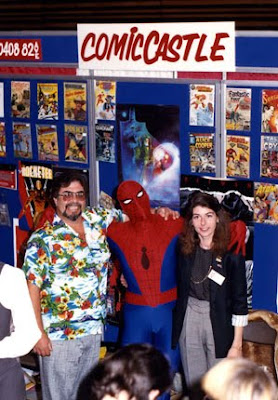
As the truck pulled away with me in tow, I expressed my concerns about being confined to the trailer, wanting rather to bound about, ham it up with the onlookers and shake hands along the parade route. Lola was more than happy to oblige. She figured as much from me, given my past performances at her and Darwin’s conventions. But having never seen the Dr. Doom costume nor being aware of its limitations, she was unsure if he’d need something to pull him or not. She provided the trailer just in case. It would turn out to be a fortuitous decision.

I hadn’t traversed a block before the crowds pelted me from both sides with “Yo, Spidey, where’s Dr. Doom?”

“Oh, I dealt with him earlier,” I countered. “How was I supposed to know he was here for the parade? I thought he was trying to conquer Canada.”

The parade route couldn’t have been more than a mile. Yet, halfway along, amid the leaps, posing and hand-shaking, I noticed the bottom of my feet starting to hurt. It wasn’t a muscular pain, but rather the sort one experiences from a scraped knee. I couldn’t fathom what was the problem. I’d participated in far longer parades on many previous occasions. Hell, the Macy’s Thanksgiving Day Parade was measurably greater and I had a couple of those already under my belt. The physical fallout from such events was never greater than the type of intense muscle pain one gets the morning after a good leg workout the day before.

Initially, I shrugged it off, alleviating my stinging soles with short bouts of walking on my hands. That wouldn’t get me too far, though, so I made dramatic pauses, crept slowly, did whatever I could to milk the route for as long as possible. But the pain became too severe and I found myself leaping onto the trailer to finish the remainder of the parade. I was mortified and more than a little worried. And the crowds weren’t exactly sympathetic.

“Hey, Spider-Man, why aren’t you swinging?” and “What? Are your webs tired (guffaw, guffaw)?” were a couple of the less pointed razzings I received.

“That storm blew me so off course, I was up all night swinging from Vancouver… I’m knackered!” I bantered back.

Blessedly, I was incapacitated for only the last few blocks, but it seemed like an eternity to complete. Lola met me at the finish and whisked me away to the signing at her store. I remember gingerly making my way to her car, trying to cover my painful steps with spider-like moves. Surely, I fooled all. Spider-Man often looks like he’s tiptoeing on broken glass.

There was already a line out the door when we arrived, but I told Lola I needed time to check my feet. In the office, I removed my suit to discover that I’d taken a layer of skin off my soles. They were raw and bloody. I could only guess that the streets of Edmonton weren’t as smoothly paved as those in The States. Their roughness was the only difference I could detect. Strangely, although my soles were shredded, the thin strip of red leather that served as the only protection on the costume’s feet weren’t damaged in the least. Neither a hole nor tear was evident.

The normally subdued Lola freaked when she saw them. Or at least her eyes grew slightly wider than usual, which for her was akin to the eye-popping, jaw-dropping of a Tex Avery cartoon character. Then again, Lola’s reaction may have been from me sitting in my bikini underwear. I didn’t think to cover up. My attention was on my injured tootsies. Besides, I dressed in front of strangers before when doing productions. Heck, didn’t I dress in the backseat of her car on the way to the parade? And it wasn’t like I was naked.

She hurried back with alcohol and bandages. And boy, did that alcohol feel good (That distant scream you heard in the late 90s? That was me.). Soon I was making my way to the signing table. Fortunately, it was near enough to the office that I didn’t have to do too much scampering to hide my pain.

The signing went well. Sure, the inquiries as to Dr. Doom’s whereabouts continued, but with my feet tended to and already feeling much improved, I was enjoying quipping with these “Doom-sayers.”

“Big surprise, Doom not showing… He is a bad guy, after all. If he can’t seize control of the planet, he takes solace in making people unhappy!” I’d playfully jab.

Fred didn’t arrive until after the signing. In fact, I accompanied Lola back to the airport to greet him. The Dr. Doom suit sat by the baggage carousel, waiting there for Fred to retrieve him since my plane arrived that morning. His mien and body language was even more downtrodden than before. Had Eeyore been present, he would have pulled me aside to express his concern. Fred wanted so much to play Dr. Doom that it wasn’t hard to convince him to don the costume for some publicity shots with Spidey at the store.

In the costume, Fred was a transformed man. He strode out of the front door of the comic store and deliberately into the street, stopping traffic and creating quite a scene. With the pain of my soles a distant memory, I followed his lead and confronted him. A struggle ensued, much to the delight of the drivers and passersby. Fred and I had experience in stage combat and made the most of it, tumbling over car hoods, flipping on top of one another. Had this been New York, we would have been run over, flipped the bird at the very least. For Fred, our mock clash of titans was cathartic. His spirits lifted and he had returned to the amiable teddy bear I had met at La Guardia Airport the morning prior.
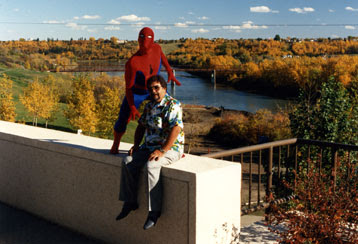
The next morning, we had breakfast with both Lola and Darwin (having apparently returned from the Galapagos Islands, no doubt). It was an equally beautiful day to the one previous and I couldn’t help but think that the travails of the last 48 hours were far behind us. The sun was shining, as we made our way to the car when suddenly, the sky went black.

“Ow! What the—?” Something had hit me. Something big.

Golf balls were pelting us from the heavens, bouncing off the tarmac and car as we hurried inside. I felt like Captain Kangaroo falling victim to Mr. Moose and his signature torrent of Ping-Pong balls. Except those never hurt the good Captain. If I never knew the experience of “being agape” before that moment, I certainly did then. It can’t be hailing, I thought incredulously. It’s July 2! I was trapped in some strange Canadian mash-up of After Hours and Trains, Planes and Automobiles. I just wanted to get home! Fortunately, the hailing stopped as suddenly as it started and we departed on time.

The return flight was not stopping through Minnesota, but rather Chicago, so Fred and I were hopeful that we would encounter no further problems. But fate still had one blow left to deliver: we missed our connection. There was only one thing to do. We proceeded to the airport bar and got hammered while awaiting the next flight home.

We arrived in New York in the wee hours of the morning. I tried to explain to Fred that appearances normally proceeded swimmingly without problem; that the nightmare that this particular gig became was nothing more than an anomaly. I liked Fred and wanted to work with him again in the future. More importantly, I believed he had the mix of spirit, dedication, playfulness and professionalism that the best character actors possessed. He would have been a tremendous addition to the team. But I caught the look on his face as we parted and I knew we’d never meet in costume again.
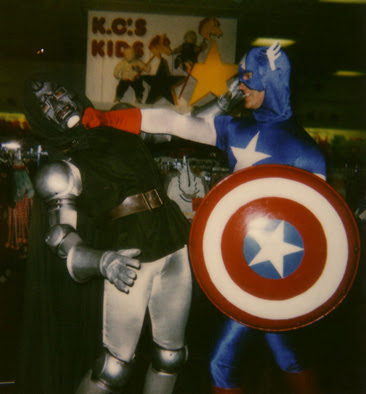
What the Fantastic Four and Marveldom assembled could not do, over more than two decades and countless battles, a frail octogenarian couple of fifty years achieved without even trying: the utter defeat of Dr. Doom!

Monday, January 11, 2010

I Love a Parade, Finale: What The—?

Previously, the 1987 Macy’s Thanksgiving Day Parade had commenced with Vroom!, ignoring the pain ’twixt his legs, marching valiantly—albeit like Rush Limbaugh walking home in wet trunks after a day at the beach—toward the televised clash-of-titans finale.

Captain America steps out from between several BJ’s economy-size comic books

The entire Marvel Universe float routine was centered around Captain America. As the most famous of the Marvel heroes after Spider-Man, who was absent, and the Hulk, whose maneuverability was the worst of all the characters, he was the obvious choice.

While the hoi polloi are wondering what danger Dr. Strange is alerting Cap to, the comics cognoscenti are wondering about the absence of any of the Red-White-and-Blue Avenger’s own books

The choreography was accompanied by a highly energized soundtrack that, if not directly stolen from Back to the Future, drew its inspiration from the hit Michael J. Fox film, over which the voices of Captain America and Dr. Strange—recorded by professional voice actors, not the actual people in the costumes—were dubbed. In fact, other than Cap, Dr. Strange is the only character who “speaks,” discounting the occasional grunt or cry of anguish and the chorus of amusing dubbed reactions that accompanied the choreography. Yes, we had an underlying fake audience track.

Dr. Strange opens the show by mysteriously producing a floating yellow orb from the folds of his cape before shouting, “Quick, Captain America! Wolverine needs your help!” The secret of the levitating orb is an inflated ball attached to fishing line and a pole held by another hero on the roof above. You can actually see the ball fall to one side as the action shifts and the actor who was manning the rod joins the fray during the televised sequence. (Above left: T.J. Glenn, the quintessential Sorcerer Supreme)

With Dr. Strange’s bit of sorcery in play, Captain America steps from the pages of the giant comics, which bookend the tower at the float’s rear, in a nice dramatic touch that reminds people that comic books are where all the exciting heroes and action to follow derive (I won’t mention that none of the recreated comics at the back of the float were actually Captain America books—Oops!). Strange delivers his line, “Captain America… Wolverine needs your help!” while sweeping an arm toward the front of the float, before Cap straps his shield to his back and moves to help the embattled X-Man. Why the Master of the Mystic Arts, Sorcerer Supreme didn’t deign to aid his colleague is another question. True, Strange was never one for fisticuffs, but employing the Crimson Bands of Cyttorak or the Winds of Watoomb would have easily sufficed.

Anyway…

Now, now... no fighting. There's enough mutant for everyone

Atop what we called the dungeon area, due to its deep gray faux Gothic façade and location underneath the shinier, more modern buildings surrounding it, Enchantress and Evil Mutant Master of Magnetism, Magneto, are playing tug-o-war with Wolverine. I won’t get into how unusual a scenario this is to any Marvelite. Suffice it to say that a mutant, even one of Wolvie’s caliber, would not normally be battling Amora, the Norse goddess of love and Thor villainess . . . certainly not mano a mano. Amora wouldn’t sully herself by touching a lowly mortal. She’d simply cast a spell or cleverly deliver a love potion. Nor would Magneto engage in close combat, rather allowing his powers do the talking. And neither is known for possessing enhanced strength, a prerequisite for anyone dumb enough to spar with Wolverine without super powers, mutant, magical or otherwise.

After the good Captain accesses the site of the struggle—climbing the side wall of the dungeon, a mere seven feet and four metal rungs—Magneto and Amora retreat. Cap chases Enchantress to the abutting bell tower (Apparently, super-soldier serum trumps mutant X gene when combating gods.). Rather than help his comrade who just saved him, Wolverine inexplicably scurries down a manhole into the dungeon… go figure.

Using a conveniently-located pole attached above the entrance into the bell tower, The Enchantress swings and kicks Cap backward in a maneuver that would make a seasoned pole dancer proud. Like something out of the climactic scenes of every episode of Scooby-Doo, Where Are You?, the love goddess runs, Cap follows, and after a quick weave in and out of the bell tower, Amora kicks again with both legs using a carefully concealed bar within the belfry. I guess when the Red-White-and-Blue Avenger didn’t slip her a dollar, she felt the need to up the ante on her routine.

When Cap recovers, he is faced with Magneto who, in a cunning moment of bait-and-switch has stepped in to help his fellow evil-doer. Ordinarily the Mutant Master of Magnetism would handily render Cap immobile or worse. He’d merely wave his hand and Cap’s shield would wrap around his head and suffocate him. But Cap easily pushes Magneto aside.

Yo, Doomsy... Pull my finger!

The fixated Cap takes up after Amora once again (Apparently, she owes him money), following Enchantress through the bell tower down the stairs on the far side of the dungeon, at the bottom of which he is greeted by Dr. Doom who, unlike Magneto, seems to have been minding his own business when he was so rudely interrupted.

Before Doom has the chance to utter, “Hey, you kids get out of my yard!” from atop the stairs Captain America points to the Malevolent Monarch of Latveria and avers (or dramatically mouths, as the case may be), “You’re through Doctor Doom!” A quick moment of “Which way did he go? Which way did he go?”—during which Doom ducks one way, Cap the other, Doom quickly doubles back and Cap appears behind him—and the dastardly doc is greeted with a right to the jaw, which is followed by an uppercut that throws him against his diabolical machinery. Cap throws a switch and electrocutes the armored baddie, a sequence accompanied by a spinning whatchamacallit, flashing lights that can barely be seen and Doom’s anguished scream . . . “Aaaaaargh!”

There must be fifty ways to love your lever

Up to this point the series of odd match-ups between various heroes and villains would go unnoticed to the hoi polloi and the average comic book fan would be too busy drooling in glee over the spotlight being thrown onto their beloved hobby to care. But the televised tableau was about to enter the Twilight Zone with the brief, but not brief enough, appearance of RoboCop. Literally behind the back of Captain America—who has turned away from Dr. Doom to free a shackled Power Man—the cyborg policeman clumsily enters from the dungeon just long enough to switch off the machine electrocuting Dr. Doom; then pauses in bewilderment—like the audience—before gracelessly ducking back into the darkness.

With all the grace of a wounded caribou, an uncharacteristically mustachioed Powerman lumbers onto the scene and asks, "RoboCop?!! What the Hell are you doing here?!!

Why a law-enforcement official helped a would-be world conqueror like Doom just heightens the weirdness of the moment, along with the utter lack of acknowledgment to RoboCop’s arrival by either Cap or Power Man. Of course, juxtaposed to Power Man’s awkwardness—which made Boris Karloff’s The Mummy look like an aerobics instructor—the audience probably thought they were seeing double.

“Take over Power Man! I’ll be back!” orders Cap before continuing to the rear of the float whence he first appeared.

If you blink while the camera pans across the base of the float, you’ll miss the cameo the back of my head makes as Iron Man, following the Silver Surfer on the street, parallel to Cap’s route alongside the float. Wolverine and Dr. Strange appear as well and all five confront the White Queen at the spot where Dr. Strange conducted his slight-of-hand earlier. The White Queen is an evil mutant whose power over subzero temperatures is similar to those of Frozone in The Incredibles. With a flourish she delivers a flurry of sub-zero bursts of energy which in reality are a bunch of streamers (but they look cool!).

For the love of humanity, not the streamers!!!

Choosing to ignore the White Queen—they’re just streamers, after all, and the combined might of the quartet of heroes should surely suffice to halt the frigid feline’s attack—Captain America climbs the girdered exoskeleton of the building beside which she stands. Look closely and you’ll see Daredevil following. Meanwhile, Green Goblin cameos atop Dr. Strange’s Sanctum Sanctorum—as it is affectionately known in the comics—before getting out of Dodge before Cap arrives. Cap gains the rooftop, and the camera angle cuts back to the base of the bell tower shooting upward. Where once Enchantress and Magneto battled Cap now stands the Hulk.

The framed metal box in which Magneto stands is an elevator that moves all of three feet at the speed of a Dancing with the Stars results show

“Up to your old tricks again . . . Hulk!” he shouts once again utilizing the finger-pointing gesture that seemed so effective when used against Dr. Doom.

Instead of running, though, the Hulk throws a tantrum, slamming one side of the tower, then the other, before he topples the structure, which is hinged in sections to give the illusion of tumbling over without the danger of actually doing so. If you watch the broadcast closely, you’ll notice Mark Hulk adjusting his head mid-tantrum, so it doesn’t go all “Linda Blair” on him. Cap is there in a flash, sliding down a fireman’s pole, placed there for no other reason.

Hulk goes off the deep end when he discovers that he’s late for the Macy’s One-Day-Only Sale

A bit of clumsy maneuvering puts the Hulk atop the dungeon where Cap and the Green Behemoth share a dance, since emulated by Kenny Mayne and his partner Andrea Hale in the 2nd season of Dancing with the Stars, before Cap hurls (read: delicately maneuvers) Hulk off the dungeon into the awaiting arms of Dr. Doom, Green Goblin and Power Man, a move which may help in explaining why a body builder was chosen over an actor for the role of Luke Cage. The routine ends with a close-up of the defeated Hulk between Dr. Doom and the Green Goblin.


I’ve since read blogs wherein the choreography is excoriated for its silliness, inanity, comic-book unfaithfulness, low-budget… you name it. Technically, these gripes may have merit, but they are unfair in their assessment, because they do not take into consideration the strict parameters under which Bill Guskey had to choreograph. The equivalent would be to pan a street-magic performer because his tricks don’t have the glitz and special effects of a David Copperfield extravaganza.

First, there were thirteen characters which needed screen time. The fact that some characters like Silver Surfer, Daredevil, Green Goblin and me, as Iron Man, got short-changed was in part due to the camera being too close at times. Had the view panned back occasionally, as when Cap spans the length of the float with a half dozen heroes in tow to confront the White Queen, the audience would have gotten a more dramatic and exciting moment, and the aforementioned neglected heroes would have gotten more bang.

Blink and you'll miss my national television debut, along with Caspar.. er, I mean, Silver Surfer

Green Goblin’s limited usage may have been planned. After all, Gobby is synonymous with Spider-Man, the Web-Swinger’s arch-rival responsible for the death of his first love Gwen Stacy. To give the pumpkin-bomb-wielding psycho any face time would only accentuate Spidey’s absence from the proceedings. Guskey even gives RoboCop his corporately-decided due.

Marvel's Green Party

Second, the float—all it’s trap doors, flashing lights and slide poles; various architecture and notable comic-book structures; collapsible tower and giant comics—needed to be featured. The Marvel Nabobs approved of the many thousands of dollars that went into its construction—not to mention the design of nearly a dozen new character costumes—so showing off the pageantry and breadth of the whole megilla was paramount. With only one means of access and egress, and the hazard of access, the Surfer’s perch was understandably omitted from the proceedings. Plus, the cameras were unable to circumnavigate the construct. Hence, the action taking place along only one side of the float.

Another superhero cameo: That’s Daredevil following Cap

Guskey had to accomplish all this in less than three minutes. This was live television, so special effects were limited and rudimentary. You couldn’t adequately show the characters’ various powers without their looking hokey. You also had to consider the hundreds of people surrounding the float. Pyrotechnic displays would have been hazardous and not allowed. Even had stunt people been hired to portray the heroes and villains, the resultant cost of insurance or a more acrobatic routine would have been astronomical. And Marvel certainly wouldn’t want to risk the embarrassment of one of their characters stumbling or, Heaven forbid, injuring themselves on national television.

Yours truly and Cap Extraordinaire Mark Nutting

Guskey accomplished all while keeping the action fast-paced and exciting. His choreography never gives the audience time to process. Characters enter and exit in a cacophony of movement leaving the audience wanting to linger on each sequence before abruptly being pulled away to the next. It is only in retrospect with the advent of YouTube—the pause, replay and dissection of such television moments—that exposes the wonkiness of the event.

Back in the day, Willard Scott covered the parade by his lonesome; no co-host, no disingenuous witty banter

As Willard Scott led the television audience into commercial break, the float continued around the uptown-west corner of Macy’s onto 34th Street (You know, where that miracle took place?), thus ending the parade. We heroes and villains scrambled to the awaiting van with one thing on our minds: getting out of costume and into a restroom!

Vroom! cannot thank enough Faithful Bloglodyte Brian Kolm who provided the awesome screen grabs from his videotape of the original 1987 broadcast of the parade.