Showing posts with label autographs. Show all posts

Wednesday, February 3, 2010

Webheads III: The Quiet Storm, The Loner, The Watcher and The You-Go-First

After receiving countless letters and emails demanding its return, I bring you, my devoted Bloglodytes, the third installment in my discussion on the types of fans I met on my near decade-long adventure as everyone’s favorite neighborhood Web-Swinger. Those of you wishing to relive those pleasurable past postings—and who wouldn’t?—have only to click on the following convenient links. For “Webheads I: The Exuberant,” CLICK HERE; For “Webheads II: The Screamer, The No-No and The Return Engagement,” CLICK HERE.
I have to admit I’m tickled when one of you reveals to me your relating to a category I’ve described when you were a wee worshipper of the webbed wonder. See if any of these spark memories…

Occasionally, I’d encounter a child without a hint of trepidation. Case in point: This little boy threw himself into my arms, giddy at meeting his hero; a marked contrast to the wee lass in the background, who stares worriedly at our meeting while clutching onto her mom.

THE QUIET STORM
Patient, careful—but not hesitant—Quiet Storms were determined to show no fear before their peers. Most often, they’d appear accompanied. I’d easily envision Quiet Storms urgently telling attendant parent that they didn’t want Mom or Dad standing by them during their Spider-Man encounter; that would be far too embarrassing. Not that the Quiet Storms wanted said parent to leave the area entirely. The savvy Mom or Dad would save their independent offspring the ignominy of their having to ask their parent to stick around with a “I’ll just be waiting over here,” as they indicated the exit area.

A far cry from any of the children described here, this young lad could not tell me enough about his day, and queried me in great length about why I was in town, where my eyes were, and who I had been battling recently.

A Quiet Storm’s steps were measured as they neared. They'd never offer conversation, or elaborate with their responses. The internal conflict betwixt their fear at approaching Spidey and the pressure to appear unafraid before their peers didn’t allow for extraneous activity. They’d answer quietly and succinctly, even though their insides were flip-flopping in terror.

“Would you like an autographed comic?” I’d ask, the book before me, Sharpie already poised.

“Yes, sir.” they’d most often politely reply. From the corner of my eye, the parent would reveal themselves with a more-than-casual-observer smile.

“What is your name?”

“Trey Daniel Phillips.”

“I’ll just put it to ‘Trey.’ Is that okay?”

“Yes, sir.”

“And how do you spell that?”

“T-R-E-Y…” Each letter carefully articulated, as if a code that would diffuse a bomb were being conveyed over a walkie-talkie.

Most often, the moment they had completed their task—must… overcome… fear… get… autograph—they’d scamper back to their parents, doing an emotional one-eighty—beaming, showing off their comic and talking a mean streak.

THE LONER:
Like Clint Eastwood in a Sergio Leone Spaghetti Western, The Loner would appear. Unfettered by parents, guardians, siblings or friends, they’d dutifully wait in line to get a comic book and go. Like the Quiet Storms, they were not talkative, just economic in their use of words, usually saying no more than a “Hello, Spider-Man” at the start, stating their name when asked, and ending the encounter with a “Thank you, Spider-Man,” before disappearing by themselves into the crowd. The Loner was never frightened, just independent. Yet, unlike The Exuberant, who were also carefree, The Loner was unemotional and never shared his experience with others.

The Loner bothered me. I always wondered what caused them to be so independent and alone at such a young age.

THE WATCHER:
From the crowd of onlookers, waist-level sets of eyes stare intently at the proceedings: The Watchers! These were children—oftentimes brethren of others in line—who were scared to death to confront Spider-Man personally, yet fascinated enough to observe the proceedings from the safety outside the barriers. Sometimes they’d whimper for their brother or sister when their turn came up—certain their siblings were walking toward their doom. Of course, once their loved one escaped unscathed The Watcher couldn’t wait to grab the signed comic out from their hands for a peek.

I’d always offer the parents of Watchers an autographed comic from my perch, handing it to their brother or sister for delivery. Sometimes, depending on the reaction, I'd get up and give the comic to The Watcher myself, stretching as far as I could muster. The Watcher, too, would extend to their wee limits, just grabbing the corner of the comic with tremulous fingers. The scene was like that in many an adventure movie with the hero saving the heroine from a perilous fall with an impossibly outstretched hand at the last possible instant.

A lot of very small children, who didn’t know me from Elmo, were simply fascinated with the primary colors of the suit. Gotta love that red-and-blue!

Some children became Watchers when confronted with the moment of truth, after spending hours in line… much to the parent’s chagrin, I might add. Literally faced with their hero for the first time they’d stop short of the signing table and park themselves at the outskirts of the autograph zone, just out of range of whatever danger they considered might befall them if they got any closer.

Oblivious to their parents’ goading to either meet Spider-Man or concede defeat, the newbie Watchers remained stock-still in their parking spot, observing each successive child in line.

I had parents—overcome with impatience—literally leave their children by my table while they went shopping. They’d return an hour later to find their offspring still transfixed, frozen in the spot they’d left them, trapped between meeting their hero or fleeing. Oftentimes it was a sibling of The Watcher, who would return and drag their brother or sister off with a “C’mon, Mom’s leaving!”

THE YOU-GO-FIRST
Traveling in small packs or duos, the You-Go-Firsts would huddle together and shuffle warily toward the signing table, directing one another to be the first to meet Spider-Man. Much like a medieval jester—who would sample the king’s repast before His Highness to ensure the food wasn’t poisoned—The You-Go-Firsts or rather the Go-First would wriggle forward, to make sure the way was safe for the rest of his or her tribe.

You-Go-Firsts shared giggle-fits as they neared, the result of mutually-shared fraught nerves. Occasionally, the Stay-Behinds would have the audacity to push forward the volunteer of their group. Of course, once their tribe mate succeeded, they’d hurry forward en masse to claim their prize, forgetting the fear they held moments before. Sometimes duos would never come to a decision between themselves as to who would go first. So they sheepishly approached like conjoined twins attached at the hip.

Sometimes kids just wanted a hug...

It was always endearing to me to see wee You-Go-Firsts step forward who were BFFs. The tell-tale signs could be matching temporary tattoos on their forearms or identical barrettes in their similarly-styled hair; they might be clutching the purse or dressed in the same color schemes. Sometimes even they sported matching outfits. Meeting Spider-Man, with its high-risk level, was something that couldn’t not be done together. They’d depart, still arm-in-arm, clutching their autographed comics, already gabbing about the experience.

I’d like to think these encounters with me are retained with fondness, periodically brought up with a “Remember when we met Spider-Man…?”

Thursday, November 19, 2009

By Any Other Name


I should have expected something unusual by the peculiar lilt in Wolverine’s voice when he introduced me to his little friend…

Wolverine, Captain America and I—Spider-Man—were appearing at the University Mall in Tampa, FL. Most often, appearances at malls would occur in a particular store and usually included one hero, two tops. But this was a major promotional event mounted by the mall itself with a budget to match, so three Marvel powerhouses were recruited.

Still, the mall tried to recoup some of its investment by offering Polaroids at $3 a shot to any fan who so desired one. That’s a buck a hero (Hell, put us in the 99¢ store!) Of course, no purchase was necessary to meet the heroes and get their autographs and to that end Marvel supplied “Marvel Fun & Games” booklets to the cause.

What, no comic books?!! I thought comics were provided to clients for signings...

When I began my web-slinging career, that was the case. Upon booking an appearance, Babs, my boss, would fill out the appropriate forms with the newsstand sales department, who would then feed the request into the system and, VoilĂ !, comic books arrived at the desired location from the nearest newsstand distributor. The exception was with gigs at comic book stores. As a means to support these keepers of the flame, as it were, who constantly struggled in an ever shrinking market, Marvel’s Personal Appearance Department offered comic shops a friendlier rate, only sans free comics. This makes perfect sense. After all, they are a comic book shop. Giving away that in which they specialize can only serve to hinder those additional sales expected from having a superhero at the store in the first place. This isn’t to say that retailers never gave away free books at gigs. Some certainly did, seeing the event as a means to get publicity and attract customers—parents and their kids—who wouldn’t normally set foot in such an establishment.

But for conventional jobs, a free allotment of comics was S.O.P. Unfortunately, on occasion, the comics never arrived or not in time, which is just as bad. Savvy clients took the clip art of the characters that Marvel also provided with every gig and designed and printed flyers the children could color as back-up; not nearly as cool as receiving a comic book, but better than nothing. Then there were the rare instances when relieved clients received the comics promptly only to discover, when they opened the box, that there were DC comics—Superman, Batman, Wonder Woman, etc.—inside (Oops! Talk about shooting yourself in the foot.).

Of course, as the only representative of the company on site and the most iconic/famous, Spidey would be the one disgruntled customers approached. (Why me? You’d think Captain America would be the go-to guy, being a captain and all, not to mention the leader of the Avengers, “Earth’s Mightiest Heroes.” I can understand not confronting the Hulk. No one likes him when he’s angry. But moi?!! I’m a menace to society, the source of all New York City’s ills, according to the Daily Bugle, that is. Don’t these people read the books? Sheesh!)

“Where are the comics?” the one-in-charge would pointedly ask. Like I’d be lugging fifty-plus pounds of funny books with me on the trip from New York.

“They should have been delivered,” I’d offer.

“Well, they haven’t. Now, I have nothing to give the kids.”

If I’d thought for a moment that this invective was a result of the person’s concern for the children’s feelings, I might have sympathized. But it was nothing more than a person worried about covering their ass and staving off a reprimand from their boss. This is not to say I wasn’t concerned about the feelings of my constituents. Au contraire, absence of free comics or flyers only upped the ante on my performance. I felt that I needed to work even harder to entertain the troops.

By ’91, the year of the Tampa appearance (No, I haven’t forgotten… thanks for sticking around…), Marvel’s Personal Appearance Department replaced free comic books with “Marvel Fun & Games” booklets. The idea was to create something that the department could easily and cheaply—comic books are heavy and thus expensive to ship—send directly from the office, circumnavigating a middleman/distributor. Also, the booklets were compact enough that the actors could carry a few hundred of them to every gig as back-up, in case the main shipment didn’t arrive.

Though I recognized the problem and applauded Marvel’s intent, the result was lacking. The “Marvel Fun & Games” booklet was nothing more than a single, black-and-white, double-sided, sheet (Big whoop!) that was folded once, and contained Marvel superhero-themed puzzles and character illustrations. I hated them! Besides looking cheap—they weren’t even in color—as a marketing tool they did nothing to draw people to the comics, thus increasing sales, which is the whole point of promotional giveaways.

The booklets lasted about as long as Furbys did, replaced by exclusive personal-appearance trading cards. Still, not a great freebie for selling comic books—trading cards, maybe, but not comics—but a lot cooler. I’d like to think it was my thoughtful, diplomatically-presented argument (read: bitching) against the puzzle “brochures,” that led to their demise, but modesty prevents me from taking credit.

As for those lackluster puzzle-pamphlets and the University Mall event…

I would have hated having to tell a child that they couldn’t receive a photograph featuring them with their favorite superheroes unless they forked over some dough (So sorry, but here’s a piece of paper with some black-and-white pictures of us on it, instead... Thanks for playing!). I realize children love getting something… anything from Spider-Man and his pals, but when they see other children getting a full-color live photo of themselves with the superheroes, it’s like the scene in It’s the Great Pumpkin, Charlie Brown when, while trick-or-treating, all the other kids get candy and Charlie Brown gets a rock. Fortunately, two comely young lasses were provided to collect money, operate the camera, keep order in the line… and gracefully say to anyone unwilling to pay, “No ticky, no laundry!”

The event took place at the center court area of the mall. It was a beautiful day, and skylights overhead allowed the sun to keep the area bright… and toasty. I certainly didn’t mind. If you’ve ever been to the Sunshine State, you know that Floridian retailers keep the air-conditioning level so high, you could store carcasses in the aisles for several weeks without their spoiling. I was quite comfortable; not so for Wolvie and Cap.

Although originally designed to be worn without an underlying muscle-suit, the Captain America costume was later incorporated with one to reflect the growing testosterone level of the character in the comics. Cap was always fit, but never a cement-head. He was a product of a “secret soldier serum,” designed by the American military, which prospective soldier, Steve Rogers, agreed to take as his way to help fight the Germans during World War II after he was deemed too frail for regular service. The serum made Rogers super-fit, but not grotesquely bulky, like the Hulk, and greatly enhanced his athleticism. Thus, Marvel hired able-bodied actors, not bodybuilders, for the role.

Wolverine, in contrast, was a “brick shithouse,” as my mother used to say: squat—technically five' four", according to the comics—square and all muscle, so Marvel decided it would be easier to have the actor playing the feisty Canuck wear a muscle-suit beneath the outer-lying spandex than to find men with the proper physique who could also act. Of course, this resulted in the Captain America actors looking scrawny in comparison, so they were subsequently forced to accompany the red-white-and-blue threads with a muscle-suit. The Captain Americas were ordinarily hot in the nearly all-encompassing costumes, but adding a muscle suit to the mix, increased the discomfort tenfold—the Wolvies were already at that level. Add a copious amount of sunshine and the two heroes were sweating more than Perez Hilton eating a corn dog (Take a look at the pit stain on Wolverine in the pic below, if you do not believe me. And that is through thick padding!).

Spider-Man, aka Peter Parker, was always just a puny nerd, who received the proportional strength of a spider when bitten by a radioactive arachnid, but remained small, albeit more wiry by virtue of web-swinging and fighting crime. Ergo, a muscle-suit never became a staple of the Spidey suit. It would make crouching, perching, leaping and contorting—the signature movements of the character—impossible.

Another drawback of the Wolverine costume was the decreased ability to hear caused by the headpiece. To achieve the recognized look of opposing vertical projections arising from the sides of his head—a look not too dissimilar to Batman’s cowl—in such a way as to retain its structure and not sag, the designer created a hard, molded form over which fabric was stretched. Though not negating the wearer’s hearing outright, it greatly reduced it.

(Separated at birth? Maybe not in the eyes of an adult, but a small child might think so...)

Contrarily, I found my hearing noticeably augmented when in the Spider-Man suit. My theory: the reduction of my sight by the white screening over my eyes caused my remaining senses to compensate. I’d find myself overhearing parents in line talking with their kids about what they were going to ask Spidey when it was their turn, while I was in the midst of autographing for another child. The look on their wee faces when I greeted them by name or brought up a nugget of info from the discussion with their parents was priceless… as was the disturbed look on Mom’s and Dad’s face as they worriedly pondered who was this strange man in the Spider-Man suit who knows their child so well.

Wolverine’s limited aural abilities and my enhanced ones begat one of my fondest Spider-Man memories, which occurred moments before the titular X-Man’s suspicious introduction which opened this posting. As could be expected, the appearance of three beloved superhero icons in the center court of Tampa’s most popular mall on a Saturday afternoon elicited quite a turnout. Greet-pose-sign-adieu-repeat became the day’s drill for Cap, Wolvie and I, with sporadic periods of straightforward signing for those children in line for an autograph and not a picture. It was during one of these signing sessions that I overheard through the hubbub the following short exchange between Wolverine and a young child of no more than four, who was obviously confused about the hero’s similarity to a certain caped crusader:

Boy: “Are you Batman?”

Wolverine: “No I’m a good man.”

The innocence of the lad’s inquiry; Wolverine’s mistaken response delivered with quiet, heartfelt reassurance, believing the lad was terrified, having asked him if he was a “bad man,” then the boy’s confused look after Wolvie’s answer… Priceless.

I, of course, being the sympathetic and supportive team player for which I am often revered, produced an enthusiastic guffaw. “Hey, Wolvie… You may want to get your ears checked. He was asking if you were Batman. You know, caped crusader, Gotham City vigilante…?”

All Wolvie could do is watch as the boy shuffled toward me, all the while looking over his shoulder at Wolverine with a look that said, This is the kind of person my mommy warned me about. Children can be so unforgiving.

Before the end of the day Wolverine got his revenge. As mentioned, the twinkle in his voice should have tipped me off, never mind his more than normal personal attention to introducing to me the little boy in question.

“Hey, Spider-Man, this is my friend…” and then he said the child’s name, which sounded like lay-MON-zhel-low (the zh pronounce like the soft French g in Gigi). This was unique even to me after five years and thousands of personalized autographs. It sounded Spanish or Portuguese and had a notable flair. I told the lad how cool I thought his name was, then dutifully asked him its spelling as I signed his “Marvel Fun & Games” booklet.

“L-E-M-O-N-J-E—” he carefully began.

“THAT’S LEMON JELL-O!” I incredulously blurted before the boy could utter the final O.

“My mom likes Jell-O,” he offered in a defeated tone.

“I love Jell-O!” My quick recovery seemed to enlighten the child and spur his twin brother, who I hadn’t noticed behind him …

“And I’m (or-RON-zhel-low)!

You guessed it: his brother’s name was spelled Orangejello!

It boggled my mind that a parent would do that to their children. Kids have a hellacious time growing up as it is without having to fend off the additional abuse sure to come from being named after a gelatinous confection made from animal hooves.

Upon reflection I cannot help but think that I’d dodged a bullet. My mom loved pickled pigs’ feet!

Tuesday, October 6, 2009

Jeepers Creepers

According to Dictionary.com (Okay, so it’s not the OED—Oxford English Dictionary—deal with it!), zany is defined as “ludicrously or whimsically comical.” I would venture to say that there is also an air of danger or unpredictability that accompanies its usage. The 60’s comic television series Laugh-In could certainly be called “zany.” Add to that talent and creativity that is almost criminal and you come close to describing Ken Steacy.

Steacy as he looks today (Don't let the sophisticated pose fool you) in a picture from his website, www.kenspublishing.com. There, you can see an example of his zaniness in a video, in which he plays a trick on his wife, the equally talented, yet grounded, Joan Thornborrow Steacy. The published works of Steacy and his wife—as well as other exemplary creators—are also available on the site.

I had the pleasure of meeting Steacy in 1988 at the Mid-Ohio Con, one of the warmest, most fun, and subsequently best, comic book shows now held annually in Columbus, Ohio. But during the show’s early years, the fairgrounds in Mansfield hosted the event, and it was in this suburban city, situated betwixt Cleveland and Columbus, where I met the artist.

With such industry luminaries as Stan Lee, John Byrne, Todd McFarlane and Dick Giordano, the convention floor was packed. But such insanely fan-favorite guests also meant that someone less popular, yet no less talented, like Steacy often found himself with smaller lines and more time to roam the show floor, bantering and teasing those colleagues tied to their tables by an endless sea of eager fans awaiting autographs.

Oh, who am I kidding? Had Steacy been all the Beatles rolled into one, signing free copies of first edition 45s of “I Wanna Hold Your Hand,” the resultant queue would not have kept him at his table for long, he is that fidgety. Squirrels have a longer attention span. Thus, it was that I found myself perched atop the table, at which phenomenally hot Spider-Man artist Todd McFarlane was signing, when Steacy strolled over.

Two examples of Steacy's beautiful airbrush work. Notice the inclusion of fuchsia... Ken just loves his fuchsia!

McFarlane only just started penciling the Web-Spinner’s adventures a few months earlier, but his outrageous interpretation of the Wall-Crawler was already a major topic of debate, especially his rendition of Spider-Man’s eyes. McFarlane’s were three times larger than had been the norm for decades, a size not seen since the Web-Swinger’s inaugural artist Steve Ditko drew the character. Marvel’s Personal Appearance Department redesigned the costumes…eventually…to reflect McFarlane’s new standard—a story recounted in my April 24, 2009, posting, entitled “My, What Big Eyes You Have”—but at the time, they were still reflective of the “old” style.

As was often the case at conventions, Spider-Man was left unfettered by a designated autograph area to roam freely amongst his adoring fans. It was inevitable that I pay a visit to the artist of Amazing Spider-Man.

The crowd in line for McFarlane’s signature was split on wanting Spidey’s autograph in addition to the popular artist’s or not. Some thought it “neat.” Others didn’t even want me to touch their comics for fear of my knocking them down a “condition” level, an absurd notion for several reasons: 1) I was wearing gloves; whereas these paranoid Felix Ungers were not. So they were doing more damage gingerly taking their vaunted “mint-condition” comics out of their Mylar sleeves than I could by running my hands over them; 2) McFarlane was also handling the book sans gloves; and 3) unless certified as being authentic—or accompanied by some other form of proof, like a photo of the artist actually in the process of signing—McFarlane’s autograph alone would lessen the value of any book he signed.

Don’t even get me started on the possible damaging effects of ink on comic covers. There were some misguided fans who brought silver or gold paint pens with which their idols were instructed to sign. Over time, the chemicals in the ink eat through the paper. Even Sharpies—another industry favorite for autographs—can hurt books. Having an artist sign on an interior page in basic pen ink is less destructive, but now the comic you were so fearful of getting thumbprints on is being opened and handled whilst getting autographed.

And I hate to break it to you, you will never be able to retire on any comic published in the last fifty years.

Now, where was I? Oh, yes, atop Todd McFarlane’s table, surrounded by comic geeks…

“Hey, Todd! I see you brought your body guard with you.” A giggle accompanied Steacy’s snarky comment.

“Yeah, but his eyes are too small,” was McFarlane’s response.

“I beg your pardon,” I retorted in feigned indignation. “I have it on good authority that I have lovely eyes. Besides… I am Spider-Man! I think I’d know the appropriate size of my own eyeballs. Yours are too big!” I replied, referring to the artist’s interpretation of the Wall-Crawler.

“Are not!”

“Are too!”

Thus, our debate descended to the level of two ten-year-olds at the playground; good-humoredly, of course. And much to the delight of the fans.

It was Steacy who broke up our prepubescent polemic. His epiphany was nearly audible; I could swear the area got momentarily brighter from the light bulb that appeared over his head. With maniacal glee, he grabbed my arm and ushered me from the wondering crowd. The next few minutes, he led me from one artist’s table to the next seeking a couple of sheets of white drawing paper. He eventually settled for off-white ones with a “This’ll do.”

I couldn’t fathom what was on Steacy’s mind, but his giddiness and focus was infectious. Had he been evil, he would’ve rubbed his hands together and Bwah-hah-hahed.

Next stop: Steacy’s own table, where several fans were camped, copies of comics Steacy drew in hand, awaiting the artist’s return. They may as well have been motes of dust. Steacy took his seat, grabbed a Sharpie and began drawing furiously, entreaties of “Could you please sign my books, Mr. Steacy” ignored. But soon, his fans, too, were caught up in the artist’s demented enthusiasm. Whereas most people would’ve backed away, they watched mesmerized as the psychotic Steacy grabbed an X-Acto Knife. Like Edward Scissorhands he attacked the paper. Two items emerged. It wasn’t until he held them up to either side of my head that I realized that he had fashioned two “McFarlane” eyes. Huh?!! But he was off again on another quest, me close behind, his growing mob of acolytes in tow.

Where Steacy found tape, I don’t know. Maybe the power of his crazed crusade caused its manifestation, but soon he was taping the two “McFarlane” eyes over the smaller ones of my costume, forgetting that there was a human being inside the suit as he manhandled my face. With a disturbing Cheshire-cat grin and twinkling eyes, he admired his work before grabbing me again.

“Let’s go show Todd!” he giddily blurted.

“I can’t see, Ken!” I exclaimed.

“Oh, yeah,” he replied with a cackle at his own stupidity. Had his mouth been full of water it would have been a spit-take.

The X-Acto knife appeared in his hand. Had he been carrying that as he whirled through the show room like the Tasmanian Devil?!!

“Don’t move.”

Don’t mo—?!!

Suddenly, he was holding my head steady with one hand while wielding the X-Acto knife with the other, slicing holes in the paper that was loosely taped to my face. Move?!! I didn’t breathe and certainly wasn’t about to protest, what with a razor-sharp blade millimeters from my eyes. More unsettling, he giggled the entire time he worked, muttering things like “This is going to be great” under his breath. Yeah, especially if blood starts spurting out of the orbs of the suit!

In seconds, the deed was done and I was still in possession of two functioning eyes. Steacy did a perfect job, too. My vision was only as impeded as it had always been when wearing the costume.

We raced over to McFarlane’s table. I bounded onto the table mere inches from the Spidey artist, whose head was down in the midst of sketching. I hunkered low and, resting an elbow on the table, chin in hand, said, “You were saying?”

To his credit McFarlane retained a straight face when he turned to greet my reconstructed visage, but I could see he was having trouble staving off a smile.

“They’re still too small,” he dryly commented before returning to his work.

Everyone erupted in laughter, including McFarlane.

Alas, though many shots were taken by fans, I only have the eyes—autographed by both Messieurs Steacy and McFarlane, who added a little comment and a sad opticon—to share. But I did get a chance to see Steacy’s handiwork when I ducked into the rest room for a peek. He did a remarkable job; I looked like a McFarlane-rendered Spider-Man. Imagine what he could do if he breathed!


Friday, July 17, 2009

Math Is Hard

Believe it or not, there were as many appearances without dedicated and secure areas for Spider-Man as there were with them. Many times I was let loose in a store with nary a hint of guidance, not even a table, chair and pen to facilitate the signing of comics for the fans.

(Yours truly signing in cordoned-off area. Notice the state-of-the-art red security ribbon tied on the trash receptacle.)

Also hard to fathom: it wasn’t always a Beatles-arrive-in-America moment at my gigs with rabid fans straining the timber of the barricades to get closer to their objet de dĂ©sir. Some businesses did a bang-up job of promoting my appearance: featuring the event in the week’s flier, advertising on local radio stations—occasionally stations broadcast from the store on the day of the proceedings—making periodic announcements over the PA system the week leading up to the occasion. Other businesses did nothing but slap the poster, which showed the date and time, that Marvel provided in the window or entrance. Then the management wondered why no one showed up, eventually coming to the erroneous conclusion that Spider-Man wasn’t a draw. I cannot tell you how many appearances I did where employees lamented to Spider-Man, “I didn’t know you were going to be here today; I would have had my husband/wife/sister”—insert relative here—“bring the kids.” Even the employees didn’t know; how would the customers?!!

In such cases when I had the books and signing implement but not the dedicated area or even wobbly fold-out card table on which to scribble my John Hancock, I’d keep the comics handy at a nearby unoccupied cash register (Do they even call them that anymore?!). I’d lead my wee fans to the spot, hop on the check-out counter and squat over to sign. I’m sure the people to my rear were happy I wasn’t a plumber, but the kids loved it. At the Grand Opening of a Hills Department Store in Chillicothe, Ohio, I parked my webbed-butt at a patio furniture display (see photo at right).

I still had to be careful not to scare children when it was a “free-range” appearance, especially those who wandered from their parents. I guess something could be said for unexpectedly terrifying kids, who do not stay by their parents’ side when in public. They’ll think twice before doing it again. Of course, the psychological damage might mean years of therapy when they’re older. Still . . .

In all seriousness, there wasn’t much more upsetting than witnessing a face of a child that you’ve terrified. So whenever I could, I presented myself to children in such a way as to make them at ease. As mentioned, this could mean nothing more than letting the child be aware of Spider-Man’s presence from a distance. In this way, the child can approach or not at his or her own discretion. I’d wave from afar and utter a friendly, “How’re ya doin’!”; perhaps do something totally silly—to extinguish any thoughts in their minds that I might be a threat—like bend to one side until my face is practically upside down. If they react in a frightened manner, I’d immediately back away and say, “That’s okay, I’ll stay over here.”

I had to be especially wary when making appearances at toy stores, the interiors of which were wall-to-wall colors, sounds and movement, accentuating the two-dimensionality of the costume. If I didn’t keep moving, I’d instantly dissolve into the scenery, virtually disappear. Remember that scene in E.T. when the title character escapes the mother’s discovering him, when she unexpectedly comes home one afternoon, by simply standing, immobile amongst the stuffed toys in the young boy’s closet? The Spider-Man suit caused the same effect in a toy store. When I did move, even after the briefest of pauses, I’d undoubtedly scare the bejeebus out of someone.

Kids wander away from their parents more often in a toy store, too. Correction: run. Something catches their eye and poof! they’re gone. They also touch, grab, explore in general. To a child, a toy store is essentially a playground where you can actually bring the fun home when you leave. It was not uncommon for my attention to be drawn to one or more children, then feel a gentle, curious poke or caress from another child that had approached me from a different angle, but didn’t realize I was alive. I’d turn and come face-to-face with a youngster performing their best Macauley Culkin in Home Alone impersonation, complete with the bone-chilling scream and flight.

From the child’s point of view... I’m reminded of the scene in the movie Jason and the Argonauts, when the crew of the Argo loot the tomb of the god, Talus. As they leave, they hear the screech of twisting metal. When they look up to the giant bronze statue of Talus that sits atop the tomb, the head slowly turns toward them in anger. You can practically hear them shitting their pants, before they run screaming back to the boat. The unfortunate child’s experience had to seem similar, even though I did not turn in vengeful anger. All I did was react as any human would when tapped or touched from behind, not that it made me feel any better knowing I was innocent of any wrongdoing when a child screamed in terror while running away from me.

There is one particular instance of my scaring a child that still haunts me. Okay, maybe “haunts” is a bit melodramatic, but I still recall the incident with guilt and wonder if I did any long-term psychological damage. No surprise that it happened at a toy store. It was time for a break and there was a lull in the action. I knew that if I didn’t make my exit immediately that could change. I also wanted to move quickly to prevent any wee quidnunc’s following me to my dressing area in hopes of seeing the man behind the mask. So off I went.

(It wasn't uncommon for toy stores to offer something for the little girls, such as Barbie, with Spidey, who was perceived as only of interest to the boys. But rarely is Babs joined by friends Chrissie and second fiddle, the unfortunately named Midge—she was named after a type of bug, after all—here with the author, during a break.)

Now, even on my worst day in the suit—say, when I had a cold or was unusually tired—my reactions were uncanny. It came with acting a role, portraying a character. Whether playing Willie Loman in The Death of a Salesman or James Bond in the character’s latest movie incarnation; whether on Broadway or off, big screen or small, community theater or public access television station; being in character heightens an actor’s level of awareness, certainly any actor fully committed to their role. Being “on,” as it is sometimes referred to, places the actor in state of vulnerability, highly receptive to his or her surroundings, no less so for Spider-Man, a character continually on his toes, ready for the slightest hint of danger.

Good thing, too. At that same moment I bounded around a corner of the aisle that would provide me with a beeline to the employee area—and my dressing/break room—a little girl who couldn’t have been more than three got the urge to stray from her mother and ran around the opposite side of the same corner around which I was speeding . . .

If Train A leaves the station at 9 A.M. going 50 miles per hour... and Train B leaves the station at 10 A.M. going 60 miles per hour... when will the trains meet?

It could’ve been ugly . . . uglier than it was. Because at the very last moment, I stopped short. All my focus was on getting to the back room, and there was no way I would’ve noticed a child that small—given the limited peripheral vision of the costume—with both of us moving that quickly, around a blind corner . . . but I stopped. I vaguely remember hearing the mother’s call to her daughter from the far end of the aisle as I fast approached. Or maybe it was superhumanly reactive on my part. Or maybe it was a greater force, that inclined me to do so. But I did. The instant the girl rounded the corner, I halted.

She didn’t, but with her size, the force—even while running—was not so great that she did more than mildly bounce off my leg. I knew I hadn’t hurt her by the way she plotzed backward on her bottom. Still, I instinctively bent down and reached out to her, saying “Are you all right?” I realized my mistake too late. I had forgotten completely that I was still Spider-Man. My concern for the child had overridden that fact. The look of sheer terror that flashed onto her face when she looked into the inhuman mien of her “attacker,” and the wail that came from her tiny lungs, immediately brought me back to reality. Oh my God. What have I done? was my initial thought, as the child’s mother rushed over. Then, I have to get away from her as quickly as possible. There was no other solution. Staying in the girl’s presence would’ve only exacerbated her fright. I paused just long enough to apologize to mom, who, thankfully, understood the situation. “That’s all right,” she responded before picking up and comforting her child.

The girl, now young woman, probably still sleeps with a giant-sized bug atomizer by her bed.

Thursday, July 9, 2009

Survival of the Fittest, Part II

We left our errant hero at a comic-book convention in Edmonton, perched precariously atop a wobbly wastebasket in an unlit, fog-filled vestibule, awaiting his cue to enter from his Spidey sponsor, the delightfully demented Darwin…

With the noise of the fog machine drowning out my cue, I had no idea whether Darwin had heralded my entrance or not. Oddly, I thought of the moment at the end of The Sound of Music when the von Trapps are announced as winners of the music festival, but fail to return to stage: “The family von Trapp . . .”—no response—“The von Trapp family singers…”—murmers arise in the audience.

I counted three Mississippi’s before carefully swinging the door open with my fingertips and taking off, hoping my timing wasn’t too far off the mark. Despite numbness in my ankles from having squatted for so long atop the trash can, my “leap of faith from the lion’s mouth” was a success. The sudden impact of hitting the floor was jarring, but not so much that anyone could notice in the cloud of mist that swirled around me.


There was applause, a hum of oohs and ahs, and a few screams from terrified children, before the floodgates opened and I was inundated with entreaties for autographs and photos. Amid the requests were the usual queries, my rote responses to which I’ve related in previous posts (Hi, Spider-Man, what are you doing in Edmonton? How did you get here? Where are your Web-Shooters?) But it wasn’t long before I received my first taste of the more refined, persnickety interrogation that can only derive from a comic-book geek.

“Hey, ‘Spider-Man,’ The Official Handbook of the Marvel Handbook says you’re supposed to be 5' 9" (At 6' 2", I am noticeably taller),” at which point my smug antagonist would hold up a copy of the referenced magazine open to the Spider-Man entry.

Originally published in 1983, The Official Handbook of the Marvel Handbook was an encyclopedia of everyone and everything within the Marvel Universe, not only all the heroes, villains, sidekicks, supporting cast members, and teams, but also such esoteric items as Wolverine’s claws, Captain America’s shield and of course, Spider-Man’s Web-Shooters. Formatted like a standard comic book, most entries covered a single page—more important characters, such as Spidey and The Fantastic Four received more pages—listing the character’s real name, height, hair and eye color, occupation, affiliates, first appearance, base of operations, etc.; and featuring a brief history and description of the entry’s powers and weapons. A full frontal drawing of the character accompanied each entry as well. It could easily become the bane of my Spider-Man existence if I didn’t nip it in the bud at the outset.

“Oh that! Do you actually think I would subject myself to being measured? Those are merely guess-timates based off the photos you see in the Daily Bugle taken by that Peter Parker guy. Why do you think I’m always crouching? So no one will get an accurate fix on my size, of course. I have a secret identity to uphold. I’m not about to enjoin the Marvel editors in a coffee clutch at the offices to get measured or tell my life history.”

This comeback usually did the trick. It refuted the actual question while at the same time insinuating any other part of the entry as nothing more than a fabrication by a bunch of funny book creators out to make a buck off of my reputation. Some of the more insidious fans, the kind that want nothing more than to suck the fun, wonder and enjoyment out of anything that brings pleasure to others, would try to trick me . . .

“Hey, Spidey . . . How’s Mary-Jane?” they would nonchalantly ask, feigning benevolence by asking about the new bride of Peter Parker aka Spider-Man (The two married the year prior).

“Mary-Jane?” I would counter in a questioning tone, but knowing full well what was coming.

“Aha! You’re not Spider-Man. You don’t even know who Mary-Jane is!” They’d aver exultantly, like a hard-boiled detective finally pointing out the killer in a room of suspects after tense-filled minutes of deduction in the final moments of a movie.

“Oh, you mean Mary-Jane Watson-Parker, Peter’s wife,” I’d interrupt, my “I-could-have-had-a-V8” response striking worry in my antagonist. “As far as I know, she’s fine. I really haven’t see the two much since their marriage, what with her acting career, his freelance photo assignments and my crime-fighting.” As the words tumble out of my mouth, the deflation from elation on the mien of my inquisitor as he sees victory trickle through his fingers is a joy to behold. As a final nail in the coffin, I add, “I think Parker was supposed to be here covering the event, but I haven’t seen him.”

Had I answered, “She’s fine,” or similarly, my attacker would have gloated “Aha! So you are Peter Parker!” which is inane (Is he exposing me as being a fictional character?!!). If Spider-Man was truly real, his identity would be secret. Any theories on his identity would be speculation, and he would answer as I did. If you think about the whole conundrum of my being the genuine article, but not the real article because there is no such person, it becomes as heady as trying to make sense of time travel in movies (I have come from the future to change the past, thus negating my existence, which would prevent me from coming to the past to save the future . . . Ahhhhhhhhhhhh!). By incorporating bits of then current Spider-Man minutiae in my rebuttal, not only did I respond as the comics’ Spider-Man would have, but I also displayed my deep knowledge of the character, serving as a warning that any further attempts at humiliation would be foolish. Occasionally, I’d relieve my interrogator the humiliation by pausing only an instant— not allowing them the opportunity to crow—before delivering my stock reply. But most times I let ’em have it.

These lame attempts to “defrock” me would arise at every comic book convention at which I appeared. It was pathetic, but I kept my eye-rolling concealed under the mask and concentrated my time on the fans who were there to enjoy the experience, not try to sully it. This inaugural show appearance did present probably my most bizarre query from a fan. Fortunately for the questioner it came during a lull, so the only witnesses were the few retailers manning their booths in the area of the show where I was confronted.

“Spider-Man . . . Remember the old cartoon of yours in the 60s? . . . You know how they’d show you swinging high above the building-tops? . . . I mean the skyscrapers are underneath you . . . So what were you swinging from? . . .”


The actual question came after a litany of aspects of the cartoon, from which I decided to save you, as if the young questioner—he seemed to be in his upper teens to low 20s—wanted to make sure I knew precisely what he was talking about, so I could answer accordingly. His tone didn’t suggest he was setting me up. Rather surprisingly, he sounded as if he really wanted to know.

Perhaps I’d reached my saturation point with the geek abuse. Or maybe the inanity of the query irked me. But I put my arm around the fan’s shoulder, drawing him in close before softly saying, “I hate to break this to you . . . but that was a cartoon . . .” Evidently my reply was not so soft that the retailers couldn’t hear as a roar of laughter erupted around us. My inquisitor’s expression was a combination of confusion and disappointment. He actually started to repeat the question as if I hadn’t understood it the first time. I saved him the trouble and explained to him that I never understood the cartoon either (Obviously I need to swing from something; I can’t rightly snag passing clouds). My reply seemed to assuage him. In fact, he seemed relieved and happy, as if a dark cloud of confusion that had been hanging over him all the years since he first watched the cartoon as a child had been lifted.

At the first opportunity I bounded over to where Lee and McFarlane were signing. A large crowd enveloped McFarlane’s table when I approached, but all I needed was a slight aperture to angle myself through and once people realized who it was, they dutifully parted as if I’d just uttered “Open sesame.” McFarlane hadn’t noticed; his head was down as he autographed a lucky attendee’s comic. Before he could raise his head I vaulted onto the table, landing inches from him. He sprung back in surprise, but his shocked look was quickly replaced with a big smile. I told him how pleased I was that he was going to be drawing my adventures. He graciously thank me, then commented on how cool it must be to play Spider-Man.

“Being the idol of millions may seem cool to you,” I answered. “But it’s a tremendous responsibility protecting the world from the likes of Doctor Octopus and the Green Goblin.”

He chuckled. “That’s a great costume . . . where’d you get it,” he continued.

“Well, when I first attained my powers and decided to use them to fight crime, I made it. I couldn’t very well commission its construction, not if I wanted to keep my identity a secret.”

At first, I’m not certain whether he knew I was an official Spider-Man or just a local in an extremely well-made costume. Or maybe he simply thought I would answer him out of character, since he wasn’t just another fan asking the questions. But he finally realized that he wasn’t going to get a straight answer while he queried me in front of others, so desisted. One generous volunteer—it may have been an attendee—took a picture of us with their Kodak Instamatic camera and gave the shot to me. The photo was later used in my first published written work for Marvel, a short one-page article for the company’s fan magazine, Marvel Age (issue #96), fittingly entitled “My Life As Spider-Man.”

Lee was the consummate gentleman, one of the nicest, warmest and friendliest persons I have ever met. Infinitely talented, but equally as down-to-Earth. He gave art lessons while at his table, using a large white tablet of paper on an easel, amidst endless requests for autographs and sketches. A weaker man would have snapped, but Lee remained as affable and patient during the first interruption as he was during the hundredth. I found myself catching brief respites, perched beside him as I watched him draw. I was mesmerized—what a talent! The approach of a fan wanting my signature would snap me out of my reverie. I’d thank Lee for the generous use of his space, excuse myself, then leap over the table to meet-and-greet the newly arrived Spidey-o-philes.

Amid the handshakes, autographs, picture posing and kibitzing, one subject of local interest frequently arose: The Mall.

“Have you been to the mall, yet?”

“Well, no . . . I’m not much of a mall person,” I’d politely respond, while thinking, How dull is it in Edmonton?

“You know about our mall, don’t you?”

“The subject has been broached.” Yeah, only about a gazillion times. People, it’s a mall!

It turns out the Edmonton Mall is the largest in the world, even bigger than Minnesota’s highly lauded Mall of America, which I also hadn’t been to. To me, malls are human ant farms. My fondest thoughts about these sacred Institutions of Capitalism are the car-chase scene in The Blues Brothers movie in which Duke and Elwood destroy one of these shopping meccas with the help of Chicago’s finest and George Romero’s Dawn of the Dead, in which one of the remaining bands of humanity make their final stand in a mall full of zombies, the tableau looking eerily similar to reality.


All malls were essentially the same in my opinion: a sprawl of smaller shops, like Spencer Gifts, Pier 1 Imports, Foot Locker and Claire’s, anchored at each end with flagship department stores, such as Macy’s, Sears and JC Pennys. Carts, selling everything from hair scrunchies to monogrammed baseball caps filled the corridors. And of course a food court with either a McDonald’s or Burger King, a pizza purveyor, a seller of Chinese food—usually named something cute with “Wok” in the title like “Wok This Way”—a hot dog kiosk, and a Cinnabon. The bigger the mall the more shops, greater number of sales carts and more expansive a food court.

The Edmonton Mall had all this and more: a miniature golf (or Put-Put) course; a professional ice rink where the Oilers held their practices; a water park, complete with simulated beach and wave machine; a lake in which an authentic replica of an eighteenth-century Spanish galleon resided; a lagoon which featured a submarine ride; two hotels; and an area with carnival rides, including a rollercoaster—all within the confines of the mall. It was as if Michael Bay had designed the place.


I have to admit I was impressed. But what really excited me was the rollercoaster; I just had to try it. Strangely, whenever I mentioned my desire, my eager mall boosters turned off-put, as if they regretted telling me about their beloved mall. “It’s your funeral,” they’d mumble as they turned away. Even when not quite so dramatic, people agreed I was mentally deficient to want to risk a ride on the Mindbender, as the coaster was called. Finally, I found someone willing to explain to me the reasons for everyone’s odd behavior. A little more than a year prior, the Mindbender leapt its tracks and three people were killed. Since that time the attraction had been shut down for repairs and had only just been reopened. Rather than being dissuaded, I was more excited than ever. The chances of a deadly rollercoaster accident happening are astronomical. The odds of two such tragedies happening consecutively would addle a brainiac. One would have a better shot at twice winning the lottery (Ride the “Death” coaster?!! Are you kidding? I want to be on the first trip after its rechristening!).

Thus, I found myself in line to ride the dreaded Mindbender whilst Darwin and Lola watched in awe. The coaster was relatively small; it was inside after all. But what it lacked in vastness and height it made up for in compact loops, tight turns and speed. Coupled with its interior placement among a bevy of innocuous chain stores—Oh, was that blur an Orange Julius?—It was a unique, exhilarating experience.

The highlight of the weekend was befriending Lee. We would later meet up in Manhattan and shoot some pool during one of his visits. But soon his popularity and schedule grew to the extent that it was hard to keep in touch, never mind actually get together. After he married, he moved to Italy, further complicating the matter. Still, on those rare occasions when we do see each other, regardless of how busy he is, he takes a moment to ask how I am and what I’ve been up to. As luck would have it, our flights from Edmonton coincided, so we waited at the airport together. Lee had a large black portfolio with him and offered me a piece of artwork before he went to his gate. I nearly fainted. Inside the portfolio were dozens of Alpha Flight and Punisher War Journal pages. The savvy choice would have been a selection from the latter. As Punisher was more popular, an original Jim Lee interior page of the character was far more lucrative than one from Lee’s Alpha Flight run. But I hate The Punisher. In my eyes he’s nothing but a gun-toting fanatical murderer, albeit of criminals . . . snore. I like my heroes super and, call me crazy, heroic. Punisher’s ethics are on par with those of murderers of abortion clinic doctors. They perceive the actions of their victims as punishable in their eyes, so killing them seems justifiable and thus not criminal, when of course they are.

As a title spun-off from Uncanny X-Men, Alpha Flight was always off-beat, its members unique. The title’s unusual stories always kept the reader off-kilter, on the edge of their seats. Despite shocking, yet never gratuitous and heartbreaking deaths, the characters persevered as superheroes. By the time Lee took over as regular penciler, few of the original team members remained. Yet, under the guidance of the under-rated, legendary writer Bill Mantlo, the series retained its signature style. I loved the series. When Lee’s run began, I noticed his exciting, detailed storytelling at once and savored every page. Now, I had a chance to own a page?!!

It was a difficult decision and my time was limited; we both had planes to catch. I chose one that was highly emotional and dramatic. Gee, what a surprise from an actor! It features the death of the villainous Purple Man, witnessed by his daughter and Alpha Flight team member, named appropriately enough Purple Girl, and colleague, the creepy Goblyn. They huddle in fear as an enflamed Purple Man staggers toward them. He collapses at their feet, his remains shattering as they hit the floor. A sobbing Purple Girl reaches toward him, safely kept at bay by Goblyn. The final panel pans back to show the two heroes embracing by the smoldering remnants of Purple Girl’s father. The child offers the only words on the page, “He’s gone.”

The page is one of my prized possessions and hangs proudly in my library. As far as Lee pages go, the page offers little; it’s from a lesser title and doesn’t feature any major characters—neither the Purple Girl nor Goblyn have been used much since the first Alpha Flight series ended in the early 90s—but it’s worth in the eyes of comic-book fandom is inconsequential. To me it’s priceless.

Monday, June 8, 2009

June Is Bustin' Out All Over!

I had never heard of the annual National Association of Television Program Executives (NATPE) convention before being offered the job to play Spider-Man at the New World Entertainment booth at the show in Houston, Texas, where it was being held in February 1988. According to the NATPE website: This affordable three-day convention and marketplace is recognized throughout the world as a key media event. If you buy, sell, develop, finance, advertise, market or license content; implement technology; exploit rights; or leverage media assets, the annual Conference & Exhibition is the best place to be for success today and growth tomorrow. In other words, it’s a yard sale for new shows looking to get picked up in syndication or established programs hunting for additional affiliates.
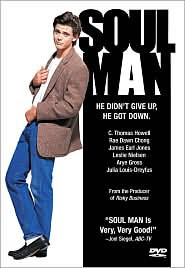
New World, which had recently purchased Marvel from Cadence Industries two years earlier, was shopping its movie properties, including the recently released, racially insulting Soul Man with C. Thomas Howell playing a white teenager taking advantage of Affirmative Action laws by wearing blackface to get accepted into Harvard, where he falls for Rae Dawn Chong who never suspects the subterfuge; and its animated shows—which it acquired with its purchase of Marvel—such as Spider-Man and His Amazing Friends. The company was also touting a new RoboCop cartoon which is planned to release later in the year. Given the in-your-face, extreme violence of the classic Paul Verhoeven political satire—the scene of Officer Murphy death is particularly acute—I found an animated interpretation to be an odd choice. New World went so far as to borrow a RoboCop outfit from Orion Films, which made the original movie, so they could feature the character at their booth along with Spider-Man. A fellow Marvel Personal Appearance actor, Dave, was chosen for the assignment. He, too, made Spidey appearances, as well as Captain America when the need arose.

The RoboCop suit came in a crate the size of a small East-European country and looked like a DIY automobile kit. One actually needed a socket wrench to put it on! Needless, to say, Dave wasn’t drinking much coffee at the show. Once on, the costume remained bolted to his body until the end of the day. Fortunately, the helmet was easily removable. Dave swore it was comfortable to wear, but when he removed the helmet after wearing the suit, it looked as if he’d just been water-boarded. Whatever unpleasantness the RoboCop outfit caused, it was never apparent in Dave’s portrayal of the character which was spot-on.

Still a relative virgin to convention-booth etiquette, I roamed the show like a Bedouin, bounding along the show aisles and in and out of booths with impunity. Little did I realize that mascots were verboten to move from their respective booths. And visiting a foreign booth was considered a severe faux pas. Staying in the booth may have crossed my mind before my initial jaunt, but the New World Entertainment booth was dead and the execs therein gave RoboCop and Spider-Man all the consideration of a bicycle at a car show. It was as if the characters were foisted upon them without their blessing. Instead of harnessing the power and attention that come from life-sized, animated representations of pop cultural icons to sell the product, the booth bigwigs escorted prospective clients past Dave and I without so much as a “Hi, Spidey!” regardless of the excited reactions of the clients they led. We were lucky to get an “Excuse me,” if we were blocking their route to the meeting area. Dave and I figured we’d would do more good as Pied Pipers, spreading the company’s word on the byways of the show floor, and leading potential buyers back.

Oh, who am I kidding? The NATPE convention is a celebrity candy store, albeit a B-list celebrity candy store with the occasional truffle, but one nonetheless. Studios go to great expense shipping in the so-called stars of the shows they are selling to schmooze with buyers. Most even provided Polaroids with them. My most exciting celebrity moment up to that point—barring meeting the creator of Spider-Man Stan Lee the year before—was meeting Bozo the Clown when I was a handful of years old, and that experience went pear-shaped when in response to his approach I screamed and fled like a Catholic at a mohel nudist colony. So when I saw celebs wandering the show floor like the cast of a George Romero flick, I had to partake in the carnage.
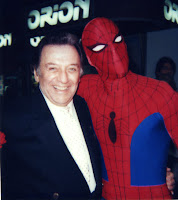
All at once, Norm Crosby, a former stand-up comedian of the Borsht Belt known for malapropism, who can be seen in original reruns of the Hollywood Squares, was Paul Newman in my eyes. Such groaners of malapropism as “Good evening, ladies and germs!” and “I resemble that remark” for a fleeting moment were like unto Shakespeare and now I had the opportunity to get my picture taken with this genius of jargon.

Speaking of Hollywood Squares, isn’t that the John Davidson, host of the new version of the venerable game-show classic, with show regulars John J. Bullock and Shaddoe Stevens? John J. and Shaddoe who?! Exactly. These were celebs that wouldn’t even make the cut for the Surreal Life. Yet, I had to get my picture with them.

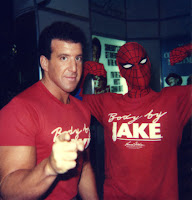
I also plied the floor when not in costume, but it was more fun and garnered greater reactions as Spidey, the mustache I had at the time that made me look like I’d walked off the set of a 70s porn flick notwithstanding. What was I thinking when I grew that upper-lip merkin?!! The only thing more ill-conceived was my decision to pose as Spider-Man with Jake of Body By Jake fame . . . in biceps-flexing mode no less! As frail and pathetic as I look next to him, I should be thankful my meager muscles were concealed behind the free T-shirt I scored at the time. Of course, Peter Parker was initially portrayed as frail in the comics, and Steve Ditko, the Web-Spinner’s debut delineator, kept him more wiry than muscular when in costume. But his successor, John Romita began packing some meat onto Parker’s feeble physique and, though never depicted in the same weight class as the Hulk or Thor, Spidey has yet to return to the scrawny nerd he once was. Still, with the tromp l’oeil effect the suit cast—which made its wearer appear one dimensional and subsequently less substantial—standing next to Jake’s massive frame made me look like a child trying on his father’s shirts.
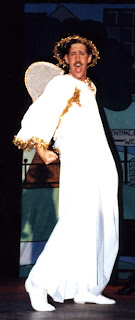
At least the costume also hid the ’stache. I shamefully have to admit that this was not the first time I had grown such a hirsute facial eyesore. Less than a half-dozen years earlier, I grew one for a musical review in which I was performing, entitled Broadway in the Park, at a summer theater production in Manchester-By-The-Sea, Massachusetts. What began as my being lazy and not wanting to shave worked for my role as a womanizer whose lascivious ways were but a defensive front for a sensitive soul in search of true love (No, I haven’t lost the plot. Bear with me. I promise that this will lead back to Houston… eventually). In the show, clad as an angel complete with halo and wings, I sang “Beauty School Dropout” from Grease. The mustache looked especially off-putting against the beatific backdrop. It was a song which I was already familiar having sung it in the small group of my high school’s glee club a few years prior, only sans facial hair.
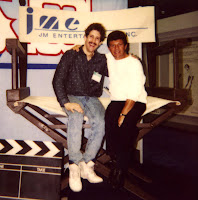
So imagine my excitement when I espied Frankie Avalon, the song’s titular crooner in the 1978 mega-successful Grease movie adaptation, offering pictures to passing fans (See, we’re back…). I haven’t the foggiest what he was promoting, but he sat in an oversized director’s chair which served as a tableau for the photos. I recall telling him that the picture was for my mom, as if I was embarrassed to have my photo taken with him. I should have been more ashamed by drawing attention to his antiquated celebrity status with my comment. When I showed my mom the photo months later, she couldn’t have cared less.
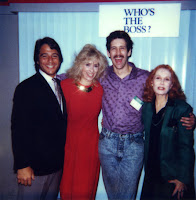
Though never a fan of Who’s the Boss? I consider Taxi and Soap to be two of the best sitcoms in television history, so I was stoked to get a photo with both Tony Danza and Katherine Helmond as the shit-eatin’ grin on my face can attest.

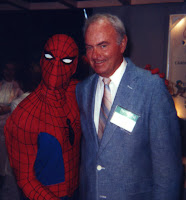
The knowledge that Harvey Korman was a pain-in-the-ass on the set of The Carol Burnett Show and could be even nastier offset was unbeknownst to me at the time and would come as a surprise years later when it was revealed in various televised retrospectives which aired after his death in 2008. With Spider-Man, he was cordial and willing to have his picture taken. Korman—attending to promote Carol Burnett and Friends—is known more for his starring role on Burnett’s show and hilarious role as Hedley Lamarr in Blazing Saddles. But in my eyes (or ears) Korman will first and foremost always be The Great Gazoo, the floating green alien that befriended Fred and Barney in the final season of The Flintstones, the series’ jump-the-shark moment. Had the series not ended that year, it surely would have the following one. It was as telling an indication that a show had outrun its course as the addition of Cousin Oliver to The Brady Bunch in its fifth and final season. The charm of The Flintstones was the zany predicaments the two leads found themselves in set against a prehistoric canvas. Though I loved The Great Gazoo as a stand-alone character, his ability to snap his fingers to ameliorate any problem coupled with his futuristic qualities was anathema to the series.
Oftentimes when gigging at a convention my badge would end up reading “Spider-Man,” which made for more than a few awkward moments to say nothing about blowing my cover when taking a break. But occasionally it worked in my favor. Such was the case when I met a young, eighteen-year-old Jason Bateman, who was at the show promoting The Hogan Family, the forgettable Valerie spin-off that changed its name after original star Valerie Harper left the show to be replaced with Sandy “Wheat Thins” Duncan. I never even watched Valerie never mind The Hogan Family, so how I recognized or gave a whit about taking a picture with Bateman baffles me. Again, the overpowering allure of NATPE held sway (Must… get… photo… with… celebrity…).

When Bateman saw “Spider-Man” on my badge, he was so excited he gushed over me like Carrie Bradshaw over a new pair of Manolo Blahniks. “You’re the guy in the Spider-Man suit? That is so cool. What’s it like to be Spider-Man? Do you know Stan Lee?” I barely had time for a few mono-syllabic grunts betwixt his excited queries. Meanwhile, Bateman held up the line of TV executives awaiting a picture with the young star for a good ten minutes. Finally, one of the suits at Bateman’s booth had to intervene. The picture was shot and we exchanged a heartfelt handshake before my departure. But I could overhear Bateman speaking with the next person stepping up for a photo as I left: “Do you know who that was? That was Spider-Man!”

Toward the end of the first day, I began to get the first inklings that perhaps my Spider-Man jaunts throughout the show were not acceptable. There were the occasional queries from other booth workers, unemployed actors, spokespeople and models dressed in various thematic dress, like the extras at the Body By Jake booth clad in workout gear and those in the Disney pavilion looking as if they’d just stepped off of Main Street at the Magic Kingdom. “Are you supposed to be in here?” “We were told that we couldn’t leave the booth.” Most were curious or didn’t care. Others were less accepting: “You know, you’re not supposed to be here?” But I was never approached by the show staff, nor admonished by the New World people, who were also not rebuked for their characters being out of line. So I was not deterred…

“Spider-Man! C’mere!” A booming voice echoed above the din.

I froze. Uh, oh.

“I said Spider-Man! Get over here!”

I was in the main central aisle. Beneath the mask, my eyes darted about, as my actions belay any concern.

“Wall-Crawling webbed wonder of the weak…over here!”

Finally, his voice stayed on the line long enough for my senses to trace, so to speak. In the distance, a good fifty feet away, standing upon a dais stood my assailant. Had he not been beckoning me with exaggerated sweeps of his arms, I might have missed him with my limited vision. I approached cautiously. Slowly, features emerged: black suit, shiny purple tie, glasses, big toothy smile… the Heat Miser hairdo clinched it. Don King was grinning like the Cheshire Cat, orating my approach like he were introducing his latest boxing phenom. “Here he is, ladies and gentleman… that hero of heroes… the arachnid arbiter of the unrighteous… the blue-and-red ridder of the repugnant…”
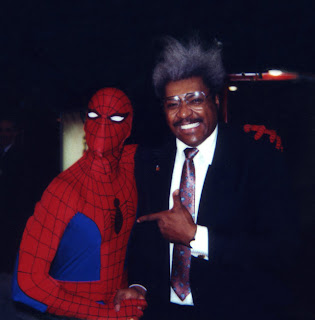
The alliterative epithets came ceaselessly, and senselessly, the more he bellowed. I don’t even think King knew what he was saying by the time I reached him. And it didn’t matter. His larger-than-life persona was infectious. He may have been an unscrupulous, double-dealing, unethical boxing promoter, as the stories attest, But I didn’t care. I loved the man. And he loved Spider-Man. I think he had the photographer take a dozen pictures before he gave me one. He was gushing and giddy and shook my hand the entire time. I half-expected him to Snoopy-dance around me at any moment. When I finally departed his side, his boisterous pronouncements began anew, but this time they weren’t directed to me or anyone in particular. “Spider-Man! I got my picture with Spider-Man! Can you believe it? Spider-Man!”

But my adventures at NATPE were about to take a disturbing turn…

Maybe it was the distance from the New World Entertainment booth, farther than I had gone to that point in the costume during the show. Maybe it was her booth’s proximity to Disney’s, which I was intending to visit to see if I could cop a shot with Mickey without their staff realizing it (A photo of Spider-Man and Mickey Mouse would have so upset Disney, but would have been ultimately cool in a Superman vs. Spider-Man sort of way). Perhaps I’d caught a wisp of a conversation about Bill Dailey signing autographs at her booth. Or maybe it was some pheromonal siren song she was secreting from her glands. But suddenly I found myself discovery the true meaning of Leave it to Beaver.

I was in the Telvan Productions booth, a syndications arm of Universal. I didn’t know this at the time. I just wanted a signed picture by Bill Dailey, Major Roger Healey on I Dream of Jeannie and Bob Newhart’s neighbor on his original eponymous TV series. I didn’t realize that Telvan also syndicated an update of Leave it to Beaver, called Still the Beaver (I guess Beaver Hunt was taken) until, as I kibitzed with the attendees in line, masking my intent on getting an autograph myself, I felt a hand slide down the back of my suit and heard a sultry, yet a vaguely familiar, voice say, “My, aren’t you nice.” I turned—shifting my body just before the hand crested my ass cheek—and found myself face-to-face with June Cleaver aka Barbara Billingsley.

Leave it to Beaver was a childhood love. It ran every morning before I had to leave for school and I never missed an episode, watching every moment from June seeing Ward off to work, and Wally and “The Beav” off to school during the opening credits to Beaver’s walk along the curb on his way home during the closing credits. I remember noticing the name of the hair stylist for the show one day, because she had the same first name as my mom, “Florence,” and a last name that appropriately fit her vocation, “Bush” (Come to think of it, it fit the title of the show as well, but I certainly didn’t realize that in elementary school.). Years later, while working for the media department as my work study while attending Boston University, I showed Psycho, and who do you suppose was the hair stylist for the Hitchcock classic? Florence Bush!

So there I was getting hit on by Theodore Cleaver’s mom. It would have been only marginally less disturbing had she just been a much older woman. I later discovered that Barbara Billingsley was born on December 22, 1915, which made her 71 years old at the time! I was a year out of college. But you wouldn’t know it. She looked amazing for her age. But she was only a few years younger than my grandmother!

She stood partially behind a counter with her back to a wall of the booth, so no one noticed her hand move along my arm when she ask me my name.

“S-s-spider-Man,” I heard myself stammer.

She pursed her lips and actually tsk-tsked me, before replying, “Oh-h-h, you know what I mean…”

Her hand started traveling down again, and I was in severe danger of my body putting me in a position where I couldn’t move from the booth even if I wanted to. Suddenly, the phrase, “Ward, haven’t you been a little hard on the Beaver?” had a whole new meaning.

With an agile hop backward, I a said, “I can’t tell you that. I have a secret identity to uphold,” then bound from the booth with my web-shooters still intact.

During my break, I came back to get Bill Dailey’s autograph. Billingsley was still there and it took all the self-control I could muster not to ask her for an autograph and, when asked who she should make it out to, answer “Spider-Man!” With my luck, she’d be even more excited. I understand that W.B. Mason look was all the rage in her time.