Sunday, April 19, 2009

Houston, We Have a Problem

The Spider-Man suit was brilliantly crafted—comfortable, functional and visually stunning. It worked on anyone from 5'9" to 6'3". It’s ease of transport made it possible to fit in any over-the-shoulder bag as small as a Ziploc. I never had to waste time at the baggage carousel, or worry that the suit might get lost in transit.

It was resilient, too. Most holes occurred along the seams and it was not rare to see me repairing the costume on flights to appearances. I still have more than a few mending kits from hotel rooms across the country. I only encountered one irreparable rip during my Spider-Man tenure, but it was a doozy.

I was flown to Houston for a week of appearances. The day I landed I was quickly hustled to a street fair downtown, changing in the car of my host along the way. It was a Sunday, and that, coupled with the street fair—which was a huge annual event for the city—ensured that businesses were closed and the blocks surrounding the area of the fair were deserted. It was eerie and more than a little I Am Legend. But after parking, I only had to bound a few blocks before I was met with what seemed like the entire population of Houston gathered in the city’s central park for the event.

I immediately looked for prospective perching spots. My host did not have a booth of any sort, so she just picked a street corner that wouldn’t interfere with any other booths. The only thing in the vicinity was a newspaper-vending machine...a wobbly newspaper-vending machine. I checked it before my ascent and though it shook, it wasn’t in danger of collapsing or falling over, so up I went. The host offered free photos and the box proved a perfect height for fans to stand before for pictures.

Normally, I could stay in a crouched position for upwards of an hour, signing autographs and posing for photos the whole while. When my knees couldn’t take it any longer, I’d leap off. I must have overstayed my usual time limit on the box, as I felt my ankles and feet go numb or rather didn’t feel them at all. Okay, time to leap off. But given the unstable condition of the vending machine and the fact that I couldn’t feel my feet, I was concerned I might break or twist an ankle upon landing. Thus, I tried to “cheat” off the box, without broadcasting my predicament.

According to Shakespeare “The best laid plans of mice and men often go awry.” You can add spiders to that list. A bit of the costume under my right butt cheek caught the corner of the vending machine and “R-I-I-I-P!!! The ass of the suit was torn wide open, exposing my cute candy-cane–striped bikini briefs. I guess it could have been worse. They could have had “wittle duckies” on them.

I stood stock-still for a moment, keeping my overexposed gluteus maximus against the front of the vending machine, like an inebriated worker on the copy machine at the annual holiday party. I can only imagine the Rorschach design my backside created on the vending machine’s display window, but I’d bet even money it didn’t look like a butterfly. My only hope was that none of my fans had noticed. Thankfully the form-fitting design of the costume kept the effects of the damage contained around my right “cheek,” so unless I left the protection of the vending machine, my little problem went unnoticed. This ignorance extended to my host, who continued to escort people forward to get their picture taken with Spidey without hesitation. I posed best I could, all the while trying to get my host’s attention. I finally had to interrupt her and ask her to come over to me. I whispered the situation into her ear. True to human nature, her immediate reaction was to look toward my butt. I stopped her.

“Trust me,” I said, “the cooler than usual wind against my ass cheek tells me it’s hanging out.”

My answer came in the form of a windbreaker one of my fans was wearing, which they graciously agreed to let me borrow. For the remainder of the day, I posed with the windbreaker tied around my waist. Most people didn’t notice or question its presence. My explanation to those who did was that I’d had a run-in with Electro on my way down from New York and he zapped a hole in the backside of my suit before I subdued him.

I couldn’t rightly take my savior’s jacket with me when I was done, so I hightailed it (pun intended) back to the car with my host playing interference behind me. Still, I was barraged by a bevy of colorful offers and marriage proposals along the way. Boy, was my face red, both inside and out!

Monday, April 13, 2009

Webheads II: The Screamer, The No-No and The Return Engagement

Continuing my award-winning series on the types of fans I encountered at my Spider-Man gigs, I showcase a trio diametrically opposed to the example of which I spoke in the previous installment (Still, available for your viewing pleasure at www.heroesinmycloset.com. Check local listings.). None of the children pictured in this post represent the categories under discussion. They are here merely to help lighten the subject matter, add a splash or three of color and satisfy those blogophiles who do not like a lot of words. And no, I do not have photos of children that would correspond to those I am about to mention (Shame on any who want to see such!)

THE SCREAMER:
Unconsolable, The Screamer screams . . . always! From the moment they first lay eyes on Spidey, a banshee wail erupts from their tiny forms, and nothing short of leaving the store will assuage their hysterics. At least, I can only assume their screaming stops when they depart, as it's the only time one can’t hear them. I understood why there were children afraid of Spider-Man. I had a featureless face; my eyes were big iris-free blobs of white, rimmed with black that extended up at either outer corner like a feline's; I spoke without a mouth, my entire face shifting when doing so; and the inhuman body posture could be unnerving. Even kids who worshipped the Web-Slinger—showing up wearing their Spider-Man Underoos—would occasionally flip-out. For them, it was a case of emotional overload at finally meeting their idol. Heck, there were adults, man and woman alike, who would run screaming when they saw Spider-Man (I’d hate to think what would happen if I wasn’t wearing a mask—cue drum riff).

Still, it didn’t make me feel any less bad when children were scared and cried. But The Screamer tore out my heart. It’s like I’d killed their dog or stolen their favorite toy. I’d turn to them and say in my softest most unthreatening tone, “I’m sorry,” only to be greeted with an even more blood-curdling scream. I’d know better than to even look in their direction, let alone speak to them, but I couldn’t help myself. I felt so terrible that I had done this to them.

And distance had no effect, The Screamer could notice Spider-Man from the furthest point in the store and “Aaaaaaaahhhhhhh!” I felt badly for the parent who held The Screamer, as well. They’d put a stranglehold on Mommy or Daddy, the likes of which would make a professional wrestler envious, and all the while screaming in their parents’ ears as they squirmed and tried to push mom or dad away from Spider-Man while in their arms.

THE NO-NO
A less dramatic off-shoot of The Screamer was The No-No. In lieu of screaming, these children uttered “no-no, no-no, no-no” in an incessant staccato as if approaching the door to the dentist’s office. They’d still wriggle furiously to get away while in their parent’s arms, much the same as The Screamer, only without the need for ear plugs. More often than not, The No-No would evolve into The Screamer. This would usually happen with a parent insensitive to his or her child’s wishes and went something like this:

The parent—with child in arms—espies the line or crowd from afar and approaches. Maybe the parent even knows of Spider-Man’s appearance and wants to surprise his or her little one.

“What’s going on over there, [insert child’s name]?” Sometimes asked innocently, sometimes uttered with premeditation.

“Look, [insert child’s name]. It’s Spider-Man.”

Despite all the great qualities of the Spidey suit—it’s nigh-perfect interpretation of the character; the ease of movement and relative comfort for the wearer; the vibrancy of its colors; the facility in its tranportation, cleaning and upkeep—it did present an odd downside: one-dimensionality, a tromp l’oeil effect that flattened the character, making him appear like a cardboard cutout, i.e. not real. From afar the affect is more pronounced. A child may not “see” me, even though directly looking at me, or sees Spider-Man, but thinks it is just a display.

Then, I move. My head turns toward the next child in line or a parent, as I deliver a quip or answer a question; it could be a movement as small as Spidey’s hand signing…

“no-no, no-no, no-no, no-no, no-no…” It begins…

In the case of a caring parent:

“Okay, Sweetie. It’s okay. He won’t hurt you. He’s a good guy.” As the child is swiftly redirected away from the signing area.

But I’m exemplifying a bad parent, so after the “no-no”s begin…

The parent continues toward Spider-Man, despite the child’s protestations, the volume and speed of delivering the “no-no”s inversely proportional to the distance from the Web-Swinger…

“C’mon, Honey. Don’t you want to get Spider-Man’s autograph?”

No, you insensitive jerk, they obviously don’t. That’s why they
re wriggling like a fresh-caught Marlin and shaking like a margherita machine, not to mention the continuous ‘No-no”s, which grow in intensity until…

“no-no, no-no, NO-NO, NO-NO-e-e-e-e-e-E-E-E-E-E-E-E-E-E!!!!”

There is no sound on Earth quite so piercing as the scream of a small child. Fire engines get out of the way, when they hear its approach.

It is only at this point that the parent turns away…

“That’s okay…okay…we’re going…” with all the sincerity of an apologizing waiter who has to return to the kitchen with your steak that wasn’t cooked properly.

And worse is the toothy smile these shameful parents sport when they’ve achieved scream-age. They knew their kid was going to scream, the sadistic bastards. The whole grotesque scene was staged for their sick thrills.


THE RETURN-ENGAGEMENT:
Another off-shoot of The Screamer, The Return Engagement begins his or her Spider-Man experience as such but returns, either of their own volition, with the prompting of their folks or by coveting the prize they see their brother or sister holding. Suddenly gone is the terror they so recently experienced. They want a comic dammit and they’re not going to let their parents leave until they’ve gotten one. They scarcely hear their parents chiding as they turn back toward the signing area. Rather than commend the kid for overcoming their fears in order to give a difficult task another go, parents would get pissy toward their child when he or she wanted to try and see Spidey again after an initial first attempt.

“If you cry again, we’re not going back,” they’d admonish. Or worse, a threat: “If we wait in that line again, you’d better not behave the way you did last time.”

The kicker was the perturbed parent who, when their little one wanted to return to see Spider-Man, grabbed their arm and pulled them toward the exit with a “No, I am not going to stand in that line again. You had your chance!” Some added the infamous, “You’d better stop crying or I’ll really give you something to cry about.” Would any of these callous moms and dads react similarly if their kid reattempted to ride a bicycle without training wheels or swim in the deep end of the pool for the first time?


No-Nos never transcended to this category. Rather, the occasional Returner transmuted to a No-No when their fear of Spider-Man turned out to be too great to overcome after all.

“If we get back in line, you’re not going to scream, right?”

Hell, if my brother/sister can do it, I certainly can.

“We’re not coming back a second time . . .”

How hard could it be. Spider-Man is a good guy . . . right?

“Get ready . . . there he is . . .”

I’ll just walk up, take my comic and—“no. no, no, NO, NO, NOOOOOO!”

If I noticed a Return-Engagement, I’d excuse myself from the child I was attending to and make sure the Return-Engagement received a comic from me—either via a sibling, parent or adult nearby—before the Return-Engagement was hustled away by Mom or Dad.

There were those occasional stories, whereby a Return-Engagement faced me successfully with their second attempt. Time would stand still as they drew closer and closer to Spider-Man. An audible hush would still the crowd. Screamer’s were rarely forgotten and quickly gained a reputation that no change in their nom de guerre would extinguish.

The suspense rises and a silent gasp is felt as the child hesitates . . . before proceeding. Now the name. The child’s mouth opens... The tension is palpable. Will it be another scream?

“Sally.”

And the child skips back to their parents.

“Another satisfied customer,” I’d playfully say, breaking up my onlookers and the mood.

Monday, April 6, 2009

Quiet Nights by Diana Krall


I picked up Diana Krall’s recently released CD, Quiet Nights, this weekend and have been playing it like a four-year-old with a Wiggles DVD, i.e. incessantly. I have always had a penchant for standards that goes back to when I was a child digging into my Mom’s 45s (small vinyls with a single song per side for the young’uns in the audience) and discovering the likes of Sammy Davis Jr. singing That Old Black Magic, a version that exemplifies Davis as not merely a great singer, but also one of the finest entertainers of any era.

The secret and challenge in performing standards is not to over-sing them; there is no need. Composers such as Johnny Mercer, George and Ira Gershwin, Hoagy Carmichael, et al were geniuses in their ability to weave deceptively simple, yet rich melodies that endure and continue to win over successive generations of fans, regardless of who is singing them. The better entertainers, such as Tony Bennet, Ella Fitzgerald and the aforementioned Davis, are adept at doing this while still making the songs their own.

One need only look at the success of Rod Stewart’s four consecutive top-selling collections of American standards as proof of the power of the genre. A lifetime of excesses have not been kind to the legendary rocker’s voice, which sounds like Brenda Vaccaro with a cold. But the moment music producers propped him in front of a mike with some tunes by Irving Berlin and Cole Porter, Stewart’s stock soared once again. He offers little by way of interpretation, but is wise enough not to impose himself onto the tunes. He simply sings them; the songs do the rest.

Krall has been performing standards from a young age, but what raises her performances above others are her breathy, seductive voice, jazzy interpretations and deft piano playing, a winning combination she continues in Quiet Nights. There is a warm, cozy feel to the collection’s ten tunes (twelve in the expanded CD) that is as inviting as a home-cooked meal or enjoying the company of another on a cold winter’s night with a bottle of wine before a crackling fire. Krall doesn’t force the tunes; instead allowing the melodies to be the focus, while still making her mark with occasional piano flourishes, economic pauses and subtle tempo changes.

Compounding the challenge to covering standards is their ubiquity; most have been done to death, and thus more difficult to raise above the fray. Krall wisely chooses some lesser-performed tunes and adds a 60s cover to the regular edition (and a 70s cover to the expanded one) to help keep the collection fresh. Still, she covers at least two songs—Where or When and The Girl From Ipanema (“boy” understandably traded for “girl”)—that could certainly be perceived as overdone. She succeeds in the former with an uptempo version that presents the Lorenz Hart/Richard Rogers classic in a refreshing matter-of-fact way that makes the subject matter more poignant than the maudlin, slow-tempo versions that abound.

Her interpretation of the latter Carlos Antonio Jobim tune is brilliant. As she begins, her tone is that of an uninterested observer, describing the paradigm of manhood that all other women adore. But as she gets to the signature “Ah-h-h-h,” her own desire begins to betray her cool reserve. Her composure reverts at the start of verse two, but crumbles even more quickly as her description becomes more suggestive. By the bridge, her exposure is complete. Her voice acquires a dreamier tone which grows more hopeful as she sings through the phrasing, taking on a note of petulance as the boy continues toward the sea without a hint of regard for the desirous chanteuse. Still, when she “smiles,” her tone is most hopeful, as if the singer is performing this last ditch effort for attention just as she hits the word, only to descend into disappointment immediately thereafter. It is during the short piano solo where Krall’s strength and advantage over other “standard bearers” lie. She even interpolates a chord from a later song from the CD, So Nice, the similar theme of which is captured in the lyrics to the chord she homages (“Someone to hold me tight/that would be very nice”).

Another standout is I’ve Grown Accustomed to His Face (again, a trade: his” for “her”). This Alan Jay Lerner/Frederick Loewe number from the popular musical, My Fair Lady is the one moment in the show that Henry Higgins lets down his aloof, professorial guard, displaying his true feelings for Eliza Doolittle. It is a song famously “spoken” by Rex Harrison in the original production. Sung from a female perspective with the lovely voicing of Krall, the tune tears at the heart. In the show, there is no doubt Higgins will eventually get the girl, but Krall sings as if her discovery has come too late; there is no additional scene to save the day, just the plaintive words of a woman who let love slip away. Gets me every time.

Quiet Nights isn’t going to convert someone to standards who doesn’t like them, the way the best Black Sabbath album isn’t going to change the minds of anyone who doesn’t like heavy metal. But if you are a fan of the genre, Krall’s latest is a treat.

Quiet Nights receives 4.5 out of 5 spiders.

Monday, March 30, 2009

The Coming of Vroom!

More than a few of my blogophiles have noticed that my entries are signed Vroom! and have rightly queried whence the title comes. Sit back my faithful and enjoy. They’ll be a quiz in the morning.

As the creator of such iconic comic characters as Spider-Man, Incredible Hulk, Fantastic Four and Iron Man, Stan Lee is known and loved the world over. And anyone fortunate enough to have met him, knows him as a boisterous, affable and warm person, whose flamboyant hucksterism might appear insincere at first glance, but quickly reveals itself to be charming and genuine, not the least bit unctuous. Stan truly loves his characters, and that love is only matched if not surpassed by his love and appreciation for the devotion the fans have for his creations.

But Stan is also notorious for having a terrible memory when it comes to remembering people’s names, a debatable weakness in character that he is the first to admit having. One gets the sense that, had Stan his way, he’d recall the name of every person from hotel doorman to infant swaddled in Spider-Man onesies that he meets on his journeys, regardless of how scant the encounter.


This problem extends to comic book professionals as well. Having left the day-to-day rigors of the Marvel offices years ago, only sporadically writing a special one-shot story—say, for the 500th issue of Amazing Spider-Man or in regard to some other such prevalent event—and handling that work from his home or personal office, he rarely, if ever, faces the industry’s current crop of talent. Not that he doesn’t keep tabs on the field. Stan still loves the medium and follows it religiously. But though he’ll recognize a current writer or artist’s name, he won’t necessarily recall what titles that pro is working on or known for, never mind having a clue as to what he or she looks like.

This was even true in the mid-eighties when I was portraying his most famous character at a time when comics were still the milieu of comic aficionados (read, “geeks”), outside the mainstream. Today comic books (or “graphic novels” to which they are referred by those who still have a stigma against using the term “comic books”) from Spider-Man to Persepolis to Watchmen have gained greater respect and have become rooted in the public consciousness.

I was unaware of Stan’s “flaw” when I started doing Spider-Man gigs with him. It first came to my attention at the Mid-Ohio Con, an annual comic-book convention in Mansfield, Ohio. Spider-Man was appearing with his creator and a bevy of other comic book professionals. As was the case, I was stationed next to Stan at his signing table where we humorously bantered about what Stan put me (Spidey) through in the books. I also noticed that he would sometimes refer to me (Spidey) as “son.” That was how he regarded the Web-Slinger, so near and dear to his heart Spider-Man was.

As this was a comic-book convention, most everyone attending genuflected before Stan, who abashedly would beg their humility and always offer a self-deprecating comment about his work and the adulation bestowed upon him. More often than not the fans would also get Spidey’s autograph, though quite a few preferred not to mar the sanctity of the book now blessed with the signature of their beloved hero Stan Lee. My feelings were never bruised by this. I understood completely and probably would have acted the same way.

When my offer to sign their comic was met with refusal, I would joke “I don’t blame you. What’s saving the world a few times over compared to penning a handful of funny books?” Or I’d make a more pronounced reference to Spider-Man, grumbling “Probably reads The Daily Bugle; believes all those disparaging comments made by J. Jonah Jameson about my being a ‘menace to society’ . . . Sheesh!” These playful comments always got a chuckle from Stan and the fans.

(Above; left to right: writer Mark Verheiden, artist Mark Nelson, artist Marie Severin, Stan Lee and yours truly at a convention in Edmonton, Canada)

Occasionally, a parent would attend for the sole purpose of having their children meet Spider-Man. Mom or Dad or sometimes both would dutifully stand in line with their charges but, when they reached Stan, the kids walked past, beelining to yours truly and delivering a hearty “Hi, Spider-Man,” while paying no heed to the strange old man behind the table. Stan would never acknowledge the slight—to him there wasn’t one—instead enjoying watching the children interact with his “son,” like a proud papa. Inevitably, the parent would notice Stan and ask, “Are you anyone?” to which Stan would good-humoredly reply, “Naw, I’m lost; I thought this was the Bingo hall,” or “I just came in here to get warm.”

Even the other guest professionals would stop by, when they were on break or during a lull at their respective tables, to meet Stan. After all, he was Stan Lee, architect of the Marvel Universe, creator of Spider-Man and so many other superheroes, and as such an inspiration, instrumental in their being in the business. Stan would greet them warmly with a vigorous handshake and copious “Aw, shucks, t’weren’t nothin’”s when they thanked him for all Stan had done for them. As they walked away, Stan would lean over to me and ask, “Who was that?”

When this first happened, I was taken aback a moment. The way Stan had so heartily spoken with the pro, one would have never suspected that he hadn’t a clue who he had just met. I do not fault Stan for not asking the pro who he or she was; it would be awkward after the person basically deified Stan for him to ask, “Who are you? What do you do?” Not to mention potentially crushing the professionals feelings.

Being a comic-book geek myself, I had all the information Stan needed. “That’s Joe Public. He’s draws SuperDuper Guy for Splendiforous Comix,” I’d reply quietly enough so that the next fan in line getting their autographs wouldn’t hear. It certainly helped that no one could see my mouth in costume. Stan always recognized the name and the series on which they worked and usually in a tone that suggested he enjoyed the work. From that point on, I would surreptitiously lean into Stan and whisper any pertinent information to him when a comic-book professional approached. This way he knew the person’s significance before he greeted them. And as the resident comic-book expert cum Spider-Man actor, I was most often the one to accompany Stan at comic events.


I even acted his Cyrano when not in costume, just more circumspect as my mouth was exposed. It got so Stan naturally leaned toward me when someone that he wanted the goods on approached, much like Anne Hathaway’s Andy Sachs in The Devil Wears Prada in the scene at the industry gala wherein she has to feed Meryl Streep’s Miranda Priestly the three-sentence bio on the VIPs as they arrived, so Miranda would greet them accordingly.

Still, given Stan’s memory or lack thereof when it came to names, I have no doubt I’d have had to reacquaint him with my name at every new event had it not been for one incident at the Mid-Ohio Con. While waiting for one of the other guests who would be accompanying the show promoter, Stan and me for dinner, Stan asked the origin of my last name (Of course, this followed his asking my last name to begin with, since he had characteristically forgotten it).

Understandably, as a consummate wordsmith, Stan loves words, their origins, usage and clever juxtapositions. He spent his tour in the army writing copy for posters that warned GIs of the dangers of contracting VD, and did so in a clever manner that proved much more effective than a more dry, surgical approach. I spent hours conversing with him in off hours about words, discussing questions like “How come you always hear of someone being uncouth, but never couth,” or listing the nomenclature for groups of animals, such as a pod of whales or murder of crows, and then suggesting alternatives or making up ones for other groups of creatures, such as a cacophony of clowns.

So when he asked about my last name, he wasn’t just taking an interest to be polite; he really wanted to know. He understood that Vrattos was Greek, but was more curious as to where the odd “v-r” consonant combo derived, since there is no V in the Greek alphabet. Truth be told, I wasn’t sure. My father had never been forthcoming with my surname’s origin, despite my persistent queries growing up. I shame-facedly admitted my ignorance, but quickly made light of my odd last name by saying, “There is only one other word in the English language that begins with a “v-r” . . . Vroom!

The M had nary a second to linger on my lips when Stan exploded in ebullience. “VROOM!” he pronounced, extending both outstretched arms to me. He was so tickled, he was giddy. I couldn’t have been prouder had Bugs Bunny knighted me “Sir Loin of Beef.” From that moment forward, I was known to him as Vroom! and he knows me still by that title today.

Monday, March 23, 2009

Football Hero


Who could forget SuperPro?

Oops, sorry! I mean . . . Who could remember SuperPro?

Not since Peter Puck (seen at right) has there been a lamer marketing ploy by a major sports league. At least the National Hockey League valiantly attempted to build interest in Peter Puck. No such luck for SuperPro.

SuperPro was a forgettable hero created by Marvel for the National Football League. He made his debut in the comics in January 1991, but his greater coming out party was at the big game of 1990: Super Bowl XXV. I’m sure no one needs to be reminded of SuperPro’s origin—he said facetiously—but for those in the audience who’ve been living on a deserted island most of their lives, here’s the skinny:
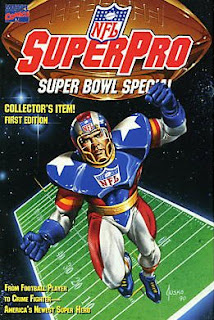
Phil Grayfield was a college all-American linebacker whose injuries sidelined his professional career. As a television investigative sports journalist, he fights evil on and off the field using a suped-up football uniform, originally designed to better protect pro football players, but which proved too costly to manufacture. The suit was primarily red, white, and blue with spot-yellow, and enhanced Phil’s natural athletic abilities. Apparently, the suit reversed the effects of those injuries that ended his career. I mean, really . . . football? Too dangerous. Fighting crime? No problem.

I was pegged for Spidey duty, along with fellow superhero actors Marc and Stewart, who would represent the Hulk and Captain America respectively. As far as any of us heroes knew, the gig was a PR event to promote Marvel. None of us knew of SuperPro. All that changed at a meeting at NFL offices in New York, where we convened one afternoon prior to our leaving. There we got the scoop: The NFL was using the Super Bowl—and the festivities leading up to it—to introduce a new hero, SuperPro. Spider-Man, Captain America and The Incredible Hulk—being internationally recognized heroic icons—would be on hand to introduce NFL’s new hero to the entire world and—more importantly—the media. Essentially we would be the whistles and bells for SuperPro’s coming out party. To spend a paid, week-long trip in Florida, playing Spider-Man at the events leading up to the Super-Bowl, perhaps including a ticket to the game? Yeah, I think I could genuflect before another hero without it bruising my ego.

The NFL didn’t need nor want the help of Marvel’s personal appearance program to find their new hero. Apparently, they felt that no experience was preferable over more than a decade’s worth when it came to hiring a character actor. Actor, Shmactor . . . they found themselves a genuine NFL football player, more precisely a recently retired L.A. Ram.

The former Ram was measured and fitted with a custom-built costume. I never saw the receipt, but the formerhead of the Personal Appearance Department once told me that the Spider-Man suits cost three thousand dollars apiece, and that was just for replacements made off the already-set design. The SuperPro suit had to have cost that much before a single yard of fabric was purchased. I’m guessing ten to twenty thousand, and that isn’t even reflecting an amount for insurance purposes, as the appraisers say on the Antiques Roadshow. It was a bill the NFL almost ate. Less than two weeks before our scheduled departure, the man who would be SuperPro backed out.
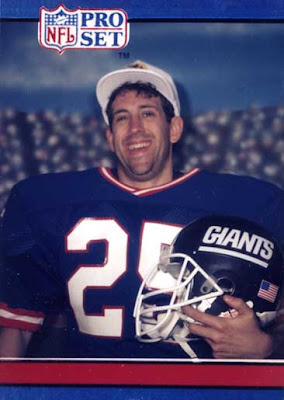
Fortunately the NFL found themselves a replacement, but he wasn’t a former professional football player. The new “Phil Grayfield” was a professional bodybuilder. As far as bodybuilders go, Phil had a neck and could scratch his back without having to rub against a tree. He looked like a cross between Willie Aames of Eight Is Enough and Ian Zeiring from Beverly Hills 90210 only with the body of Lou Ferrigno. He had a good toothy smile and looked like a typical all-American, hot-dogs-and-apple-pie–type of guy. In the SuperPro uniform, Phil looked great, surprising given that he replaced the man for whom the suited was custom fitted. The NFL marketing nabobs obviously thought so as well going by the excited grins on their faces as they paraded him through the NFL offices like a blue-ribbon heifer. (Above l. to r.: Our Phil Grayfield, Marvel Personal Appearance Department head Alison, Marc and Stewart strategize during an NFL dinner before the big game)

Like good second fiddles, we heroes dutifully followed. It was immediately made clear that we were going to have our work cut out for us when it came to spotlighting SuperPro. Phil was certainly nice enough, but he had the charisma of a mannequin. Put up against professional character actors, he all but disappeared. Patrick Swayze had it easy teaching Baby how to dance next to the Herculean task set before us. And of course, being the most iconic of the characters, the onus fell more squarely on my shoulders. (Below: the "Just-Us League" under the stands at Tampa Stadium.)
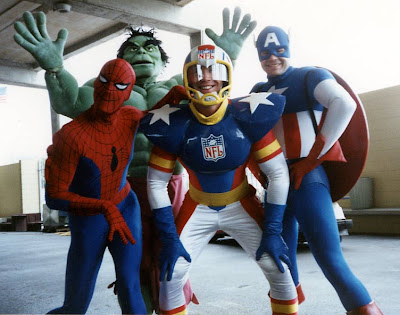

Alison, Marc, Stewart and I flew down on the Saturday the week prior to Super Bowl weekend. The NFL had flown Phil down a day or two prior. This special treatment of Phil was something the three of us “lesser” heroes would have to get used to. Although the game was to be played in Tampa, we flew into Orlando—a quick hour’s drive west—because the recently-opened Walt Disney World Dolphin Hotel was the NFL’s Super Bowl headquarters. We would be rooming there as well, only not the first night. The superheroes were scheduled to appear at a football clinic in Tampa early the next morning.

The flight was uneventful, but as we deplaned the flight crew informed us that the flight was the last Eastern Airlines flight . . . ever. While in the air the company went out of business and the crew was informed that they were out of work. The forced smiles and cheery “B’Bye”s were even more disturbing than usual. I’ve never been more relieved that firearms are not allowed on flights. While Alison began the process of rescheduling our flight home—an unenviable task given she had to find four seats on a flight out of Orlando the day after the most famous annual sporting event in the country, arguably the world, when tens of thousands of people would be flying out—we went to claim our luggage and the trunks holding our costumes. Not the Spider-Man costume, of course. That I carried with me. If the other costumes got lost in transit, at least Marvel’s most famous character would still be available. In fact, I had brought two costumes, just in case. The gig was far too important to risk damage or loss to the suit. Plus, with nearly ten days of continuous use, without access to cleaning facilities, a single costume would smell mighty ripe by the final days.
We were also responsible for shlepping the SuperPro suit around, which traveled in a trunk only slightly smaller that that used to transport the Hulk. And when I say “we,” I mean Alison, Stew, Marc and I; Phil was provided with his own humungous SUV. Wouldn’t want him to break a fingernail and thus jeopardize his SuperPro portrayal all because he was responsible for transporting his own costume.

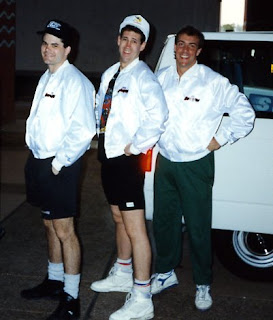
The trunks in question—holding the Hulk and SuperPro costumes—were the same proportion as a steamer trunk, only much bigger. One could easily store an artificial Christmas tree in a trunk, complete with lights, garland several boxes of ornaments, stand, as well as Santa and several reindeer. The Captain America costume fit in a large over-the-shoulder duffel bag. But the shield . . . Oy! Imagine a pizza box designed to hold a garbage can lid or one of those circular metal sleds. A Cadillac from the early seventies wouldn’t be able to transport one of these costume storage facilities in its trunk, never mind two of them, Cap’s shield and costume, four adults and enough luggage for a ten-day trip. So we rented a van and headed for Tampa. (Above: Stewart, yours truly and Marc, stand before our trusty van in our SuperPro jackets)

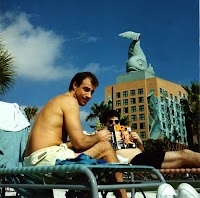
Super BowI XXV was to be played in Tampa Stadium, home of the Buccaneers, but we would be lodging in Orlando—a short hour’s drive from Tampa—for all but the first night of the trip. The reason: The NFL had booked its rooms at the new Dolphin Hotel, located in the Disney World resort area. A companion to the Swan Hotel, which opened January and sat directly next to it, The Dolphin opened in June, a mere seven month prior. It was Disney World’s most luxurious hotel; no surprise then that the NFL was staying there for its most important event of the year. As a part of the Super Bowl festivities, we were staying there as well. But early the following morning of our arrival, SuperPro and the Marvel heroes were scheduled as guests at a football clinic for kids in Tampa. The highlight of the clinic was the participation of some of the NFL’s greatest stars, including Dan Marino, Bernie Kosar, Warren Moon and Ozzie Newsome, who would be overseeing the various activities. (Above: Marc and Stewart enjoy a rare off-day at The Dolphin.)
I couldn’t have been less enthused about meeting Dan Marino, the Hall-of-Fame quarterback for the Miami Dolphins, who were my beloved New England Patriots biggest rival. The only positive from meeting Marino would be the ability to tell friends later that I had met football legend Dan Marino. . . . or so I thought.

After our arrival and change into costume, Alison had the characters split up each to participate in a different activity overseen by an NFL star. Lucky me. I was directed to an area of the field where Dan Marino was throwing passes to a group of kids. Lined beside Marino, the children would one-by-one take off down the field ten to twenty yards, then cut across where Marino would lightly toss the ball to them.

It was a beautiful day: sunny, relatively dry and not too hot. Unfortunately, sunshine reeks havoc with the vision of anyone wearing the Spider-Man costume. The white mesh stretched over the eyes creates what can best be described as snow blindness when one faces the rays of the sun. The expansive field on which the activities were being conducted provided no shadows that might relieve the problem, either. I was able to cheat my way across the field to Marino and the kids, looking askance the sun under the mask while not twisting my head, so I wouldn’t appear drunk and start walking into anyone.

On my way, a young boy approached me. He had broken off from another group that were going off with one of the other NFL players and characters to partake in a different activity. “Hey, are you the guy that wrote that article for Marvel Age?” he asked.
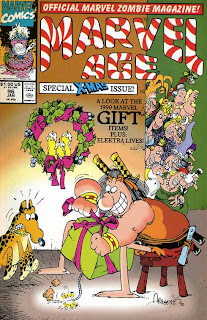
It took a moment to realize to what he was referring. An article I had written for Marvel’s in-house magazine, Marvel Age, had appeared in the issue that was available in December. It was my first writing assignment ever, and I had hopes that it would lead to my writing more articles and eventually the comic books as well.

Marvel Age was similarly packaged as a traditional comic book—same dimension, paper stock and color process—and featured behind-the-scenes articles on everything Marvel, whether that be future storylines; upcoming toy releases and other licensed product, like T-shirts and hats; or new titles that would soon be released. I wrote a half-page piece, entitled “My Life as Spider-Man.” It encapsulated some of my adventures as the company’s most famous character and accompanied a shot of me perched on a table top beside a seated Todd McFarlane, the penciler for the Amazing Spider-Man comic at the time.

It was kind of cool that this kid had enjoyed my article and made a point of finding out if I was the same guy he had read about. At the same time I felt strangely exposed. I was more concerned with landing my first writing gig for Marvel than with “outing” Spider-Man. Fortunately, no one at Marvel seemed to notice.

As I got closer to Marino, the kids toward the back of the line and those who had already had their turn began to swarm around me, eliciting high-fives, shaking my hand and asking the usual array of questions. I immediately struck a pose in a crouched position. I would normally do this anyway when meeting younger to heighten the effect of the costume while also putting me closer to their level, in hopes of setting at ease any of those kids that are freaked out by the experience. But I also wanted to use the children to shade my eyes. Though they averaged twelve years of age, they were tall enough to do the job. Otherwise, I couldn’t see the high-fives coming at me or the hands being extended to shake, let alone the risk of trampling the smaller ones.

"Hey, Spider-Man, why are you in Tampa?” was an immediate query.

“I came to visit my friends in Tampa. Took a bit longer than I anticipated, though. Once I swung out of Manhattan, I ran out of buildings and had to hop a ride on a southbound bus,” I replied. “Fortunately, the Fantastic Four are keeping an eye on things while I’m away.”

“Let’s see you shoot a web,” another asked.

“No can do. I never shoot my webbing irresponsibly, and with great power comes great responsibility. I just hope the Green Goblin doesn’t show up. I didn’t even put my web-shooters on. Otherwise I wouldn’t be able to shake hands with you guys.”

At which point I would go into a short explanation of how I shot webbing, using my middle two finger pressed against the inside of my palm while keeping my wrist bent down so as not to impede its firing. Then I had the kids show me how to shoot webbing if they, too, had a set of web-shooters.

“C’mon, who's next?!”

Dan Marino’s pointed question did little to stem the kids’ enthusiasm for Spider-Man, but it was only then that I noticed—even with my limited eye sight—that he stood alone, and not a single child paid him heed.

For the life of me, I cannot explain what happened next. Maybe my actions were an attempt to return the children’s focus onto Marino or maybe it was pure ego that drove me. There was no think; there was just do. Seeing the line empty, I shot out from the throng of youngsters and passed Marino calling, “Throw me a pass, Dan!” I sped straight out from his right about thirty yards; then cut across in front of him. Only in the instant that I looked toward him did I realize I was in big trouble; all I could make out was a faint, fuzzy blob in the distance.

What a f***ing idiot I am! I can barely make out shapes directly in front of me, never mind twenty yards away. And touch? My hands are covered in slick spandex. If I am even lucky enough to get my hands around the ball, I will only feel it once the ball’s slipped through my grasp. What was I thinking? How bad will it look if Spider-Man misses this catch? Spider-Man CANNOT drop this ball. Stephen Vrattos? PShaw! He can drop the ball, especially one thrown by Dan Marino. But if Spider-Man misses the ball—before the expectant eyes of a dozen or so adoring fans—that could end my short-lived career as the world-renown web-swinger; at the very least, I would never again be chosen for any high-profile events.

Call it divine intervention or Spider-Sense, but my cut cross-field had only taken me about five yards, when I noticed a flash of shadow as the rocket that Dan threw at me eclipsed the sun for a fraction of a second. I could only react. I leapt, shot my arms out and something akin to a head-butt slammed my sternum. Hitting my chest did little to slow the projectile as it caromed upwards, delivering an uppercut to my chin. Good thing to; had the football bounced off me in any other direction I wouldn’t have had the chance to get my arms around it and pull it in. Showing none of the terrifying affects of the experience, I lightly alit, and without losing stride, jogged smoothly back to the fuzzy blob that was Dan Marino, nonchalantly tossing him the ball and delivering a cool, “Thanks, Dan,” before rejoining the children, who were oohing and aahing over what they had just witnessed.

Meanwhile a sharp pain accompanied every breath I took and I could hardly speak; my jaw was numb. It didn’t take a science nerd like Peter Parker to understand that the pass that Marino threw Spider-Man was not the easy lob he administered to the children. And while Spider-Man—or rather the average joe beneath the costume—was certainly no youngster, he wasn’t a professional football player either. And that pass was a rifle, or rather, in football parlance, a shotgun. Marino wanted me to drop that ball. maybe he even hoped it might knock me/Spider-Man down—physically and psychologically; show the kids what a nobody Spider-Man is.

There is every possibility that Marino—having been throwing a seemingly endless stream of unsatisfying easy passes—just reacted like a well-oiled, Hall-of-Fame quarterback to the sight of an adult going out for a pass, the bronco enduring the heft of a cowboy until the gate is finally flung open and he can buck to his heart’s content to throw off the annoying rider. I might buy that explanation if it wasn’t for they way he acted the rest of the day: like a petulant child.

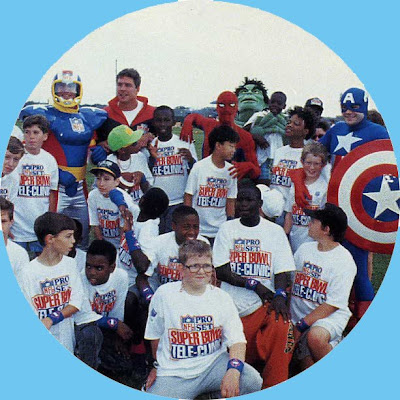
As they day wrapped up, the kids were gathered together with the superheroes and the NFL stars for a group photo. I was directed to stand next to Dan Marino. As the photographer prepared to shoot, I placed my hand—fingers splayed in a traditional Spidey manner—on Marino’s shoulder. He violently shrugged my hand off and spat, “Watch the hair, man!” I was dumbfounded. I wasn’t anywhere near his precious hair, and a simple “Please, don’t touch me”—while still being undeservedly rude—would have sufficed. I didn’t say anything, but remember thinking, “That’s Mr. Man to you, Mr. Dan ‘No-Super-Bowl-Ring’ Marino!”

Monday, March 16, 2009

Webheads I: The Exuberant

Although every child I met, was unique in his or her own way, and I was ever on my toes to expect the unexpected, there were several general categories in which I could place the children that I encountered in my travels...

THE EXUBERANT:
Unfettered with doubt, these kids could hardly restrain themselves in line. They’d practically run past the table when their turn arrived, they were so overcome with excitement. Some would launch themselves into my lap without warning—sometimes to painful results. All would introduce themselves and carry on with me like they’d known Spider-Man personally for years, which, in their minds, they had—through cartoons, books and their parents’ passed-down enjoyment of the character. They’d ask how I was doing; what I was doing in Chillicothe, Ohio on a Sunday afternoon; could they have a comic; whatever. Would he or she like their picture taken with Spider-Man? Hell, yeah! Most times they made it sound like they were doing me a favor by conceding to pose. They were fearless, brash and bold, often surprising their own parents.

There was a little boy I met in a Florida Wal-Mart that could be used as a blueprint for The Exuberant. It wasn’t particularly busy in the store. In fact, I remember wondering where all the children were. The general manager blamed the weather. It was a gorgeous day; people were out enjoying it. At least that was his argument. Listening to him, one might think that mild, sunny days were a rarity in Florida, so unusual that anyone not taking advantage of this headline-making occurrence risks never experiencing another such day for the rest of their lives. Yeah, right. That’s why thousands of Noreasters spend their entire winters here, for the chance—though the odds are stacked well against them—of witnessing a beautiful day here, so they might tell their grandkids one day of the time the sun came out in Florida.

I suspected it had more than a little to do with a lack of promotion on the manager’s part. The prerequisite poster—announcing my arrival with date and time, which Marvel provided—was taped to the front entrance, but when was the last time you tried to push open a door that had a sign on it that read PULL? It happens all the time, because people are inured to posters on shop windows. The sign was most likely all the manager did to promote the event. In fact, I had to enlighten the woman at the customer service desk—who had no prior knowledge of my appearance—to make periodic announcements that Spider-Man was in the store signing free comic books. Apparently, it slipped the General Manager’s mind to undertake even that small gesture of promotion for the event.

My suspicions were confirmed when I was repeatedly confronted by shoppers with “Oh, Spider-Man. I didn’t know you were going to be here,” followed by the even more frustrating, “I would have brought the kids.” What? Haven’t you heard? It’s beautiful out. Everyone’s out enjoying the weather. Except apparently the many parents who were shocked to see me in Wal-Mart.

Fortunately, there was one parent who did make note of the poster. I was standing in the main entranceway, only toward the back of the store. Suddenly, a cry erupted from the entrance. “SPIDER-MAN!” I turned but the midmorning sun streaming through the glass doorway made customers look like the aliens disembarking from their spaceship at the end of Close Encounters of the Third Kind—silhouetted forms whose outlines were skewed by the intense light enveloping them. This included the tiny form running toward me.

Thank goodness he continued to scream, otherwise I wouldn’t have known he was closing in on me so quickly. I crouched with arms outstretched and girded myself. Standing would have given me more stability, but it only takes one enthusiastic child running into Spider-Man for an embrace and subsequently slamming their heads into Spidey’s family jewels to teach this ole Web-Swinger to crouch in the face of oncoming Exuberants. He hit me like the Dino hits Fred Flinstone when Fred returns home from work. I believe my exact response was “OOF!”

Now, having personalized literally thousands of autographs, I’d heard all sorts of unusual names. And judging from the sari this boy’s mom and grandma were wearing and the turban his dad was sporting, I assumed the boy to be Indian and figured that his name would reflect that. Still...

“Hi, Spider-Man. I’m an ass!” he announced with a big smile on his face and look of excitement in his eyes.

Excuse me.

It took me a second to realize that the child’s name—however spelled—was pronounced an-ASS. “Don’t be so hard on yourself,” I amusingly countered.

“What are you doing here?” he continued with nary a hint in his eyes that might have indicated that he heard my response never mind recognized its humor. I gave my standard reply.

“I had some time off from battling bad guys and thought I’d swing down to visit some of my friends in Florida. Would you like a comic book.” I offered.

“Sure, I’d like a comic book” he replied, as if I were stupid for asking him so obvious a question.

He stood by my side, watching closely as I wrote, his hand patting my head. That’s right. He was patting me as someone would a dog. I certainly wasn’t offended. Oftentimes children who were curious and brave enough touched or patted me. They wanted to see what it was like to touch the costume or to make sure I was real. This boys touch was more than that. It was affectionate. Spider-Man was his friend and this was his way of conveying his excitement on finally meeting him.

Oh, the boy’s name? Anas—not far astray from the way he pronounced it. And one name and little boy I will never forget. (Editor's note: Child pictured is not the child mentioned in the anecdote, though he was certainly a member of The Exuberant.)

Monday, March 9, 2009

Maggie May

The general impression from those who saw me in the costume was that is was uncomfortably hot to wear. Nothing could be further from the truth. Spandex is permeable to a degree. As the suit was greatly stretched while worn, the permeability of the spandex increased. Couple that with the fact that during most appearances my activity was minimal—posing for pictures, signing autographs—and most controlled environments i.e. store interiors, became chilly in a short while. The public’s concern for my comfort, though, was amusing.

“Aren’t you hot in there?” Was one of the most asked questions posed to me. The situation dictated which stock response I’d deliver.

“No, the radiation in my bloodstream keeps my temperature at a constant,” was the answer in most circumstances. But there were certain instances, at industry events, for example, where I was allowed to be a bit more “playful” or, in the following instance, “cheeky” may be a more apropos description.

At the 93rd American Booksellers Association Convention in Miami in 1993, Margaret Thatcher, former Prime Minister of Great Britain, became the unknowing victim of Spidey’s playfulness.

The ABA, as it was commonly known back then, is a massive, yearly trade convention that gather book retailers from all over the world to get a first glimpse at the new product coming out the next year by publishers from across the globe. Retailers do a large chunk of their ordering at this event. (Or at least did. Book Expo America or BEA, as it is now called, is on life support. The continued downturn in book sales caused by less people reading books and the advent of the internet, i.e. online discount book sellers, such as Amazon and downloadable material, etc.; has seen the importance of, and need for, this event dwindle. But back in the early 90s, it was still a vibrant, essential industry show.) Competition is insane. Publishers bring in their most renown writers to gain the attention of the retailers, who’ll stand in line for hours to meet Tom Clancy and get a free autographed copy of his latest work.

Anyone with a red “Buyer” badge was treated like a star, publishers reacting like cats to catnip, whenever one came into view. Besides all the free books they could carry, retailers were inundated with tchotchkes, backpacks, books bags, T-shirts, etc. as tribute. All others were treated like lepers.

Both Marvel and Capital City Distributors—once a major comic book distributor—had booths across from each other. I was working both sides of the aisle as Spidey with a colleague playing Wolverine. As if the prospect of a free Polaroid with two world-famous superheroes wasn’t enough to induce the retailers to swarm our booths, Marvel also had Clive Barker there. Barker had created a line of horror-inspired comics, due for release later in the year, that Marvel was touting. The Razorline, as it was called, consisted of four titles: Hyperkind, Saint Sinner, Hokum & Hex—written by former Entertainment Weekly contributor Frank Lovece—and Ectokid, written in part by Larry Wachowski, one half of the famous Wachowski Brothers, who created The Matrix. Unfortunately, the line made its debut shortly before the comic-book crash of the mid-90s and died, no title lasting more than nine monthly issues.

The booths were bordered by a cross-aisle, essentially two corners of an intersection, diagonally across to which was the booth of a publisher of calendars. One of its big releases for the coming year was a swimsuit calendar, featuring the model Nikki Taylor, who appeared one morning to promote it. She wasn’t actually signing copies of the calendar, though, but rather enticing black-and-white swimsuit shots. Seeing a break in the hordes of male book buyers, lasciviously jockeying for a moment with the supermodel, I leapt over and got a quick pic and autograph. Nikki was good-humored about meeting the web-swinging idol of millions, though she didn’t get too close when the photo was taken. I didn’t care. I may not have had a date for, or even had the nerve to ask a girl to dance at, the one and only school dance I attended, but nyah, nyah, I’m getting my picture taken with Nikki Taylor (You expect maturity from I guy who makes his living as Spider-Man?)

On the final day of the show, word came back to the Capital City booth that Margaret Thatcher—promoting her book The Downing Street Years—was on her way through the hall. In fact, she was making her way down the aisle parallel to ours that instant. The Capital City Rep, who was taking the photos, mentioned how wild it would be to get a shot of Spider-Man with Ms. Thatcher. That’s all I need to hear. I bounded away with the Cap City guy at my heels. As soon as I turned the corner, I was met with a contingent of security personnel escorting Britain’s former Prime Minister in my direction. I didn’t hesitate, walking directly toward her.

Britain’s crack security detail, didn’t so much as utter an “Eh, what?” or “Blimey.” Maybe they were caught off guard (so to speak). Or maybe, seeing as I wasn’t “packing”—the suit didn’t allow for concealed weapons and my…ahem…web-shooter was no cause for concern, they didn’t perceive a threat. More likely, they received as big a kick out of it as I did. I’m certain they were prepared to take me down if I tried anything aggressive. I slinked my way through them and greeted Ms. Thatcher. She put one hand to her to her chest, taken aback, as I shook the other.


“Oh, my,” she blurted. “Aren’t you hot in there?”

“It depends on what you like,” I countered.

“Oh, oh . . .” she nervously giggled like a schoolgirl in response.

There was a flash and I was gone as quickly as I appeared. The photo was printed in the next edition of Capital City’s retailer newsletter, and the encounter was chronicled in the following month’s New Yorker in the “Talk of the Town” section. In a piece, entitled “Scarlet Lady,” Ms. Thatcher’s appearance at ABA was discussed, but the author of the piece didn’t quite get the facts straight, claiming that Ms. Thatcher asked Spider-Man if he was from New York. Perhaps, the writer was being polite. Maggie and I know what really happened (wink, wink).

Friday, March 6, 2009

You Gotta Have Art

NOTE: The following posting was written in the blog’s infancy under a banner that has since changed. Artist Rusty Haller was a good friend and talented creative soul who contributed spot cartoons for several postings during the site’s first year until his heartbreaking and sudden death (see “Goodbye, Rusty…”). He will always be missed.

Here is the original Banner that graced the site for
the Blog’s first two-and-a-half years


Amid the the deluge of emails, letters, faxes, phone calls and wires that I am inudated with daily concerning Heroes In My Closet, one question pops up more often than zits on a tween working the frialator at Mickey Ds: Who drew your banner? At first I thought these queries stemmed from members of the artist’s family using pseudonyms or a lunatic cosplay fringe group trying to undermine my blog because of some ill-conceived impression that I was unjustly muscling in on their territory. But it quickly became evident that there was more than a passing interest across the board in my banner Michaelangelo, which, I have to admit, tends to bruise the ego some. After all it’s my blog. What part of Heroes In My Closet don’t you understand? It’s all about me...me, me, ME!

All kidding aside (No, really...I was joking), I can certainly understand my blog-faithfuls wanting know who did the wonderful banner that adorns this site. RUSTY HALLER is the talented fellow’s name and I count myself very fortunate to be able to call him “friend.” I first became aware of Rusty when I was writing articles for Marvel Age magazine, Marvel’s own periodical pat-on-the-back that provided info to its fans on everything from future plotlines to behind-the-scenes exposés on creative personnel, production...whatever. Rusty provided humorous single-panel comics from time to time and, quite enjoying them, I asked the editor how I could contact the artist in hopes of purchasing some of the original art. I got Rusty’s number and called. It wasn’t long before our conversation went from my kudos for his art and his grateful thank-yous to geeking out over our mutual love of classic cartoons and toys. Thus began our friendship.

Rusty’s knowledge of obscure television shows and commercials put me to shame. It was like the difference between shooting a bullet and throwing one. He'd send me videotapes of never-aired pilots, long-forgotten commercials and shorts that were produced only for studio personnel. Did you know that in the mid-60s there was a proposed Wonder Woman show conceived and executed by the same team that made the Batman television series (No, I’m not talking to you with the bootleg lost episodes of Cool McCool—I know you know! I'm talking to those outside the realm of geekdom.)? It was so corny, it reeked of ethanol, and so cheesy, I was on Lipitor for months after seeing it. But I loved it...and Rusty knew I would. Then there’s the animated Winston cigarette ad featuring the characters from The Flinstones. Overcome with guilt from watching Wilma and Betty working in the yard, the two take a break behind the house to enjoy a Winston cigarette. It’s so wrong and cool at the same time.

Rusty’s work has appeared in such cartoon and TV-show inspired comics as Ren & Stimpy, ALF, Danger Mouse, Duckula, The Flinstones; and in coloring books, most notably featuring art inspired by the recent Go Teen Titans cartoon series. In recent years, he’s begun Ace and Queenie, an anthropomorphic James Bond-meets-Hart-to-Hart adventure comic that’s filled with puns and visual gags. The series runs sporadically in Furrlough, a comic book for aficionados of anthropomorphism, and on its own eponymous website.

Wednesday, March 4, 2009

Aside of "Flies"

Following my posting of March 1, "Would You Like Flies With That," I received an email from legendary Jim Hanley himself. Being the magnanimous person that he is, he expressed his enjoyment reading the story (My face hasn't been this red since I retired the suit!) and even sent me a copy of a newspaper ad which promoted the event. The ad reveals that the appearances actually took place on Wednesday evenings (I had originally written of their taking place on the weekend), which I have since amended in the original post. He also provided some follow-up info, reminding me that Jim Hanley's Universe had finally scored a retail spot—with walls and eveything—in the mall in 1988, which he successfully ran for a year and a half before deciding he'd had enough of the cutthroat world of mall politics. I urge everyone to visit Jim's store in Manhattan (4 West 33rd St.) whether you're a comics fan or not. His store features not only row upon row of comics—everything from Donald Duck to Watchmen—but also action figures, books, T-shirts, statuary, magazines and related pop culture tchotchkes and ephemera, all of it cool. I defy anyone to not find something of interest. Tell 'em Spidey sent ya!

Swing Out, Sister

I'd like to take this opportunity to thank my sister Stephanie for the great job she did as photographer during the Spider-Man gig recounted in my previous post of March 1. She was visiting me from Boston, Massachusetts, and spent eight hours of her vacation in a mall in Staten Island (I mean, after Spencer Gifts, what else is there; and that'll take you thirty minutes, an hour tops if you linger over each and every salacious gag and black-light poster.). But she never complained, taking pictures and keeping me company instead. And she did a great job of it too as indicated by the shots on display in my post. Here she is with me (I'm the one in the webs), posing for a quick pic in the mall office where I transformed before greeting the screaming throngs.

Sunday, March 1, 2009

Would You Like Flies With That?

I had only been in New York—or Jersey City to be exact—less than a year when I got the call from Barbara, my boss and head of the Personal Appearance Department (actually, at the time, she was the department!). The gig was for a comic-book retailer, Jim Hanley, who owned and operated a comic shop on Staten Island, appropriately titled Jim Hanley's Universe. Jim was hoping to convince the mall management to allow him to operate one of those ubiquitous cart/kiosks—that specialize in selling a variety of the same object, whether it be bangles, personalized caps or scrunchies—that clog the walkways but nonetheless have become de rigueur of malls.


At the time, comic books did not have the cachet they have today and were still viewed with a certain degree of disdain as being nothing more than fodder for delinquents. Thus, Jim couldn't simply rent a cart, but rather had to prove to management that the comics and related paraphenalia he wished to sell was worthy of the mall's illsustrious standards. Being the savvy and progressive comic book retailer that he is—to this day recognized as a pioneer in the industry who still runs the original Staten Island store and a New York City location around the corner from the Empire State Building that is acknowledged as one of the best shops in the country—Jim decided to hire a Spider-Man to promote his cart on four consecutive Wednesday evenings during this probationary period. Knowing me to be a huge comics fan, information gleaned from my initial interview at Marvel, Barbara offered me the job. I leapt at the chance (pun intended).

I soon learned that Jim was not only a good comics retailer, but also a great person. He called me at my home in Jersey City, and offered to pick me up and drive me personally to the gig. I would otherwise have had to take New Jersey's PATH train to Manhattan, switch to the NYC subway going downtown, then hop the Staten Island ferry, a trip that would have taken a good two hours, if I was lucky. Jim insisted, saying that it was a quick and easy trip over the Goethals Bridge, which spanned the Hudson River connecting New Jersey with Staten Island. Upon arrival that initial Wednesday, I couldn't help but notice an unpleasant stench in the air surrounding the mall. This was my introduction to the Staten Island landfill, the biggest in New York, which has since been closed to more dumpings. But back in 1987, it was in full swing and on a warm day, if the wind was just right—which I learned was every day—the smell could bring tears to a glass eye. I hurried inside before the heady aroma started me hallucinating.

The Jim Hanley's Universe cart was directly beside the food court and I was directed to roam freely throughout upon my return from the changing area in a nearby office. I was still new at the Spidey thing and was a trifle uncomfortable not having a designated area in which to greet fans and sign autographs. As with most mall food courts, this one was busy, more so in the evenings, and I couldn't help but also feel intrusive hopping about the tables while people were trying to enjoy their meals. But the mall patrons were nothing but friendly and inviting, and I was quickly put as ease. It was customary for Marvel to provide Spider-Man comics for appearances and this gig was no different. With the tables continually full, I took to signing the books atop the garbage cans that were generously scattered about, positioned beside the mall's support columns. The one negative moment of the entire four Wednesdays occurred during one such autographing session. I was suddenly and painfully startled by the impact of a fist on my upper back, though I gave no indication of the attack to my audience, who didn't seem to notice, as I was beside a column and my stealthy adversary crept up behind me using the column to hide his actions. I kept my composure and nonchalantly turned to confront my attacker. There stood a young teenage boy with a horrified look on his face. "They dared me to do it," he stammered pointing to a group of other boys who were cowardly fleeing the area. I drew my face close to his ear and quietly said, "Whether you believe that I am real or not doesn't matter. Don't ruin it for those who are enjoying it...Leave...now!" He's probably still running.

As the mall's 9:00 PM closing time drew nigh, the crowds thinned, so I took it upon myself to visit some of the shops in the area. I'd bound up to clothing shoppers and help them with their selections. They'd ineviably ask what Spider-Man was doing at the Staten Island mall. "Just taking a break from fighting the Green Goblin," I'd reply. At the Friendly's restaurant I'd sit with younger fans and ask them what they were getting. I would suggest flies as a topping or a side dish, regardless (The reaction to which is wonderfully captured in the accompanying photo above.).

After the final Wednesday, Jim took me to see his Staten Island store—this was after my pleading to do so over the four weeks. It was a better comic shop than many that I had encountered over the years, belieing the commonly held belief of the general public that comics shops were dark, dusty, disorganized and unwelcoming. He was also the first comics retailer to bag complete runs of limited series and offer them for sale at special prices. Such hard to find, seldom talked about, but worthy series, such as Silent Invasion, Silverblade and Stig's Inferno could be purchased complete without the hassle of hunting down individual copies. A simple mention that I had wanted to read Silent Invasion and before I knew it, Jim was placing it in my hands to take home, refusing payment.

Comic-book retailers order books on a non-returnable basis, which means that whatever they order, they receive at greater discounts BUT cannot return any items that do not sell. Book sellers like Barnes & Noble get a slightly lower discount, but can return whatever copies they do not sell for a full refund, reducing their risk to virtually nothing. They can order a million copies of a book and after several months return every single issue if they desire to do so. A comics retailer swallows every cent that goes into an order. This lopsided practice did not go unnoticed by me when Jim gave me the twelve issue run of Silent Invasion gratis.

I participated in many events over the ensuing years at which I had the pleasure to see Jim and talk about the industry. He remains at the top as a professional and a person. For a guy whose spent most of his life in the dumps, he's one of the happiest I know.