Tuesday, October 6, 2009

Jeepers Creepers

According to Dictionary.com (Okay, so it’s not the OED—Oxford English Dictionary—deal with it!), zany is defined as “ludicrously or whimsically comical.” I would venture to say that there is also an air of danger or unpredictability that accompanies its usage. The 60’s comic television series Laugh-In could certainly be called “zany.” Add to that talent and creativity that is almost criminal and you come close to describing Ken Steacy.

Steacy as he looks today (Don't let the sophisticated pose fool you) in a picture from his website, www.kenspublishing.com. There, you can see an example of his zaniness in a video, in which he plays a trick on his wife, the equally talented, yet grounded, Joan Thornborrow Steacy. The published works of Steacy and his wife—as well as other exemplary creators—are also available on the site.

I had the pleasure of meeting Steacy in 1988 at the Mid-Ohio Con, one of the warmest, most fun, and subsequently best, comic book shows now held annually in Columbus, Ohio. But during the show’s early years, the fairgrounds in Mansfield hosted the event, and it was in this suburban city, situated betwixt Cleveland and Columbus, where I met the artist.

With such industry luminaries as Stan Lee, John Byrne, Todd McFarlane and Dick Giordano, the convention floor was packed. But such insanely fan-favorite guests also meant that someone less popular, yet no less talented, like Steacy often found himself with smaller lines and more time to roam the show floor, bantering and teasing those colleagues tied to their tables by an endless sea of eager fans awaiting autographs.

Oh, who am I kidding? Had Steacy been all the Beatles rolled into one, signing free copies of first edition 45s of “I Wanna Hold Your Hand,” the resultant queue would not have kept him at his table for long, he is that fidgety. Squirrels have a longer attention span. Thus, it was that I found myself perched atop the table, at which phenomenally hot Spider-Man artist Todd McFarlane was signing, when Steacy strolled over.

Two examples of Steacy's beautiful airbrush work. Notice the inclusion of fuchsia... Ken just loves his fuchsia!

McFarlane only just started penciling the Web-Spinner’s adventures a few months earlier, but his outrageous interpretation of the Wall-Crawler was already a major topic of debate, especially his rendition of Spider-Man’s eyes. McFarlane’s were three times larger than had been the norm for decades, a size not seen since the Web-Swinger’s inaugural artist Steve Ditko drew the character. Marvel’s Personal Appearance Department redesigned the costumes…eventually…to reflect McFarlane’s new standard—a story recounted in my April 24, 2009, posting, entitled “My, What Big Eyes You Have”—but at the time, they were still reflective of the “old” style.

As was often the case at conventions, Spider-Man was left unfettered by a designated autograph area to roam freely amongst his adoring fans. It was inevitable that I pay a visit to the artist of Amazing Spider-Man.

The crowd in line for McFarlane’s signature was split on wanting Spidey’s autograph in addition to the popular artist’s or not. Some thought it “neat.” Others didn’t even want me to touch their comics for fear of my knocking them down a “condition” level, an absurd notion for several reasons: 1) I was wearing gloves; whereas these paranoid Felix Ungers were not. So they were doing more damage gingerly taking their vaunted “mint-condition” comics out of their Mylar sleeves than I could by running my hands over them; 2) McFarlane was also handling the book sans gloves; and 3) unless certified as being authentic—or accompanied by some other form of proof, like a photo of the artist actually in the process of signing—McFarlane’s autograph alone would lessen the value of any book he signed.

Don’t even get me started on the possible damaging effects of ink on comic covers. There were some misguided fans who brought silver or gold paint pens with which their idols were instructed to sign. Over time, the chemicals in the ink eat through the paper. Even Sharpies—another industry favorite for autographs—can hurt books. Having an artist sign on an interior page in basic pen ink is less destructive, but now the comic you were so fearful of getting thumbprints on is being opened and handled whilst getting autographed.

And I hate to break it to you, you will never be able to retire on any comic published in the last fifty years.

Now, where was I? Oh, yes, atop Todd McFarlane’s table, surrounded by comic geeks…

“Hey, Todd! I see you brought your body guard with you.” A giggle accompanied Steacy’s snarky comment.

“Yeah, but his eyes are too small,” was McFarlane’s response.

“I beg your pardon,” I retorted in feigned indignation. “I have it on good authority that I have lovely eyes. Besides… I am Spider-Man! I think I’d know the appropriate size of my own eyeballs. Yours are too big!” I replied, referring to the artist’s interpretation of the Wall-Crawler.

“Are not!”

“Are too!”

Thus, our debate descended to the level of two ten-year-olds at the playground; good-humoredly, of course. And much to the delight of the fans.

It was Steacy who broke up our prepubescent polemic. His epiphany was nearly audible; I could swear the area got momentarily brighter from the light bulb that appeared over his head. With maniacal glee, he grabbed my arm and ushered me from the wondering crowd. The next few minutes, he led me from one artist’s table to the next seeking a couple of sheets of white drawing paper. He eventually settled for off-white ones with a “This’ll do.”

I couldn’t fathom what was on Steacy’s mind, but his giddiness and focus was infectious. Had he been evil, he would’ve rubbed his hands together and Bwah-hah-hahed.

Next stop: Steacy’s own table, where several fans were camped, copies of comics Steacy drew in hand, awaiting the artist’s return. They may as well have been motes of dust. Steacy took his seat, grabbed a Sharpie and began drawing furiously, entreaties of “Could you please sign my books, Mr. Steacy” ignored. But soon, his fans, too, were caught up in the artist’s demented enthusiasm. Whereas most people would’ve backed away, they watched mesmerized as the psychotic Steacy grabbed an X-Acto Knife. Like Edward Scissorhands he attacked the paper. Two items emerged. It wasn’t until he held them up to either side of my head that I realized that he had fashioned two “McFarlane” eyes. Huh?!! But he was off again on another quest, me close behind, his growing mob of acolytes in tow.

Where Steacy found tape, I don’t know. Maybe the power of his crazed crusade caused its manifestation, but soon he was taping the two “McFarlane” eyes over the smaller ones of my costume, forgetting that there was a human being inside the suit as he manhandled my face. With a disturbing Cheshire-cat grin and twinkling eyes, he admired his work before grabbing me again.

“Let’s go show Todd!” he giddily blurted.

“I can’t see, Ken!” I exclaimed.

“Oh, yeah,” he replied with a cackle at his own stupidity. Had his mouth been full of water it would have been a spit-take.

The X-Acto knife appeared in his hand. Had he been carrying that as he whirled through the show room like the Tasmanian Devil?!!

“Don’t move.”

Don’t mo—?!!

Suddenly, he was holding my head steady with one hand while wielding the X-Acto knife with the other, slicing holes in the paper that was loosely taped to my face. Move?!! I didn’t breathe and certainly wasn’t about to protest, what with a razor-sharp blade millimeters from my eyes. More unsettling, he giggled the entire time he worked, muttering things like “This is going to be great” under his breath. Yeah, especially if blood starts spurting out of the orbs of the suit!

In seconds, the deed was done and I was still in possession of two functioning eyes. Steacy did a perfect job, too. My vision was only as impeded as it had always been when wearing the costume.

We raced over to McFarlane’s table. I bounded onto the table mere inches from the Spidey artist, whose head was down in the midst of sketching. I hunkered low and, resting an elbow on the table, chin in hand, said, “You were saying?”

To his credit McFarlane retained a straight face when he turned to greet my reconstructed visage, but I could see he was having trouble staving off a smile.

“They’re still too small,” he dryly commented before returning to his work.

Everyone erupted in laughter, including McFarlane.

Alas, though many shots were taken by fans, I only have the eyes—autographed by both Messieurs Steacy and McFarlane, who added a little comment and a sad opticon—to share. But I did get a chance to see Steacy’s handiwork when I ducked into the rest room for a peek. He did a remarkable job; I looked like a McFarlane-rendered Spider-Man. Imagine what he could do if he breathed!


Thursday, October 1, 2009

Goodbye, Rusty...


I am having a very hard time writing this...

Rusty Haller, the artist whose work donned the original header of this website and has appeared in numerous postings since the site's inception, died in his sleep last night at the young age of 45.

A good friend, I spoke of Rusty in my March 6, 2009, posting, and featured some of his wonderful art. Rusty was incredibly talented, with a sense of humor that could be silly, suggestive, or oftentimes both, but always funny. He was most proud of his anthropomorphic Man from U.N.C.L.E. meets Hart to Hart comic, Ace and Queenie, which ran in several issues of Furrlough and can be seen on its eponymous website.

The past year has been difficult for Rusty. He was living with his mother when she passed away in her sleep one day. Lack of work lead to his being evicted from his apartment. But it seemed as if his life were on an upswing. He was taken in by a friend in Ohio and had several solid prospects. Just earlier this week, I had referred him to my sister, who had since spoken to Rusty and hired him to design a logo for her.

I cannot help but get angry at Rusty's difficulty in finding work, a situation that filled him with constant worry and I'm sure led to his passing. He was so fucking talented!

I figured the best, most appropriate, way to honor him would with more of his work.

I'll miss him... and the world will miss his art... Goodbye, Rusty...

The original header, which graced the blog for its first two-and-a-half years

This illo of Ace and Queenie captures the passion Rusty had for his creation.

Rusty's wonderfully demented humor can be seen in this panel from sample pages he submitted to Marvel in the hope of getting work on his favorite title, Ren and Stimpy... Sadly, he never did.

Rusty's work appeared in many comic books, including Marvel Comics ALF and DC Comics Loony Tunes. The above example is part of a spread from Issue #14.

Rusty's work was by no means limited to comic books. He recently designed the art for a Teen Titans coloring book and this piece was featured on the cover of the November 2, 2005, issue of New Haven's free newspaper Play.

I'll end on a lighthearted note (I'm sure Rusty would agree).
This page comes from a story in issue #21 of Marvel Comics What The—? and features Rusty's take on She-Hulk's—or in this case, Sheeza Hulk's—problems with dating.

Tuesday, September 29, 2009

What Is It?


This past weekend, I attended the 2009 SPX (Small Press Expo) as an exhibitor for Fanfare/Ponent Mon, a small U.K. publisher of translated European and Japanese graphic novels. SPX is one of the first, largest and best conventions for independent comic book creators and publishers, and is held annually in Bethesda, Maryland.

The above piece was drawn by 4-year-old Adam Dembicki, whose dad, Matt, is the creator of Xoc, a mini-comic, which was nominated for an Ignatz Award—the indie comic equivalent of an Oscar, named after the brick-throwing mouse of George Herriman's newspaper strip, Krazy Kat—in the category of Best Mini-Comic. I had the pleasure of sitting next to Matt during the show.

Adam spent a good deal of time keeping his dad company at the two-day event. He was an adorable, precocious, but very well-behaved, child who passed the time drawing at the table. As he was completing this masterpiece, he noticed my watching him. With a cheerful grin, he turned and handed me the work, which he subsequently signed after his father's "Aren't you going to sign it for the gentleman" prompting.

It only took me a moment to recognized what Adam had captured in his deceptively simple pencil drawing. But can you?

Friday, September 25, 2009

"It's Been Taken Care Of."


This cartoon appeared in the New Yorker soon after the news was announced that Disney had purchased Marvel. I think it's brilliant, although I have to question the artist's interpretation of what I believe is Iron Man, standing behind Wolverine's right shoulder. The Golden Avenger looks more like a Transformer in the Middle Ages. A modicum of research—a ten second search on Google—would have brought up thousands of pictures from the comics and photos from the recent worldwide hit film that could have been used as reference. It's as if the artist couldn't be bothered or was told to include Iron Man by the editor—the cartoon would have worked just as well without the character. But that's a quibble; I love the stylings of the others.

Now, about the thong that Spider-Man appears to be wearing over his suit...

Monday, September 21, 2009

The Pale Blue Eye by Louis Bayard

A retired New York City detective enlists the aid of a young cadet by the name of Edgar Allan Poe to solve the mystery of a suspicious suicide at West Point during the military academy’s early days in this engrossing historical whodunit by Louis Bayard.


As a fan of both Poe and historically-based fiction, I was immediately intrigued by the premise. Bayard smoothly captures the spirit and ambiance of Poe’s work—even the most innocuous scenes carry a sense of foreboding—and the language of the era, without those elements disrupting the flow of the narrative.


Detective Gus Landor is a fascinating character. Forced into retirement and out of the city due to work related stress, he reluctantly accedes to the school’s wishes to look into the matter only to find his efforts rebuked at every turn by the academy’s upper echelon’s efforts to keep the whole affair as quiet as possible. West Point’s very existence was already mired in controversy and under critical review, and even something as seemingly innocent, albeit tragic, as a suicide could lead to the school’s closure.


With the faculty providing no assistance, Landor convinces his clients to allow him to enjoin Cadet Poe—impressed by the youth’s unique perceptive talents and methodical, yet odd, behavior—to help him. The resultant mix of seasoned, but tired, big city cop and erudite, peace-loving military student makes for an enthralling combination wrought with tension.


The ending shocks like the best of Poe’s writings.


The Pale Blue Eye gets four and a half out of five spiders


Wednesday, September 16, 2009

Spider Sense Tingling


Former Marvel Bullpenner and colleague Steve Bunche and creator/author of the Vault of Buncheness blog—for which you will find a link to the right—took this photo a few weeks ago at Dragon Con, one of the country's longest-running and most popular fantasy conventions, held each year in Atlanta.

I think it is pure genius; a brilliantly executed depiction of ace Daily Bugle photographer Peter Parker, a.k.a. Spider-Man, on an assignment when his Spider Senses start tingling, just as original Spider-Man artist Steve Ditko conceived, and every Spidey artist has emulated since. Bunche took copious amounts of photos of the costumed attendees—superheroes and pop culture icons—many of which are truly amazing.

Monday, September 14, 2009

There’s Got to Be a Morning After

The first few years I worked for Marvel, the appearances were sporadic. And since the majority occurred on the weekend, the most any actor could hope for was booking eight days out of the month, and that wouldn’t be enough for a Spider-Man performer to support himself in New York without carrying another job or finding additional acting work… paying acting work. This was even true for the most-seasoned veteran, Jeremy, who made more per Spidey gig due to his tenure with the company.

I moonlit as a waiter, which offered flexible scheduling, although the salary sucked—the legendary Tavern on the Green, where I worked for a short time, paid only $2 an hour. But the tips made up for the shortfall.

I never made the gossip rags as an actor, but I did as a waiter (Go figure!) That's me in my waitering togs behind the left shoulder of Doonesbury creator Gary Trudeau, a photo that appeared in the June 15, 1987 issue of US magazine. I was working at the famed Tavern-On-The-Green at the time.

Oftentimes I’d work the Friday before an early morning departure to a gig. Even had I gone straight home—an hour commute, if I caught the trains right; otherwise the wait between them at that time of night could be upwards of thirty minutes—I’d only be looking at a handful of hours’ sleep. That’s if I went straight home. But anyone who’s waited tables knows that as soon as the last table in your section has departed and you’ve cashed out is when your evening begins.

There was always a nearby watering hole that would be the bar of choice. The kitchen staff could usually be found already a few in the bag when the first members of the wait staff arrived. Cooks—at least those working the kitchens of New York City restaurants—are notorious for their alcoholic intake. I once worked with a head chef who hid bottles of Old Granddad whiskey in the kitchen, secreting nips as the night progressed until he could hardly stand let alone prepare a meal. A sous chef I once worked with went to the pub o’ choice after his afternoon shift one day and remained there drinking copious amounts of beer until his next shift the following afternoon, which was a double. After that next night’s shift, he went back to the bar!

And before you get all in my face about bars not permitted to legally remain open a full day, I will clarify. True, New York law states that an establishment cannot serve alcohol for 24 straight hours; they must lock their doors for at least one hour a day, during which they cannot serve. The bar of which I refer circumnavigated this law by allowing/reminding patrons to order as many drinks as they wanted before the appointed hour—I believe 5–6 am in this pub’s instance—then the owner/manager locked the doors. While the following sixty minutes ticked away, customers were free to drink those potables they had already purchased while the bartenders stood idly by until time was up. Then they’d resume their regularly scheduled service.

(Back to our posting, already in progress) Quiet nights necessitated closing sections in the restaurant early. Depending on how early would dictate whether the waiters serving those sections would either cut their losses and go home or start blowing their meager night’s tips on liquid refreshment. They were also the waiters most plastered by the end of the evening, having begun drinking the earliest.
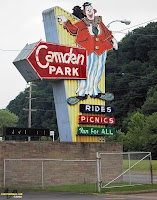
One weekend I had a single-day, Saturday Spider-Man gig at Camden Park in Huntington, West Virginia. Whenever possible, flight arrangements were made the same day as an appearance. The convenience and possible sleep deprivation of the actor be damned. If a few shekels can be saved having Joe Spidey depart at the crack of dawn—meaning his awakening at least two hours before said crack—so be it; never mind Spider-Man’s subsequent lack of joie de vivre, the obvious absence of bounce in his step, or his mumbling of children’s names. In all honesty, it was an understandable policy. The client was picking up the tab, and the appearance fee alone was several hundred dollars a day. For a small business, that’s a hefty bit of lucre. Add one night’s stay at a hotel, plus dinner, depending on when the performer arrives, and the expense becomes too onerous to bear. Of course, the client risks the character’s being late due to a travel delay, but it was a worthwhile financial gamble.

In this instance, Camden Park was featuring two heroes, Spider-Man and Captain America, so all expenses were double. The additional cost of hotel accommodations for two people—Marvel policy insisted on each actor getting his/her own room—would have added a few hundred dollars to the total. Ouch!


And the actors, including myself, preferred leaving the morning of a gig. We were only paid a meager per diem fee of $30 for travel days when I began Web-Slinging. And that only applied if leaving before 3 pm. Thirty dollars was hardly fair recompense for a day’s work—in my case, a Friday night shift was guaranteed to bring in a hundred dollars after tipping the busboys and bartenders. The Camden Park job would allow me to appear without losing money.

Strangely, though I had moved to Queens from Jersey City several months before, my boss Barbara had scheduled me on a flight out of Newark Airport. I can only imagine that she must have made the arrangements before my relocation. She couldn’t possibly have forgotten about my move; it was her former apartment I was newly subletting. Fortunately, Turner—one of the waiters with which I worked—lived close to the airport in New Jersey. We were both working that Friday night shift, so he graciously offered to put me up at his place, from which I would leave for the airport via car service the following morning. Besides saving the client the insane amount of money it would have cost for a car service or taxi to get me to Newark Airport from my new home in Forest Hills, Queens—for cabs, there was an added charge of something like $45 on top of the meter fee for leaving the state; I think simply threatening the cabbie with a trip to New Jersey cost $25—the shortened trip to my point of departure made it possible to have a quick drink with my buddy after work.

Does anyone not know where this is going?

The Friday night shift was all that I dreamed it would be. I had to dream it; I couldn’t recall a thing by the time I got to my friend’s apartment that night… or, more precisely, early the next morning as it turned out. That quick drink turned into several, which in turn translated into, “Let’s continue this party at the Scrap Bar!”

The Scrap Bar was literally a hole in the ground. Located on MacDougal Street off Bleeker in The Village, the bar was situated down a flight of stairs from the street level. The only indication of its being anything other than a skanky, dark descent into the building’s basement was a string of barbed wire, interlaced with Christmas lights, that spanned the entrance. I believe “Scrap Bar” may have been welded into a rusted sheet of metal amid the wire, but it was hardly legible in the dim colored rays cast by the festive holiday lights. A heavy iron door—natch—lead into an only slightly more illuminated room about the size of a one-car garage, only with the headroom of a phone booth. Continuing the theme set by the name, the walls were adorned with floor-to-ceiling corrugated metal sheeting. A smattering of tables—large machinery cogs set on thick iron axles—stood before an oh-so-comfy metal bench that arced from the doorway around the left side and part of the far wall. An eight-foot bar of—wait for it—iron, stood in the far right corner from the entrance. It was fronted by metal stools.

What little illumination there was, came from fluorescent lighting set beneath the front overhang of the bar and behind overhanging metal sheets along the back of the bar. Long strands of plastic tubing (Plastic! What the—!), set with pinpoint bulbs—that afforded even less light than solar walkway lamps—meandered along the walls and ceiling; and four television sets set into the wall behind the bar, the screens of which displayed nothing; their blueprint-blue screens simply glowed. The soundtrack to this post-apocalyptic cantina was uncharacteristically not Heavy Metal, but rather Alternative. Siouxsie and the Banshees, The Smiths, Roxy Music, The Cocteau Twins, et al. filled the darkness from speakers secreted in the cornices set in the metal sheeting along the walls. To call The Scrap Bar a dive would have been an insult to dives.

I loved it.

Many beers and a few shots of Ouzo later, Turner and I headed for Jersey. I vaguely recall meeting Turner’s roommate, Brian, who was still awake when we arrived sometime in the wee hours of Saturday morning. Fortunately, he was not nearly as shit-faced as we were and was able to schedule a car service and set the clock for me to wake up a mere couple of hours hence. Brian was even prescient enough to calibrate the alarm to its loudest setting and position it next to my head on the floor where I was sleeping.

Two hours later, I still didn’t hear it. But because it was so loud, it woke Brian up in his bedroom down the hall. When the noise continued more than a minute—a clear indication that I was 1) still unconscious, 2) too hungover or stupid to figure out how to turn it off or 3) dead—he stumbled into the living room and shut it off himself, screaming curses at me the whole time. That and the fact that he might’ve kicked me—I cannot recall, but given my state, it’s entirely possible—roused me enough to rub two of my few surviving brain cells together and force myself awake.

I mumbled an apology while Turner’s roomie stomped back to his room. Actually, I said, “bibe bwowwy.” My tongue was about the size of a Sealy Posturpedic King-sized mattress and it was nestled firmly between the bags of sawdust that were my cheeks. The fact that any noise came out was an accomplishment.
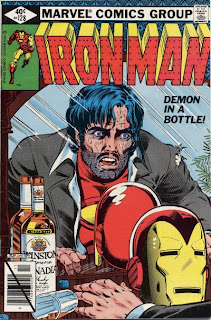
I staggered to the bathroom, caroming off the walls like a pinball, Verdi’s “Anvil Chorus” pounding against my skull. My stomach flip-flopped more than a candidate up for election as I stripped and pulled myself into the shower. Yes, I had factored in time to bathe. I know what you’re thinking: Why not forego the shower and sleep a little longer? First of all, an extra thirty minutes of sleep would have been inconsequential; it’s therapeutic effects on my state would not have registered, not nearly as much as a hot shower. I also didn’t want to stink of booze or body odor when confronting my fans. I also brushed my teeth, having packed my toothbrush alongside the costume in my gym bag. I wasn’t worried so much about people catching a whiff of my breath—which would have made fans look forward to my farts—because the mask provides an effective buffer. Rather, nothing helps allay impending puking more than a minty fresh mouth, mint being a homeopathic remedy for upset stomachs. Plus, to have not brushed would have meant spending the whole morning with the unappetizing taste of stale beer in my mouth, anathema to keeping one’s stomach down.

At one point during the shower I thought I was going to get reacquainted with the potables of a few hours prior, but it thankfully subsided and I was able to complete the task unimpeded. The livery blessedly awaited me when I walked out the door. I don’t think I could have handled calling the car service to inquire where my ride was, which would have entailed awaking Brian to get the number—I’m pretty sure I’d have felt the kick this go-around—dialing said number—focusing and motor functions being low on my list of abilities at the time—and wending my way through the morass of the monosyllabic-grunt exchange that would have commenced betwixt my inebriated self and the car dispatcher, ninety-percent of which could trace their roots back to the Paleolithic era. I used my waning moments of lucidity to mumble “Newark Airport” and “American” to the driver before collapsing in the backseat to catch what few winks I could manage during the quick trip to the terminal.

Mark Nutting—Captain America—was already waiting when I stumbled to the gate. Mark was the consummate Red, White and Blue Avenger: tall; blonde-haired and blue-eyed; with an expansive chest, chiseled jaw line and perfect smile. He couldn’t be more “American” if he rode in on a John Deere tractor, apple pie in hand, whistling John Philip Sousa marches. And he had the personality to match; a genuinely good, honest, charismatic fellow with a great sense of humor; the kind you’d want as a big brother; the yin to my yang… certainly if viewed at that instant. If my appearance gave any hint of the previous evening’s escapades, he didn’t acknowledge it. But he wouldn’t. I spared him the agony of being politely ignorant, quickly revealing my state. I knew he wouldn’t think ill of me; that just wasn’t his way. He simply laughed good-naturedly. Thankfully, either the additional shut-eye or the cup of coffee I now gripped and sipped settled my stomach enough to enjoy a vomit-free flight, despite the headache which continue to throb.
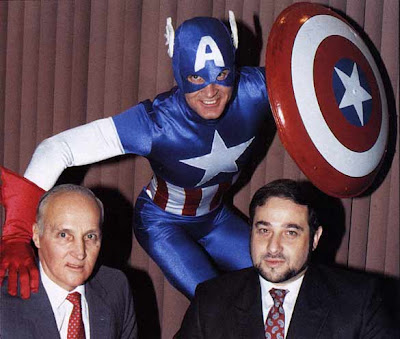
Here's Mark as Cap in a promotional shot from the Winter 1991 in-house Marvel newsletter. The angle makes him appear skinny, but in person, Mark filled out the costume nicely. In later years, Marvel made the Captain America actors wear a muscle suit under his signature red-white-and-blue threads. But Mark would have looked fine without it.

We landed about an hour and a half later, where we were picked up and dutifully whisked to the park. The sun was shining, and the day was already warming up to be a “scorcher,” as my mother would say. One consolation was the humidity or lack thereof. Still, I prayed we would be signing in a shaded area. I had no delusions that our event would be held inside, never mind air conditioned.

We arrived with an hour to spare before our scheduled appearance and escorted to the main office at the front gate where we would be transforming into our superheroic alter egos. Along the way our chaperone pointed out what was to be our signing area. A “holding pen” would have been a more apt description. In an empty expanse not too far from the entry gates were a dozen forest-green wooden tables, each approximately two and a half feet wide by six feet long, configured into a rectangle, which couldn’t have been more than ten feet by twice that long. Gone was any hope of shade.

Well, I was never one to “phone in” my Spider-Man appearances, regardless of the circumstances, and I wasn’t about to do so now, especially as I was responsible for my current state of infirmity. I whispered a little prayer in my head to whatever power was in charge asking for strength to see me through the day and swearing sobriety—or at least temperance—the night prior to any gig thereafter. As I pulled the mask over my head the fabric felt like a cheese grater against my scalp. I could swear the pulsating of my head was visible, resembling Fred Flintstone’s toe, the affect’s of a dropped bowling ball. With Cap leading the way, we bound from the office and hit a wall of heat.


But worse still were the rays of the sun. I was immediately blinded as the white mesh fabric that covered my eyes reflected back, effecting “snow blindness,” its debilitating brightness salting my wounded cranium; God’s spotlight, shining an accusing finger on this sinful member of his flock. A favorite adage of my grandmother came to mind in that instant: “You made your bed; now sleep in it!”

I did.

Without breaking stride, I followed my colleague, casting my eyes downward beneath the mask, which enabled me to just make out his boots below the blinding rays of the sun. I could hear the crowd cheering our approach to the makeshift superhero petting area. They appeared as nothing but amorphous shadows in my limited purview. Suddenly Cap leapt, gaining the autograph zone as the crowd parted. I followed, but seasoning my leap with spidery goodness that allowed me to cheat a leg onto the table without giving a shout-out to my feebleness.

Captain America and I stood there soaking in the adulation. Actually, we were scared witless. People screamed out our names, like those hapless fans at rock concerts who are so overwhelmed with being in the presence of their musical hero/es, they just scream his/her/their name for lack of any other way to express themselves. Only in this instance, everyone was one of those fans. And they were all straining toward us, arms outstretched with comics and assorted ephemera they wanted us to autograph. It was like a scene from Night of the Living Dead, a tide of zombies straining against slapdash barricades to get to the last humans on Earth. Maybe we should have waited until after lunch!

The park did not supply security, either, probably thinking the tables would keep the rabid hounds at bay, as it were. We were on our own, back-to-back, neither deigning to plunge into the frenzy that tightened around us as the tables inexorably scraped closer inward. Every time I considered confronting the wide-eyed, salivating spidey-o-philes encircling us, I had visions of the Scarecrow when the flying monkeys attacked in The Wizard of Oz. I’d submerge amidst a flurry of flailing arms, webbed swatches of red- and-blue flying hither and yon, only enough of me left to gesture and cry, “And then they took my Web-Shooters and threw ’em over there!” At least Cap had a shield. Of course, an ax didn’t help the Tin Man much.
Almost at once, we both decided to enter the fray. “Once more unto the breach, my friends… once more!” I shouted and jumped onto a table. Cap strode forward opposite me. Better to divide and conquer… yeah, right! I was immediately covered in hands pawing every part of my body. I felt like the water pump in The Miracle Worker. Yes, asses were fondled, heads were petted, biceps were squeezed. Fortunately, in my crouched position, I was able to keep from getting my jewels pinched. A pen appeared from a women’s handbag and she was nice enough to let me keep it after I autographed a comic book for her (Bless you!). I hate to think what would have happened had she taken it back and left me without a writing utensil to provide signatures to the rest of the pack. Still, neither my presence nor the autographs I was feverishly scribbling assuaged the roar of the crowd. You’d think I was signing blank checks.
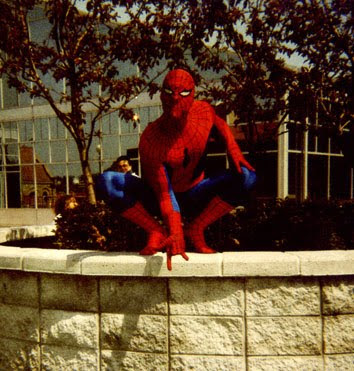

For the next two and a half hours, I remained hunkered on the table, signing. Occasionally, I straightened for a photo, but I was quickly back in autograph mode. I signed comics, ticket stubs, napkins (They quickly ran out of the few hundred comic books that Marvel provided); a Sharpie materialized and I scribbled on sneakers, T-shirts, pant legs, backpacks, baby bibs, breasts… Yes, breasts! A woman with platinum blonde hair, enough makeup for the entire summer run of Cats and a figure that would make Dolly Parton blush pulled the top of her blouse down to the tips of her aureolae and commanded, “Sign these!” The view was vertiginous to say the least. The NFL ground crews responsible for painting the team logos in the end zone have less room with which to work. I took full advantage. John Hancock was turning in his grave with envy when I was done. This set off a torrent of requests for autographed breasts. I felt like I should have thrown beads.

This evolved to other body parts; arms, legs, feet, faces, foreheads, backs and asses! It was inevitable. This was long before the “Brittany” look, so in most cases, there was less of a peek than one would get from the average plumber, Joe or otherwise. Still, it was surreal; a nerd who used to think Trixie on Speed Racer was hot, now inundated with women exposing themselves to him. Oscar Wao eat your heart out!

Not that it was all cheesecake. Oftimes it was chicken thighs, cellulite and stretch marks. Elderly women who hadn’t been so excited since The Lawrence Welk Show was renewed the first time were hitching up their bloomers, unsettling my fragile stomach. The few times I hesitated when confronted with underage girls, their moms goaded me on, sidling up with their pound of flesh as soon as their daughters were done getting branded.

Throughout, the sun’s rays beat down and the temperature rose steadily as noon approached. I was one big ache and soaked with sweat. I must’ve reeked of alcohol, but no one commented. Who knows, maybe that’s what sent the females wild. I didn’t see Mark once, but at some point past noon, he tapped me on the shoulder and addressed the crowd in a stentorian voice that could only have been Captain America’s. “Sorry folks, Spider-Man and I have to take care of some business. We’ll be back later.” I wanted to kiss him and sigh, “My hero!” Instead, I alit from the table and bolted from the area, breaking land speed records on my way to our dressing room and respite from the horde of hysterical humans and the heat.

As much as I wanted to unzip, my hands were shaking and I couldn’t quite get my arms over my head, the result of severe dehydration. Mark was directly behind me, though, and gave me a hand. My head must have looked like a newborn’s when I unmasked, squeezed after hours of steady compression. I collapsed in a chair and wallowed in the euphoric cool of the office air conditioning. After copious amounts of water and a sandwich (By this time, I had sweated out the toxins poisoning my body and was ravenous… and strangely desirous of a glass of milk.) I was feeling better. The headache was gone, but I was overcome with fatigue. Still, I didn’t dread the resumption of signing the way I shuddered in anticipation of the earlier round.
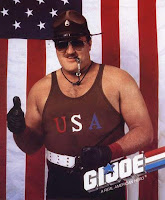
Also lunching at this time was World Wrestling Federation (neé World Wrestling Entertainment) celebrity Sergeant Slaughter, who was also a member of the G.I. Joe Adventure Team on a then Saturday morning cartoon, entitled G.I. Joe: A Real American Hero (In the mid-eighties, Hasbro re-envisioned G.I. Joe from a single 12-inch doll to a team of 3-inch elite special forces operatives). The Joe cartoon ran in various incarnations from 1985 to 1991, and during its run Slaughter was introduced as a Joe.

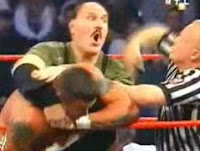
An imposing figure, Slaughter turned out to be an amiable family man of two little girls, who made his home in Connecticut. He revealed his desire to design and begin a program of special countrywide appearances with actors playing the various members of G.I. Joe. No foreigner to character events himself, he took great interest in Mark and I and our escapades (I wisely failed to mention that morning’s indiscretion). Similarly, we were not shy about extolling our virtues as actors and experience as characters, as we tried to convince the good Sergeant that we’d be perfect for his little venture. Numbers were exchanged and Mark and I turned our attention to Slaughter’s wrestling career. He neither supported the veracity of the “sport” nor disavowed it. And we respectfully didn’t press the issue. He claimed his signature move the Cobra Clutch was authentic and that no one had yet been able to break the hold. I certainly wasn’t going to test him on the point.
That afternoon’s signing went much the same as the morning’s with the exception that I wasn’t running on fumes and the sun, having started its descent, was less oppressive. By the last hour, it had settled behind some trees, and Cap and I found ourselves shaded with an occasional breeze pleasantly soothing our weary bones. It seemed as if my penance had been completed.

The park officials thought it a shame that we didn’t have time to try out a few rides. A devout rollercoaster aficionado, I would normally jump at the chance to pop my coaster cherry at Camden Park, even if it risked missing my flight. But my body had been battered enough, and I was grateful not to have to invent some excuse for not accepting their hospitality.
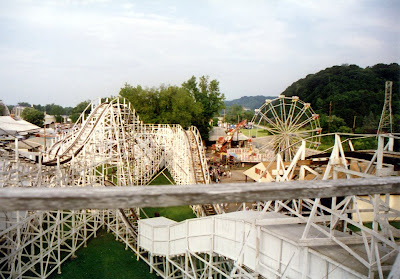

It was at this moment that Mark elected to tell our hosts of my morning malaise (Apparently, Pollyanna, he’s not!), unsubtly remarking how “Steve, probably isn’t in any condition to enjoy the kiddie rides, never mind a rollercoaster (So much for the adage: ‘You can take the man out of the Captain America costume, but you can’t take the Captain America out of the man.’).” It was quite a revelation to the attendants, who would’ve never guessed that I was suffering, considering the great job I had done as Spider-Man. We shared a laugh, and the park officials went on to relate another Cap/Spidey appearance of a few years prior, during which the actor playing Captain America went on the coaster soon after lunch. It wasn’t immediately apparent that anything was amiss as the two heroes disembarked, other than the fact that the good Captain was holding his shield strap-side up and horizontally to the ground as if he were panning for gold. The Red-White-and-Blue Avenger had hit the mother lode, all right, but it wasn’t gold chunks he’d discovered!

As we were driven to the airport, I was thankful I hadn’t contributed anything new to the park’s dubious legacy. I couldn’t imagine having lost my lunch while in the suit. Talk about a facial! Ugh! The gig was a complete success and blessedly uneventful. But the appearance wasn’t over yet…

Unsurprising, I had no recollection of how small the airport was and, it being a Saturday evening, the terminal—all one of them from what I could tell—was empty, aside from a ticket agent or two and some security personal. Mark and I each carried not but a single over-the-shoulder bag, his noticeably larger as the Captain America costume was more involved—with boots, gloves, headpiece, etc.—than Spider-Man’s. There was also the matter of the shield. Still a few years from Marvel Personal Appearance heyday, when all the costumes would get a much-needed upgrade and several new characters were introduced, Cap’s shield was transported in the same duffel bag with the rest of his togs. A heavy, cumbersome, metal thing, the shield measured in the neighborhood of two-and-a-half to three feet wide. Scrapes from numerous battles with screaming fans across the country covered its surface, and the bolts which fastened the strap to the back penetrated its face like the neck bolts on Frankenstein’s monster. On the gatekeepers’ security monitor, Cap’s shield must have looked like a satellite dish.

I had just eased through the checkpoint and was picking up my bag when I heard the confused voice of the security agent manning the screen inquiring about the strange item in Mark’s luggage which had just passed her view.

“Sir, what’s do you have in your bag?” she asked Mark.

“Oh, that’s my shield… I’m Captain America.” he innocently replied with a toothy grin.

“Excuse me?”

By this time the second agent at the walk-through metal detector had come over. I could see that Mark’s response was not going over too well, so…

“And I’m Spider-Man!” I offered (What the Hell was I thinking?!!).

As if my two cents hadn’t exacerbated the situation enough, I unzipped my bag and drew out part of the costume…

“See?” I added, as though I had just presented the key evidence to the jury. What was I expecting, the agents slapping their foreheads like they could have had a V-8, offering a drawn-out “Oh-h-h-h…,” and sending us on our way, apologizing for their stupidity?

The agent picked up her mike and said one word: “Security.”

As Mark and I desperately tried to explain exactly who we were—visions of spending the night in the county hoosegow dancing in our heads—two gun-toting airport officers appeared at the gate. The situation looked hopeless.

“I can vouch for them, officers.”

Sergeant Slaughter had just entered the gate area. He still wore his signature hat and mirrored glasses, though even sans these the gate personnel would have recognized him. Turns out, one of the security guards had heard of the event at Camden Park that day. In fact, his wife had taken their kids there to see Spider-Man. After handing out a few autographed comic books—the smart actors always kept extras with them—we were on our way. On the flight, I couldn’t help but wonder why we had so much trouble at the gate until Slaughter arrived. Didn’t the gate agents know that a Captain far outranks a Sergeant?

Saturday, August 8, 2009

See You in the Funny Papers

Writer Gerry Conway has made a name for himself, scripting and producing a number of successful television shows, such as the Tom Bosley divine detective vehicle Father Dowling Mysteries; the Dick Van Dyke medical whodunit, Diagnosis Murder; and Law & Order. In 1969 he began his career as a comic book writer while still in his teens with a short story for DC’s House of Secrets #81. For the next two decades thereafter he wrote for many of both Marvel’s and DC’s most prominent titles, such as Superman, The Avengers, Justice League of America and Amazing Spider-Man.

In fact, Conway had the dubious distinction of taking up the mantle of writing the Amazing Spider-Man from creator and decade-long scribe Stan Lee with issue #111 in 1972 at the tender age of nineteen. Less than a year into penning the Web-Slinger’s adventures, Conway wrote off one of the series’ most beloved characters, Gwen Stacy, a move for which some Spidey-o-philes have never forgiven him. Whether the original idea to kill Peter Parker’s paramour came from Conway or elsewhere within the hierarchy of Marvel at the time has been debated, but the impact of the story continues to resonate more than three decades later, which is a testament to the power of Conway’s craft especially at such a young age.

Conway had yet begun his television career and was still writing the Web-Slinger’s adventures—albeit within the pages of one of the hero’s spin-off titles, The Spectacular Spider-Man—when I met him at a shopping mall in Chattanooga, Tennessee. The mall was celebrating comic books with a myriad of tables and displays in the main concourse. Area dealers sold books and related merchandise and Marvel promoted themselves as well as sponsoring the appearance of some the company’s current writers and artists. Besides Conway, artists Mark Bagley and Wayne Vansant were also in attendance.

In 1983, Marvel released the Marvel Try-Out Book. Packaged the size of comic art boards, the book featured instructions, and included blank pages and ones delineated with blue pencils of an actual Spider-Man comic’s page, on which aspiring comic-book artists could practice penciling and inking, respectively. To promote the release of the book, the company held a contest with the Grand Prize being an assignment on one of its titles. Bagley won, thus kicking off his career. Bagley had just begun his first regular assignment as penciler on a soon-to-be-released teen superhero comic, entitled New Warriors, which Marvel was promoting with his appearance in Chattanooga. The success of New Warriors later led to Bagley becoming the regular penciler on Amazing Spider-Man, which in turn would lead to his greatest claim to fame, penciling Ultimate Spider-Man, the flagship title of Marvel’s reboot of its entire line in 2000. Vansant penciled the critically acclaimed war drama The ’Nam, which was based on actual accounts from veterans of the Vietnam War. Then promotions guru for the big M, Steve Saffel, was there to host the company’s guests.

Marvel also made my appearance possible. In order to get the most bang for their costumed-character buck, they arranged for me to perform double duty as both Spider-Man and Dr. Doom, comicbookdom’s maniacal monarch of fictional Latveria and arch-villain of the Fantastic Four. I hadn’t performed as Doom before and looked forward to doing so, though my enthusiasm was immediately tempered by the realities in transporting his higness’s attire.

The Doom “armor” consisted of a pair knee joints and combination arm/elbow pieces both pulled on with elastic straps; a pair each of boots and gauntlets, the latter connected to circular-molded wrist and forearm coverings; and a custom mask. Under the armor was worn a shiny silver stretch bodysuit. It differed from the Spider-Man suit in that it was less giving and thicker, which made it warmer. There were snaps sewn into the under garment at the shoulders, to which the arm/elbow pieces were attached. A forest green tunic covered the torso, hiding the shoulder snaps, and was accessorized with a deep brown belt with golden, antique-finish buckle. A heavy, long hooded cape of the same color as the tunic completed the picture. It fastened around the mask with Velcro, creating a snug and secure fit that ensured the hood’s perfect symmetry about the mask, and featured two gold ornamental medallions betwixt hung a chain below the neck. For such a complicated ensemble, the look was spot-on.

Though not nearly as cumbersome as the huge crates in which the Hulk costume was stored and freighted, the Doom suit fit snugly in an over-the-shoulder, khaki green canvas bag, which made the carrier appear as though they were on leave from the army. Still, the bag was still too big not to go unchecked when flying. Checking baggage was not something I had ever had to do with the Spider-Man suit and I didn’t care for the additional time tacked onto my trip or the concern of waiting for Doom to appear on the luggage carousel.


(This photo from a later gig shows the original Dr. Doom costume with open eye slits)

That minor inconvenience was balanced with the relative ease of wearing the costume and opportunity to portray a character well removed from the Web-Spinner’s. Far from the crouching and gymnastic leaping that wearing the Spidey costume entailed, Doctor Doom regally strode about, cape dramatically flowing, arrogantly debasing everyone around him à la Darth Vader. It was freeing and fun not having to play “nice” and, unlike the Green Goblin, which demanded a demented high-pitched cackle and laugh, I could orate in my natural basso voice. Whenever I got bored or tired bouncing about, I’d don the Doom suit. Whenever it was no longer great to be king, I’d crawl into the humbler, more playful threads of Spider-Man.

The Doctor Doom costume would have been perfectly comfortable if not for the fumes of the industrial glue within the mask that made my eyes water. I suspect that the Dr. Doom costume and that of the Green Goblin were constructed as part of the same order, as the unpleasant industrial-glue “bouquet” of both masks was the same. And their construction could only have occurred at a time when the adverse effects of “sniffing” glue were relatively unknown and thus their use in the creation of costume masks was more lenient. Making my eyes water was one thing. God knows what inhaling this stuff was doing to my lungs. No wonder Doom and Goblin were so cranky all the time.

My vision was equally as limited when portraying the evil monarch of Latveria as it was when playing Spidey’s arch- nemesis. Though the occipital region of the latter was larger, each of it’s openings was covered with a painted screen to emulate the pupils and whites of eyes. The Doom mask may have sported unobstructed eye apertures, but they were smaller, thin rectangular cut-outs to the Goblin’s wide orbs. I could cheat peeks through the mouth opening of the Doom mask, which prevented my having to continually bend over, like one of those drinking-water-from-a-glass-rocking-bird toys, to prevent me from stumbling over small children, strollers, chairs and mewling fanboy. A later revision to the Doom mask sported larger eye openings, but added black screens within to hide the wearer’s actual orbs, thus negating any increased visibility that the wider openings may have effected. I preferred the original. The evil would-be world vanquisher was ever drawn in the comics with his eyes peeking out from behind the iron mask. It was off-putting, more so in person.

Both Bagley and Vansant were good ole boys from the south, immensely talented, yet humble, and open-hearted. I learned that Bagley’s favorite character was Spider-Man and he yearned to draw his adventures someday (He got that wish in the mid-nineties). Each provided sketches to everyone who visited their tables. And not the usual hurried headshot scribbled in marker—nowadays you’d be lucky to get that. No, these were full-figure drawings of any hero you wanted. Vansant was going so far as rendering his art in color, using a variety of colored markers that he had brought with him. Not to be outdone, Bagley asked to borrow Vansant’s instruments to bolster his black-marker sketches with shading. Unfortunately the number of fans was modest. The mall was uncharacteristically quiet for a spring weekend. The only reason that I could see being the beautiful weather; it was sunny, dry and cool. Altruistic soul that I am, I couldn’t bear the thought of these professional artists’ magnanimous donation of time and skill go to waste, so I asked monsieurs Bagley and Vansant to do sketches for me. When asked what I wanted, I replied, “I don’t know. Whatever you feel like drawing.” They were doing me a favor, after all (Altruistic and compassionate, what can I say?).

I had no idea what kind of ghoul Gerry Conway was. I hadn’t even read the original issues of Spider-Man wherein Gwen Stacy appeared and eventually was “knocked off,” but I knew about the man who “killed” her and the controversy her death caused in the comic book field. More than a few mark Gwen’s termination as the end of comics’ Silver Age, which began in the late 50s with the reinvention of DC’s Golden Age heroes, like the Flash in Showcase #4, the commonly acknowledged start of the Silver Age; and the debut of the Justice League of America, which inspired The Fantastic Four at Marvel and that company’s subsequent creation of Spider-Man, Incredible Hulk, X-Men, et al.

I envisioned a dark, gaunt, brooding figure clad in black with the look of a serial killer, who plucked off the wings of butterflies in the downtime between autographing comic books with his own blood. In actuality, Conway was a congenial, friendly sort with a good sense of humor and clad in an unremarkable light-colored shirt and worn blue jeans.

As a longtime scribe of Spider-Man, he got a kick out of seeing the Web-Slinger come to life. Contrary to his taking offense at my haranguing him (as Spidey) for killing my girlfriend, Gwen Stacy, he enjoyed the ribbing and returned the jabs in kind, faulting Gwen as being a boring character long overdue to meet her maker. Out of costume, our chemistry continued as we discussed his writing career and my less-than-stellar acting one, in which he inexplicably took great interest, including my continuing stint as waiter, the cliché vocation of aspiring actors across the country. At the time of our meeting, I was working at a steak and seafood restaurant, Publicans-On-The-Pier, on the upper level of Pier 14 at New York City’s fabricated tourist destination, the South Street Seaport.


I had recently had a new photo montage of myself printed, one side featuring two abutting portrait headshots with greatly differing looks, and the other presenting a jigsaw puzzle of action shots of me posing in a variety of staged situations, along with my contact information. Upon my showing it to Conway, he asked if he could keep it. I only had about a gazillion of the things, more than enough for mailings to agents, production companies, directors, networks, studios, family, friends and the entire populations of several provinces in China, so immediately acceded to Conway’s outrageous demand.

Normally, once a gig is done, I have to rush to the nearest airport to catch a flight. At the very least, I spend a final night in the hotel and awaken at the crack of dawn to take the first flight out. But during the Chattanooga appearance, after two days at the mall, there was an additional day before everyone’s departure, on which Saffel scheduled a field trip to a place called Rock City.

Rock City?!! What is Rock City? Is it near Bedrock?

This ignorant Yankee’s knowledge of Chattanooga consisted of the “Choo-Choo” song, so brilliantly parodied in Young Frankenstein, and an obscure 1969–1971 Hanna-Barbera cartoon, The Cattanooga Cats, which I often mistook as “The Chattanooga Cats,” even though when I was young I had a coloring book based on the show with the title plainly visible on the cover. I also believed the name of the height-challenged cowboy with the enormous, red handle-bar mustache that often fell victim to Bugs Bunny’s playful shenanigans was pronounced “YO-zeh-mite Sam,” though he clearly introduced himself otherwise at the start of most every cartoon in which he appeared. So I have a history of ignorant bliss when it comes to the obvious.


On the route to Rock City, farmhouses, silos and barns dotted the countryside the way Starbucks cafés do today, and on nearly every one was an ad for Rock City. “Come to Rock City.” “Rock City, 9 mi.” “See Historic Rock City, Route 58.” Rooftops of weathered barns that looked as if they hadn’t been touched since Roosevelt’s New Deal alerted passing travelers to Rock City. They looked like something from the opening credits of Green Acres. I half expected the occasional clapboard structure to read “Eddie Albert” or “Eva Gabor.” These signs are apparently so renowned that best-selling author Neil Gaiman—Coraline, Stardust, Sandman—mentions them at the climax of his 2001 novel, American Gods, which takes place at a Rock City vista, Lookout Mountain. Neil Gaiman is a Brit and even he knew of Rock City. Where the hell was I when the Rock City memo went around?!!

There were also sequential billboards along the highway’s shoulder, too, spaced approximately several hundred feet apart; “Wholesome Family Fun…” “Legendary Rock City…” “TN Hwy 58 Up Lookout Mountain Ramp…” This was virile marketing long before it was guerrilla marketing. Before the trip, I had as much interest in this historic sight as I had in a recipe for haggis. But after a few miles of ubiquitous signage and endless billboards, I was King Arthur and Rock City was the Holy Grail; nothing was going to stop me.

Rock City opened in 1932, but few were eager to trek up to its mountaintop location until owner and sign painter Clark Byers loaded up his pick-up with the intention of persuading any farmer he could to use their barns or other buildings for advertising. At its peak during the 50s and 60s, as many as 900 structures featured Rock City advertising from Florida to the Canadian Border, Texas to the Carolinas. Byers was a marketing genius, way ahead of his time. One has to wonder how he would promote Rock City today, what with the endless possibilities of the internet.

Taking full advantage of ancient rock formations, breathtaking panoramic views, beautiful waterfalls and awesome caverns, Rock City is a theme park created as if by Mother Nature. Byers designed walkways, stone walls, rustic bridges and arches around the natural formations, interweaving these constructs as the mountain’s terrain dictated. The result is a testament of nature’s power and grandeur. Suffice it to say the build-up of endless barn and roadside signage en route was still insufficient in hailing this great park. The greatest wordsmiths of history could not adequately describe its wonders. The fact that I was spending an afternoon with one of the comic world’s most famous writers and two of its most promising stars was lost to me as I took in the sights, including one vista point where you can see seven states at one time.

As mentioned, the weather couldn’t have been nicer. Yet, the park was even quieter than the mall; we were evidently there off peak, though oddly on peak all at once (Thank you. I’ll be here through the week. Try the veal.). The brochure features photos of walking dwarf mascots —one named Rocky— various fairy-tale notables, such as Snow White and Humpty Dumpty; and even a clown creating balloon sculptures; entertaining guests. Thankfully, they were all absent during our visit. There were such fantasy characters throughout the park nonetheless; garishly painted statues sitting atop walls; lawn-gnomes amidst the stalagmites in the caverns; even a mechanical, singing and banjo-playing dwarf! Ugh! I found these artificial “sweeteners” a slap in Mother Nature’s face, needlessly deflecting attention from her beauty. But I’m sure the park’s marketing wizards felt the need to take such arguably dim-witted moves in order to better lure families to Rock City. Perhaps it was Byers himself who started the campaign, proving that nobody is perfect.

It was a lovely way to wrap-up a gig. Ninety-percent of the time, I’d be hustling out the door of the venue at which I was appearing to catch a flight at the area airport, leaving the echo of Pleasure meeting yous and Let’s keep in touches in my wake. Unfortunately, I never did see Vansant again, but would see Bagley on various occasions thereafter. Gerry and I exchanged phone numbers. He had planned to visit the Big Apple in the near future and promised to call. I wasn’t holding my breath.

Less than a year later, I was doing researching for my job, i.e. reading the latest batch of comics sent to me by Marvel, specifically The Spectacular Spider-Man #158. The adventure opens with our erstwhile hero being attacked by the Trapster—née Paste-Pot Pete as his weapon of choice was a gun that fired quick-hardening superglue—while web-swinging to the South Street Seaport to meet his then wife Mary-Jane for lunch. As luck would have it, Spidey’s paste-coated self plummets into the restaurant where he was to meet his beloved. And who should be waiting on Mrs. Parker? Why her good friend and fellow actor, Stephan the Waiter, that’s who. Conway had written me into the storyline, complete with a job in food service at the locale where I worked in real life. Rendering my countenance was comics legend Sal Buscema, to whom Conway had sent my photo collage and info.


Conway made one alteration in naming the character Stephan as opposed to Stephen, which was either a typo or his way of defending himself should I not like the way my character was written and subsequently threaten to sue (No chance!). More likely, he wanted my character to sound snooty, to fit with the upscale establishment in which he erroneously envisioned my working. In any case, I was gobsmacked as only a comic-book nerd could be. I was in Spider-Man; not simply a cameo, but a fully-realized character and friend of the hero! The issue went on to be a sellout. Jealous types will argue that the reason for the book’s popularity was its being the first episode in the “Cosmic Spider-Man” story arc, in which Spidey receives the Captain Universe power (Don’t ask.). But it also happens to feature the inaugural appearance of Stephan the Waiter. Coincidence? I think not!